

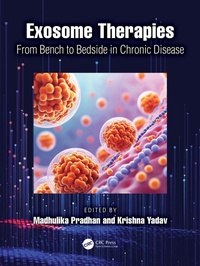
Exosome Therapies
From Bench to Bedside in Chronic Disease
1st Edition
Will be published approx. on 6. July 2026
242 pages
978-1-040-68934-9 (ISBN)
Description

This book provides a comprehensive overview of the evolving field of exosome-based therapies for chronic diseases. It explores the biology of exosomes, including their discovery, composition, biogenesis, and their role in intercellular communication and targeted drug delivery. The chapters review the challenges and advancements in exosome isolation, characterization, and engineering, highlighting their potential in treating chronic diseases. The book also examines the therapeutic applications of exosomes in cancer, neurological, cardiovascular, metabolic, and inflammatory disorders, while also addressing their applications in immune modulation, wound healing, and next-generation cancer vaccines. It also presents the translational aspects of exosome-based therapies, including preclinical and clinical outcomes, integrating advanced techniques such as exosome kinetics, drug delivery systems, and clinical trials.
Key Features:
Provides foundational knowledge of exosome biology, including their biogenesis, composition, and signaling mechanisms.
Explores innovative methods for exosome isolation, engineering, and drug delivery applications.
Discusses the therapeutic potential of exosomes against various chronic diseases, including cancer, cardiovascular, and metabolic disorders.
Highlights clinical trials and translational approaches to bridge the gap between research and patient care.
Addresses challenges in manufacturing, regulatory considerations, and future directions for exosome-based therapies.
It is useful for researchers and students of biomedical sciences, pharmacology, and biotechnology.
Key Features:
Provides foundational knowledge of exosome biology, including their biogenesis, composition, and signaling mechanisms.
Explores innovative methods for exosome isolation, engineering, and drug delivery applications.
Discusses the therapeutic potential of exosomes against various chronic diseases, including cancer, cardiovascular, and metabolic disorders.
Highlights clinical trials and translational approaches to bridge the gap between research and patient care.
Addresses challenges in manufacturing, regulatory considerations, and future directions for exosome-based therapies.
It is useful for researchers and students of biomedical sciences, pharmacology, and biotechnology.
More details
Edition
1. Auflage
Language
English
Place of publication
London
United Kingdom
Publishing group
Taylor & Francis Ltd
Target group
College/higher education
Professional and scholarly
Product notice
Reflowable
Illustrations
28 Tables, color; 33 Line drawings, color; 33 Illustrations, color
File size
5,86 MB
ISBN-13
978-1-040-68934-9 (9781040689349)
Copyright in bibliographic data and cover images is held by Nielsen Book Services Limited or by the publishers or by their respective licensors: all rights reserved.
Schweitzer Classification
Other editions
Additional editions
Book
approx. 07/2026
1st Edition
CRC Press
€136.50
Not yet published
Persons
Madhulika Pradhan is the Director and Professor at the School of Pharmacy, Rungta International Skills University, Bhilai, Chhattisgarh, India. She has over 15 years of teaching experience and 13 years of research experience, specializing in the design and development of novel drug delivery systems. She holds a Ph.D. in Pharmaceutical Technology from Pt. Ravishankar Shukla University, Raipur, and a Master of Pharmacy in Pharmaceutical Biotechnology. Recognized among the World's Top 2% Scientists (2025) by Stanford University and Elsevier, Dr. Pradhan is a distinguished researcher focusing on topical and transdermal drug delivery systems for psoriasis treatment. Her expertise spans preformulation studies, formulation development, and preclinical pharmacokinetics, incorporating advanced methodologies such as Quality by Design (QbD), Design of Experiment (DOE), and preclinical animal model development. With an H-index of 28 and I-10 index of 43, Dr. Pradhan has published extensively in high-impact journals, including the Journal of Controlled Release, International Journal of Biological Macromolecules, and Journal of Drug Delivery Science and Technology. She has authored over 80 research articles and 20 book chapters with leading publishers such as Elsevier, Springer Nature, and CRC Press. Her innovative research has led to two granted patents (Australia and India) in nanomedicine and pharmaceutical technology. Dr. Pradhan has received several prestigious recognitions, including the Chhattisgarh Young Scientist Award (2015), UGC-BSR Meritorious Fellowship (2012-2015), and International Travel Fellowships to present her research in the USA, Singapore, and Malaysia. She has also served as Guest Editor for reputed journals such as Current Pharmaceutical Design and Drug Delivery Letters. Her research expertise encompasses nanoparticles, exosome delivery systems, nanovesicles, solid lipid nanoparticles (SLNs), nanostructured lipid carriers (NLCs), and hydrogels for controlled drug release. Her current research focuses on cancer-targeted delivery systems and psoriasis therapeutics, contributing to the translation of pharmaceutical nanotechnology from bench to bedside.
Krishna Yadav is an Assistant Professor at School of Pharmacy, Rungta International Skills University, Bhilai, Chhattisgarh, India, with over eight years of academic and research experience in pharmaceutics and novel drug delivery systems. He holds a Ph.D. in Pharmaceutical Technology and a Master of Pharmacy (Pharmaceutics, Gold Medalist). Recognized among the World's Top 2% Scientists (2025) by Stanford University and Elsevier, Dr. Yadav specializes in the design and development of advanced drug delivery systems, including nanoparticles, nanovesicles, hybrid exosomes, and sustained release formulations, with a particular emphasis on cancer, dermatological, and chronic disease management. He has authored and edited multiple books with Springer Nature and CRC Press, and serves as an Editorial Board Member of Scientific Reports (Nature Portfolio). He has also acted as Guest Editor for Current Pharmaceutical Design and Drug Delivery Letters. With more than 85 research articles, reviews, and book chapters published in leading journals (Elsevier, Wiley, Taylor & Francis, Springer), he has attained an H-index of 26 and a cumulative impact factor exceeding 186.43. He is also a recipient of international and national awards, including the prestigious 2025 LEO Foundation International Travel Grant (University of Copenhagen, Denmark). Dr. Yadav's contributions include granted patents (Australia) and filed Indian patents in nanomedicine and pharmaceutical innovations. His research continues to advance exosome-based therapeutics, nano-enabled targeted delivery, and translational pharmaceutics from bench to bedside.
Krishna Yadav is an Assistant Professor at School of Pharmacy, Rungta International Skills University, Bhilai, Chhattisgarh, India, with over eight years of academic and research experience in pharmaceutics and novel drug delivery systems. He holds a Ph.D. in Pharmaceutical Technology and a Master of Pharmacy (Pharmaceutics, Gold Medalist). Recognized among the World's Top 2% Scientists (2025) by Stanford University and Elsevier, Dr. Yadav specializes in the design and development of advanced drug delivery systems, including nanoparticles, nanovesicles, hybrid exosomes, and sustained release formulations, with a particular emphasis on cancer, dermatological, and chronic disease management. He has authored and edited multiple books with Springer Nature and CRC Press, and serves as an Editorial Board Member of Scientific Reports (Nature Portfolio). He has also acted as Guest Editor for Current Pharmaceutical Design and Drug Delivery Letters. With more than 85 research articles, reviews, and book chapters published in leading journals (Elsevier, Wiley, Taylor & Francis, Springer), he has attained an H-index of 26 and a cumulative impact factor exceeding 186.43. He is also a recipient of international and national awards, including the prestigious 2025 LEO Foundation International Travel Grant (University of Copenhagen, Denmark). Dr. Yadav's contributions include granted patents (Australia) and filed Indian patents in nanomedicine and pharmaceutical innovations. His research continues to advance exosome-based therapeutics, nano-enabled targeted delivery, and translational pharmaceutics from bench to bedside.
Content
Chapter 1: Introduction to Exosomes: Discovery, Composition, Biogenesis, and Historical. Chapter 2: Recent Technological Advances in Exosome Isolation, Characterisation, and Engineering. Chapter 3: Essential Concepts of Exosome Kinetics: Overview and Biological Relevance. Chapter 4: Exosome Engineering: Innovations in Cell Therapy and Targeted Drug Delivery. Chapter 5: Exosome-Based Therapeutics in Neurological Disorders. Chapter 6: Innovative Exosomes Therapy in Cardiovascular Disease Management. Chapter 7: Exosome-Based Targeted Drug Delivery in Cancer Treatment. Chapter 8: Harnessing Exosomes for the Development of Next-Generation Cancer Vaccines. Chapter 9: Unveiling Exosome-Based Therapeutic Insights in Metabolic Disorders. Chapter 10: Exosome-Mediated Immune Regulation in Autoimmune and Inflammatory Diseases. Chapter 11: Exploring Exosome-Based Therapies in Respiratory Diseases. Chapter 12: Exosome Applications in Skin Regeneration and Wound Healing. Chapter 13: Exosome-Mediated Immunomodulation and Therapeutic Opportunities. Chapter 14: Clinical Translation of Exosome Therapies: Current Trials and Outcomes.
