

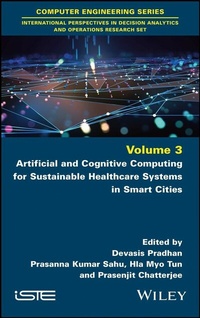
Artificial and Cognitive Computing for Sustainable Healthcare Systems in Smart Cities
Description

By exploring the integration of advanced technologies in smart cities, the authors examine and discuss how AI and cognitive computing can be harnessed to enhance healthcare delivery. The book provides focused navigation through innovative solutions and strategies that contribute to the creation of sustainable healthcare ecosystems within the dynamic environment of smart cities.
From optimizing resource utilization to improving patient outcomes, this comprehensive exploration provides insight for readers with an interest in the future of healthcare within the era of intelligent urban development.
More details
Other editions
Additional editions
Persons
Devasis Pradhan works as an Assistant Professor Grade 1 and is Dean (Research and Development) at the Acharya Institute of Technology, Bengaluru, India. He is a co-editor on the Editorial Board of eight international journals.
Prasanna Kumar Sahu works as a Professor in the Department of Electrical Engineering at NIT Rourkela, Odisha, India. His research interests include microwave devices, nanomaterials, and nanotechnology.
Hla Myo Tun works as a Pro-Rector for Research and Engineering Higher Education at the Yangon Technological University (YTU), Myanmar, where he specializes in professional training for Engineering Higher Education leaders.
Prasenjit Chatterjee works as a Professor of Mechanical Engineering and is Dean (Research and Consultancy) at the MCKV Institute of Engineering, West Bengal, India. He has contributed to 120 research papers in international journals.
Content
Preface xiii
Devasis PRADHAN and Prasanna Kumar SAHU
Introduction xv
Devasis PRADHAN, Prasanna Kumar SAHU, Hla Myo TUN and Prasenjit CHATTERJEE
Chapter 1 Artificial Intelligence and its Application in Healthcare Systems 1
Manthan GHOSH, Deepa DAS, Rohit DEY and Nitish SINHA
Chapter 2 Medical Laboratory Artificial Intelligence: The Applicability in Nigerian Medical Laboratories 25
Uchejeso Mark OBETA, Nkereuwem Sunday ETUKUDOH, Obiora Reginald EJINAKA and Amaechi Eze ODONO
Chapter 3 Machine Learning and Deep Learning for Smart City Services 53
Shweta Mayor SABBHARWAL, Manpreet Kaur AIDEN and Sonia CHHABRA
Chapter 4 An Intelligent Healthcare System Based on Machine Learning Models for Accurate Detection of Heart Disease 75
Madhumita PAL, Smita PARIJA, Ganapati PANDA and Ranjan K MOHAPATRA
Chapter 5 3D Volume Rendering of MRI Images for Tumor Detection and Segmentation using nnUnet 93
Sai AYUSH, Sai Sreeram GADDE, RAJESWARI and Shivarudraiah SUMALATHA
Chapter 6 Implementation of Key Generation in Kyber for Post-Quantum Cryptography using VIVADO 105
Srinivasa Murthy OMKAR, Siddabassappa Manjunath SUJAN, RAJESWARI and Shivarudraiah SUMALATHA
Chapter 7 Computational Intelligence and Big Data Analytics for Smart Healthcare: A Comprehensive Study 119
Bhawna KAUSHIK and Mayank SAINI
Chapter 8 Bioinformatics, Healthcare Informatics and Analytics: An Imperative for Improved Healthcare System 139
Pushpendra Pal SINGH and Rakesh Kumar DIXIT
Chapter 9 Natural Language Processing in Healthcare: A Systematic Review 155
Bhanudas Suresh PANCHBHAI and Varsha Makarand PATHAK
Chapter 10 Artificial Intelligence and Large Language Models in Mental Healthcare: A Systematic Review 195
Mansi CHITGOPEKAR, Abdul Raffie NAIK and Mahimna VYAS
Chapter 11 Unleashing the Future: Exploring the Transformative Potential of 5G Technology in Healthcare 217
Varalakshmi DANDU
List of Authors 241
Index 245
1
Artificial Intelligence and its Application in Healthcare Systems
In the current age of contemporary medicine, the healthcare sector has advanced significantly thanks to artificial intelligence (Al) and data science, as well as sophisticated devices and high-end computers. Such AI-assisted health assistance can offer an appraisal of a patient's status, as well as assist clinicians in making key treatment decisions.
As new unique software technologies arise regularly, the FDA has set a goal to implement more stringent regulatory control for these rapidly evolving goods, in order to assure patient safety. Artificial intelligence refers to items that have specific software programs or algorithms that can assess and adapt to new data continually. All are referred to as AI because the technology of the software and the algorithms is very intelligent. It could be determined by how the software is programmed in terms of its ability to analyze statistical data, relying on expert systems that rely on decision trees, their statements and other machine learning techniques. AI algorithms, in essence, are software that learn from fresh data and then act on it. Locked algorithms yield the same result every time the same input is supplied, and they apply the fix function, so some of the examples or techniques have a decision tree or a complex classifier, and those are applied to a given set of inputs. An adjustable algorithm adapts over time in response to new information or data.
The algorithms learn how to change their behavior by adding new input types or new cases to an existing database, and then the new version of the algorithm is deployed in the second phase of the update. Medical device software can be expanded using AI, and machine learning technologies again have real-time ability to adapt. Based on real-world feedback, they can improve device performance. When AI- and ML-based programs are incorporated to start treatment, they are then designated as a medical device software.
1.1. History of healthcare system
Modern medicine, or medicine, started to emerge after the Industrial Revolution in the 18th century. Hippocrates is a historical person in medicine. It is closely associated with him and his disciples. History demonstrates how civilizations' attitudes towards sickness have evolved from the prehistoric generation to the recent generation. Babylonian, Chinese, Egyptian and Indian medical traditions are among the earliest.
The microscope was invented as a result of increased understanding during the Renaissance. Humorism was supposed to explain the etiology of disease before the 19th century, but it was progressively supplanted by the germ hypothesis of disease, which led to efficient treatments and even cures for many infectious diseases. Military medics revolutionized trauma care and surgical techniques. The fast rise of cities necessitated the development of public health measures, particularly in the 19th century. Advanced research facilities first appeared in the early 20th century, generally in conjunction with prominent hospitals. Antibiotics were among the novel biological medicines that emerged in the mid-20th century. These advances, together with advances in chemistry, genetics and radiography, resulted in modern medicine. Medicine was significantly professionalized in the 20th century, and new occupations as nurses and physicians opened up for women. One of the first Indian writings dealing with medicine is the Atharvaveda, a sacred Hindu literature originating from the Early Iron Age. The Atharvaveda also has herbal treatments for a variety of diseases. Herbs used to heal diseases would subsequently become an important aspect of Ayurveda. Ayurveda, which means "full wisdom for long life", is another Indian medicinal system. Its two most renowned books are from the Charaka and Sushruta schools of thought. Ayurveda's early roots were constructed on a combination of ancient herbal techniques and a substantial addition of theoretical conceptualizations.
As an alternative form of medicine in India, Unani medicine found deep roots and royal patronage during medieval times. It progressed during the Indian Sultanate and Mughal periods. Unani medicine is very close to Ayurveda. Both are based on the theory of the presence of the elements (in Unani, they are considered to be fire, water, earth and air) in the human body. According to the followers of Unani medicine, these elements are present in different fluids, and their balance leads to health and their imbalance leads to illness.
1.2. Literature studies
Gillies et al. (2016) use AI technology to interpret clinical pictures that include massive amounts of data.
You et al.'s (2018) team investigated how aberrant genetic transcription in lengthy RNAs without coding can be used to identify stomach cancer.
Shin et al. (2010) created an electronic diagnosis optimization approach to locate neurological damage.
Karakülah et al. (2014) used AI technology to identify phenotype information from clinical studies in order to improve the precision of genetic anomaly detection.
Based on a "double-blind validation study", IBM Watson is a trustworthy AI system for supporting cancer detection (Somashekhar et al. 2017).
The benefits of AI have been thoroughly researched in the above literature (Shin et al. 2010; Karakülah et al. 2014; Gillies et al. 2016; Somashekhar et al. 2017; You et al. 2018). AI can use complex algorithms to read features from massive amounts of healthcare data and then use the results to improve clinical practice. It can also be outfitted with self-learning and correcting capabilities to increase its precision in response to input.
1.3. Evolution of AI
Computers are machines that operate based on the input they receive. They are unable to think by themselves or use reasoning. Computers operate entirely on the information given by humans. However, there has been a persistent push in the recent age to instill human intelligence into computers and make them think. This gave rise to the artificial intelligence (AI) field. Machine learning is the foundation of our project. But first, let us take a look at AI. AI is a catch-all phrase for any software program that allows a machine to think like a person. AI is any software that causes the computer to learn from the data presented or update itself with its numerous inputs in the same way that people do. AI is a broad phrase that encompasses several topics, including ML, neural networks and deep learning. Alexa and Siri are two current and immediately relevant instances of AI. The first artificial neurons, developed by McCulloch and Pitts in 1943, marked the beginning of AI (French et al. 1973). Donald Hebb (Munakata and Pfaffly 2004) first presented Hebbian learning in 1949. This notion is about the strength of the connections between neurons. In 1955, two men named Allen Newell and Herbert A. Simon created the first AI software, "Logic Theorist," which proved 38 of 52 mathematical programs supplied to it. John McCarthy developed the term artificial intelligence at the Dartmouth Conference in 1956. McCarthy is also recognized as the "Father of Artificial Intelligence". AI made a great jump in the beginning, but a few years of AI winter followed. Winter in this context refers to a period when scientists working on AI faced a massive backlog of work owing to a lack of funding. When world chess champion Gary Kasparov lost a chess championship to IBM Deep Blue in 1997, the golden age of AI began (Newborn 2000). In 2002, the "ROOMBA", an AI-enabled vacuum cleaner, was released for home usage (Jones 2006). By 2006, AI had become a key aspect of Facebook, Twitter and Netflix. More examples include IBM Watson (Strickland 2019), the Android app Google Now (Zhong et al. 2014) and others. Python, Tensor Flow, Java and C are examples of AI programming languages.
1.3.1. Advantages and disadvantages
1.3.1.1. Advantages
- With the assistance of AI, the likelihood of human mistakes is greatly reduced.
- AI is a far greater risk taker when it comes to experiments or expeditions where human life could be jeopardized, such as defusing a bomb, carrying out any space voyage or experiment, etc.
- AI can do repetitive tasks such as sending reminder emails, thank you emails, verifying documents and classifying emails as spam or starred. In a word, it can perform any unusual work that humans may lose interest in.
- AI can work indefinitely without taking breaks or vacations, unlike humans.
- AI allows certain commonplace apps, such as OK GOOGLE, SIRI and CORTANA, to mention a few.
- AI makes decisions at a far faster rate than humans.
- With the aid of AI, the medical industry has evolved considerably, since it is now feasible to diagnose and cure life-threatening disorders.
1.3.1.2. Disadvantages
- The assistance of AI in healthcare systems reduces the human factor, which is a key part of the healthcare sector, especially in medical surgery.
- Because AI works better and more quickly than humans, it has increased unemployment.
- AI has turned out to be rather expensive since constant advances necessitate changes in hardware and circuits. Frequent changes entitle us to a large sum of money.
- Machines, unlike humans, cannot think for themselves and are completely...
