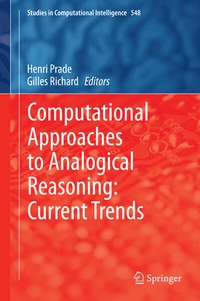
Computational Approaches to Analogical Reasoning: Current Trends
Description

Analogical reasoning is known as a powerful mode for drawing plausible conclusions and solving problems. It has been the topic of a huge number of works by philosophers, anthropologists, linguists, psychologists, and computer scientists. As such, it has been early studied in artificial intelligence, with a particular renewal of interest in the last decade.
The present volume provides a structured view of current research trends on computational approaches to analogical reasoning. It starts with an overview of the field, with an extensive bibliography.
The 14 collected contributions cover a large scope of issues. First, the use of analogical proportions and analogies is explained and discussed in various natural language processing problems, as well as in automated deduction. Then, different formal frameworks for handling analogies are presented, dealing with case-based reasoning, heuristic-driven theory projection, commonsense reasoning about incomplete rule bases, logical proportions induced by similarity and dissimilarity indicators, and analogical proportions in lattice structures. Lastly, the volume reports case studies and discussions about the use of similarity judgments and the process of analogy making, at work in IQ tests, creativity or other cognitive tasks.
This volume gathers fully revised and expanded versions of papers presented at an international workshop' as well as invited contributions. All chapters have benefited of a thorough peer review process.
More details
Other editions
Additional editions