

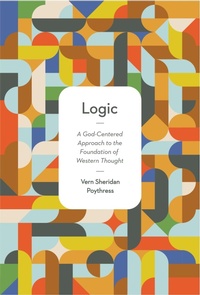
Logic
Description

For the well-rounded Christian looking to improve their critical thinking skills, here is an accessible introduction to the study of logic (parts 1 & 2) as well as an in-depth treatment of the discipline (parts 3 & 4) from a professor with 6 academic degrees and over 30 years experience teaching. Questions for further reflection are included at the end of each chapter as well as helpful diagrams and charts that are appropriate for use in high school, home school, college, and graduate-level classrooms. Overall, Vern Poythress has undertaken a radical recasting of the study of logic in this revolutionary work from a Christian worldview.
More details
Other editions
Additional editions
Person
Vern S. Poythress (PhD, Harvard University; ThD, University of Stellenbosch) is Distinguished Professor of New Testament, Biblical Interpretation, and Systematic Theology at Westminster Theological Seminary in Philadelphia, Pennsylvania, where he has taught for four decades. In addition to earning six academic degrees, he is the author of numerous books and articles on biblical interpretation, language, and science.
Content
- Intro
- Title
- Copyright
- Content
- Tables and Illustrations
- Symbols Used in Parts II-IV
- Preface
- Part I: Elementary Logic
- Part I.A: Introducing Logic and Argument
- 1 Logic in Tension
- 2 Why Study Logic?
- 3 What Do We Trust?
- 4 Formal Logic
- 5 Inductive Logic
- 6 The Importance of Formal Logic
- Part I.B: God in Logic
- 7 Logic Revealing God
- 8 Logic as Personal
- 9 Logic within Language
- 10 Suppressing the Truth
- 11 Logic and the Trinity
- 12 The Absoluteness of God
- 13 Logic and Necessity
- 14 Transcendence and Immanence
- 15 Reflections on the Mediation of Human Knowledge of Logic
- 16 Fallacies and God
- Part I.C: The Problem of Classification
- 17 Analogy
- 18 Unity and Diversity
- 19 Stability of Meaning
- 20 Form and Meaning
- 21 Context for Meaning
- 22 Persons and Logic
- 23 Logic and Religious Antithesis
- 24 Theistic Proofs
- 25 Rethinking Western Thought
- Part I.D: Aristotelian Syllogisms
- 26 Theistic Foundations for a Syllogism
- 27 Venn Diagrams
- 28 Syllogisms of the First Figure
- 29 Checking Validity by Venn Diagrams
- Part II: Aspects of Propositional Logic
- Part II.A: Truth in Logic
- 30 Truth in Logic: Truth Functions
- 31 Divine Origin of Logical Functions
- 32 Complex Expressions
- Part II.B: Perspectives on Truth in Logic
- 33 Venn Diagrams for Truth Functions
- 34 Other Representations of Logical Truth and Falsehood
- 35 Boolean Algebra
- 36 Truth-functional Equivalence
- 37 Harmony in Truth
- 38 Perspectives on Truth Functions
- Part II.C: Propositional Logic
- 39 Introducing Propositional Logic
- 40 Axioms of Propositional Logic
- 41 Alternative Axioms
- 42 Dispensing with Axioms
- 43 Perspectives on Propositional Logic
- 44 Soundness and Completeness of Propositional Logic
- 45 Imitations of Transcendence
- Part III: Enriching Logic
- Part III.A: Predicate Logic
- 46 Introducing Predicate Logic
- 47 Theistic Foundations for Predicates
- Part III.B: Quantification
- 48 Quantification
- 49 The Theistic Foundation for Quantification
- 50 Axioms and Deductions for Quantification
- 51 Soundness of Quantification
- Part III.C: Including Equality and Functions
- 52 Equality
- 53 Functions
- Part III.D: Introducing Formal Systems
- 54 Troubles in Mathematics
- 55 Axiomatizing Mathematics
- 56 Studying Proofs
- 57 Theistic Foundations for Proof Theory
- 58 A Computational Perspective
- 59 Theistic Foundations of Computation
- 60 Models
- 61 Theistic Foundations for Models
- Part III.E: Special Logics and More Enriched Logics
- 62 Higher-order Quantification
- 63 Multivalued Logic
- 64 Intuitionistic Logic
- 65 Modal Logic
- 66 Theistic Foundations for Modal Logic
- 67 Models for Modal Logic
- 68 Conclusion
- Part IV: Supplements
- Part IV.A: Supplements to Elementary Logic
- A1 Antinomies with Sets: The Set of All Sets and Russell's Paradox
- A2 Deriving Syllogisms of the First Figure
- A3 Syllogisms of the Second Figure
- A4 Syllogisms of the Third and Fourth Figures
- Part IV.B: Supplementary Proofs for Propositional Logic
- B1 Some Proofs for Boolean Algebra
- B2 Deriving Whitehead and Russell's Axioms
- B3 Practice in Proofs
- B4 The Rule of Replacement
- B5 Reasoning toward the Completeness of Propositional Logic
- Part IV.C: Proofs for Quantification
- C1 Deductions of Rules for Quantification
- C2 Natural Deduction of Syllogisms
- Part IV.D: Proofs for Formal Systems
- D1 Introducing Gödel's First Incompleteness Theorem
- D2 Simple Proofs within a Formal System
- D3 Deriving Natural Deduction and the Associative Axiom
- D4 Helping Lemmas
- Part IV.E: Other Proofs
- E1 The Halting Problem for Computer Programs
- E2 Diagonalization
- Part IV.F: Philosophy and Logic
- F1 Kantian Subjectivism
- F2 The Role of Logic in Philosophy
- F3 A View of Modern Logic
- F4 Modal Ontological Argument
- F5 Reforming Ontology and Logic
- Bibliography
- Back
