

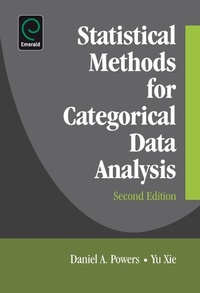
Statistical Methods for Categorical Data Analysis
2nd Edition
Published on 13. November 2008
296 pages
978-1-78190-659-0 (ISBN)
Description

This book provides a comprehensive introduction to methods and models for categorical data analysis and their applications in social science research. An explicit aim of the book is to integrate the transformational and the latent variable approach, two diverse but complementary traditions dealing with the analysis of categorical data. This is the first introductory text to cover models and methods for discrete dependent variables, cross-classifications, and longitudinal data in a rigorous, yet accessible, manner in a single volume.The second edition of this book includes new material on multilevel models for categorical data. Several chapters have undergone extensive revisions and extensions to include new applications and examples. Highlights of the 2nd edition include a detailed discussion of classical and Bayesian estimation techniques for hierarchical/multilevel models, extensive coverage of discrete-time hazard models and Cox regression models, and methods for evaluating and accommodating departures from model assumptions. The accompanying website contains programming scripts to replicate each example using various statistical packages, which has proven to be an invaluable resource for instructors, students, and researchers.
This book presents the essential methods and models that form the core of contemporary social statistics. The book covers a remarkable range of models that have applications in sociology, demography, psychometrics, econometrics, political science, biostatistics, and other fields. It will be especially useful as a graduate textbook for students in advanced social statistics courses and as a reference book for applied researchers. Companion website also available, at https://webspace.utexas.edu/dpowers/www/
This book presents the essential methods and models that form the core of contemporary social statistics. The book covers a remarkable range of models that have applications in sociology, demography, psychometrics, econometrics, political science, biostatistics, and other fields. It will be especially useful as a graduate textbook for students in advanced social statistics courses and as a reference book for applied researchers. Companion website also available, at https://webspace.utexas.edu/dpowers/www/
More details
Edition
2nd edition
Language
English
Place of publication
Bingley
United Kingdom
Target group
Professional and scholarly
File size
2,03 MB
ISBN-13
978-1-78190-659-0 (9781781906590)
Copyright in bibliographic data and cover images is held by Nielsen Book Services Limited or by the publishers or by their respective licensors: all rights reserved.
Schweitzer Classification
Other editions
Additional editions
Daniel Powers | Yu Xie
Statistical Methods for Categorical Data Analysis
Book
11/2008
2nd Edition
Elsevier
€104.70
Shipment within 10-15 days
Content
- Front cover
- Statistical Methods for Categorical Data Analysis: 2nd Edition
- Copyright page
- Dedication
- Contents
- List of Figures
- List of Tables
- Preface
- New to the 2nd Edition
- Use of This Text in a Course on Categorical Data Models
- Acknowledgments
- Chapter 1. Introduction
- 1.1. Why Categorical Data Analysisquest
- 1.2. Two Philosophies of Categorical Data
- 1.3. An Historical Note
- 1.4. Approach of This Book
- Chapter 2. Review of Linear Regression Models
- 2.1. Regression Models
- 2.2. Linear Regression Models Revisited
- 2.3. Differences between Categorical and Continuous Dependent Variables
- Chapter 3. Models for Binary Data
- 3.1. Introduction to Binary Data
- 3.2. The Transformational Approach
- 3.3. Justification of Logit and Probit Models
- 3.4. Interpreting Estimates
- 3.5. Alternative Probability Models
- 3.6. Summary
- Chapter 4. Loglinear Models for Contingency Tables
- 4.1. Contingency Tables
- 4.2. Measures of Association
- 4.3. Estimation and Goodness-of-Fit
- 4.4. Models for Two-Way Tables
- 4.5. Models for Ordinal Variables
- 4.6. Models for Multiway Tables
- Chapter 5. Multilevel Models for Binary Data
- 5.1. Introduction
- 5.2. Models for Clustered Binary Data
- 5.3. Models for Longitudinal Binary Data
- 5.4. Estimation
- 5.5. Item Response Models
- 5.6. Summary
- Chapter 6. Statistical Models for Event Occurrence
- 6.1. Introduction
- 6.2. Frameworks for Analyzing Transition Data
- 6.3. Discrete-Time Methods
- 6.4. Continuous-Time Models
- 6.5. Semiparametric Rate Models
- 6.6. Summary
- Chapter 7. Models for Ordinal Dependent Variables
- 7.1. Introduction
- 7.2. Scoring Methods
- 7.3. Logit Models for Grouped Data
- 7.4. Ordered Logit and Probit Models
- 7.5. Summary
- Chapter 8. Models for Nominal Dependent Variables
- 8.1. Introduction
- 8.2. Multinomial Logit Models
- 8.3. The Standard Multinomial Logit Model
- 8.4. Loglinear Models for Grouped Data
- 8.5. The Latent Variable Approach
- 8.6. The Conditional Logit Model
- 8.7. Specification Issues
- 8.8. Summary
- Appendix A: The Matrix Approach to Regression
- A.1. Introduction
- A.2. Matrix Algebra
- Appendix B: Maximum Likelihood Estimation
- B.1. Introduction
- B.2. Basic Principles
- References
- Subject Index
