

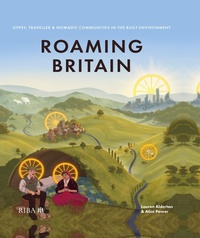
Roaming Britain
Description

Gypsies and Travellers once followed routes passed down from generation to generation, returning to the same stopping places in tandem with the seasons and opportunities for work.
Now, stopping places are practically non-existent, and sites are often placed in environmentally hazardous areas - near motorways, industrial estates, and railroad tracks. This threatens their itinerant lifestyles and cultural heritage, and poses significant health risks to sites' residents.
Roaming Britain guides readers through the long history of nomadic living in Britain. It explores how this way of life manifested in the communities' homes - both moveable and static - from tents and wagons, to trailers and sites, to bricks and mortar. Looking beyond the elaborate decorations of traditional caravans, it showcases the adaptability, ingenuity, and resilience shared by Gypsy and Traveller communities, and how this informs their creative practices.
Brought to life with stunning archival photography and research, the book is both a celebration of the rich history of nomadic communities in Britain, and an interrogation of how architects, planners and the built environment can better serve them.
Features:
Photo essay by Romani artist Corrina Eastwood
Design strategy by Irish Traveller architect Darren Ward
Previously unpublished material from archives across the UK, including the RIBA Collections.
With a foreword from Friends, Families and Travellers.
'A comprehensive summary of the history of the travelling communities in Britain, which explains the value of stopping places and how restricting them erodes the sense of identity and the value of these excluded cultures. It makes it clear that planners should pay attention to culturally appropriate environments and buildings, with Gypsy, Roma and Traveller design committees as part of the system.' - Baroness Janet Whitaker
More details
Other editions
Additional editions
Persons
Alice Power is Assistant Curator of Architecture and Urbanism at the Victoria and Albert Museum. Alice has been at the museum for six years, working on projects such as Rapid Response Collecting and V&A East Storehouse project. She has a long history of involvement in projects around social inclusion, including around the Irish Diaspora.
Lauren Alderton has been Assistant Curator at the RIBA Drawings and Archives Collection since 2018. She has contributed to projects focused on making the RIBA Collections more inclusive, and her interests lie in the social histories found in the built environment.
Content
Preface / About the Authors, Acknowledgements, Practising Urban Design, PART I: Urban Design Analysis, Route Hierarchy, Movement & Facilities, Service & Access, Legibility, Public Realm, Green Infrastructure, Site Attributes, Morphology, Land Use, Building Heights, Architectural Quality, Heritage, Serial Vision, Character Study, Strategic Location, Policy, Socio-Demographic Data PART II: Designing the Urban, Urban Block Principles, Service Requirements, Buildings & Architecture, Corners, Enclosure, Public Realm Principles, Street Design, Public Space Design, Green Infrastructure Design, Technical Standards PART III: Communicating Urban Design, Technical 2D Plans, The Cross-Section, Sketching, 3D Visualisation, Graphical Presentation, A Transparent Urban Design Process, References, Index, Image Credits
