

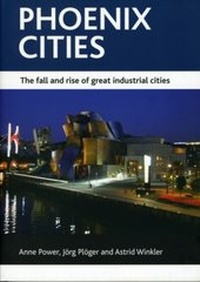
Phoenix cities
The fall and rise of great industrial cities
1st Edition
Published on 16. March 2010
432 pages
978-1-84742-685-7 (ISBN)
Description

'Weak market cities' across European and America, or 'core cities' as they were in their heyday, went from being 'industrial giants' dominating their national, and eventually the global, economy, to being 'devastation zones'. In a single generation three quarters of all manufacturing jobs disappeared, leaving dislocated, impoverished communities, run down city centres and a massive population exodus.
So how did Europeans react? And how different was their response from America's? This book looks closely at the recovery trajectories of seven European cities from very different regions of the EU. Their dramatic decline, intense recovery efforts and actual progress on the ground underline the significance of public underpinning in times of crisis. Innovative enterprises, new-style city leadership, special neighbourhood programmes and skills development are all explored. The American experience, where cities were largely left 'to their own devices', produced a slower, more uncertain recovery trajectory. This book will provide much that is original and promising to all those wanting to understand the ground-level realities of urban change and progress.
So how did Europeans react? And how different was their response from America's? This book looks closely at the recovery trajectories of seven European cities from very different regions of the EU. Their dramatic decline, intense recovery efforts and actual progress on the ground underline the significance of public underpinning in times of crisis. Innovative enterprises, new-style city leadership, special neighbourhood programmes and skills development are all explored. The American experience, where cities were largely left 'to their own devices', produced a slower, more uncertain recovery trajectory. This book will provide much that is original and promising to all those wanting to understand the ground-level realities of urban change and progress.
Reviews / Votes
"...this work is a scholarly and accessible exploration of the rise and fall of industrial cities, and provides useful hints on the history and future of recovery." Neil McInroy in New Start Magazine "Post-industrial cities have much in common across Europe, in both old and new member states. For this reason I am struck by five key ideas in Phoenix Cities:The timescale needed for these cities to recover is long - a whole generation:
many different interventions are needed - land use, environment, social inclusion, citizen participation and responsive projects all contribute to recovery:
interventions must fit together, requiring a strategic perspective and decision-making structure that guarantee the continuity of delivery for the duration:
new skills are vital to people returning to employment after the collapse of traditional jobs: finally, in the 'European model' of urban recovery, public investment plays a decisive role in the renewed take-off of these cities." Sylvie Harburger, Caisse de Depots
More details
Series
Edition
First Edition
Language
English
Place of publication
Bristol
United Kingdom
Publishing group
Bristol University Press
Target group
Professional and scholarly
Illustrations
Not illustrated
ISBN-13
978-1-84742-685-7 (9781847426857)
DOI
https://doi.org/10.51952/9781847426857
Copyright in bibliographic data and cover images is held by Nielsen Book Services Limited or by the publishers or by their respective licensors: all rights reserved.
Schweitzer Classification
Other editions
Additional editions
Anne Power | Joerg Ploeger | Astrid Winkler
Phoenix cities
The fall and rise of great industrial cities
Book
03/2010
1st Edition
Policy Press
€55.00
Shipment within 15-20 days
Persons
Anne Power is Professor of Social Policy at the London School of Economics and Political Science (LSE) and a visiting senior fellow at the Brookings Institution in Washington. She is the author of City survivors (The Policy Press, 2007).
Joerg Ploeger completed his PhD at the University of Kiel, Germany, in 2006 and worked on the Weak Market Cities programme at LSE from 2006-09. He is now at the Research Institute for Regional and Urban Development in Dortmund, Germany.
Astrid Winkler obtained an MSc in social psychology at LSE and worked on the CASE Neighbourhood Study before helping Anne Power to set up the Weak Market Cities programme.
Joerg Ploeger completed his PhD at the University of Kiel, Germany, in 2006 and worked on the Weak Market Cities programme at LSE from 2006-09. He is now at the Research Institute for Regional and Urban Development in Dortmund, Germany.
Astrid Winkler obtained an MSc in social psychology at LSE and worked on the CASE Neighbourhood Study before helping Anne Power to set up the Weak Market Cities programme.
Content
Part one: The tale of seven cities: Introduction: what are weak market cities?; Industrial giants: emerging on the back of history; A change in direction: political turmoil and a ferment of new ideas; Neighbourhood interventions: can small scale make a difference in big cities?; Part two: Learning from 50 years of boom and bust: seven European case studies: Introduction; Leipzig; Bremen; Sheffield; Belfast; Bilbao; Torino; Saint-Etienne; Part three: Are weak market cities recovering or struggling?: Towards a recovery framework; Part four: What can European cities learn from the American experience of urban industrial decline and post-industrial recovery initiatives?: How do American weak market cities compare with Europe?; Will American cities recover?; What are the lessons for Europe?; Part five: Conclusions: What do European cities teach us?; where does the future lie?
