

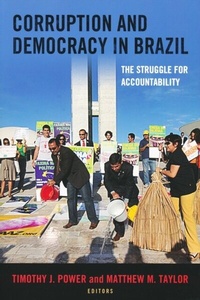
Corruption and Democracy in Brazil
The Struggle for Accountability
1st Edition
Published on 31. October 2020
277 pages
978-0-268-08980-1 (ISBN)
Description

Brazil, the world's fourth largest democracy, has been plagued in recent years by corruption scandals. Corruption and Democracy in Brazil: The Struggle for Accountability considers the performance of the Brazilian federal accountability system with a view to diagnosing the system's strengths, weaknesses, and areas of potential improvement; taking stock of recent micro- and macro-level reforms; and pointing out the implications of the various dimensions of the accountability process for Brazil's democratic regime.
The book's essays take a multidimensional approach to the accountability matrix in Brazil. The first section of the book investigates the complex interrelationships among representative institutions, electoral dynamics, and public opinion. In the second section, authors address nonelectoral dimensions of accountability, such as the role of the media, accounting institutions, police, prosecutors, and courts. In the final chapter, the editors reflect upon the policy implications of the essays, considering recommendations that may contribute to an effective fight against political corruption and support ongoing accountability, as well as articulating analytical lessons for social scientists interested in the functioning of accountability networks.
The book's essays take a multidimensional approach to the accountability matrix in Brazil. The first section of the book investigates the complex interrelationships among representative institutions, electoral dynamics, and public opinion. In the second section, authors address nonelectoral dimensions of accountability, such as the role of the media, accounting institutions, police, prosecutors, and courts. In the final chapter, the editors reflect upon the policy implications of the essays, considering recommendations that may contribute to an effective fight against political corruption and support ongoing accountability, as well as articulating analytical lessons for social scientists interested in the functioning of accountability networks.
Reviews / Votes
"This insightful discussion of the ways in which Brazilian institutions combine to make corruption all but inevitable provides a convincing opening argument for the editors' case that it is institutional design, and not the personal proclivities of political actors, that have so firmly entrenched the culture of corruption in Brazil." -International Law and Politics"The contributors to this volume are professionals in their fields with extensive experiences in researching governmental processes and cultures as well as familiarity with Brazil's bureaucracy." -Colonial Latin American Historical Review
"Among Latin American countries, Brazil has the reputation of being most corrupt. . . . The present volume addresses the institutional development of accountability that is being fleshed out by civil and governmental groups in the press, the electoral system, the legislative controls, the various police units, and the courts. The analysis is penetrating. . . . Recommended for all Latin American collections and those concerned with transparency." -Choice
"This is a timely, insightful, and cohesive volume that will greatly benefit students of Brazil and analysts of corruption in developing countries. The authors are very much on top of their subject matter, much of which is not easily accessible in the academic literature despite the emphasis on corruption being so pervasive and harmful."-Wendy Hunter, University of Texas, Austin
"By focusing on the largest democracy in Latin America, Brazil, a country with both a history vexed by political corruption and an elaborate web of accountability-enhancing institutions and organizations, Timothy Power and Matthew Taylor have produced a study of extraordinary value for comparative politics. They have gathered a rich array of original research by top scholars on major areas of the network of accountability. Each chapter answers the editors' core questions regarding how corruption operates, can be detected, and is preventable, while making clear those aspects that remain a drag on Brazil's quality of democracy." -Alfred P. Montero, Carleton College
"Corruption stories are often told as lurid tales of individual greed. This book persuasively insists instead that corruption and the responses to it are embedded deep in national institutions-one might say they are politics by other means. This first-rate collection presents a powerful analysis of recent Brazilian democracy in practice, showing how accountability institutions have greatly strengthened since the transition to democracy, while remaining weak in ways that undermine citizens' trust in their government. While closely focused on Brazil, the book also embodies an approach worth emulating for studying corruption elsewhere." -Kathryn Hochstetler, University of Waterloo
"Timothy Power and Matthew Taylor have produced a compelling, comprehensive volume on accountability dynamics in Brazil that will inform future policy and research regarding corruption. The analyses in this book raise important questions for practitioners and for the general public. In pursuit of answers to these questions, this team of researchers does not sugarcoat matters. They document dimensions of improved accountability as well as resilient dynamics of impunity. This well-organized book is accessible to academics, policy makers, and students." -Charles H. Blake, James Madison University
More details
Series
Language
English
Place of publication
Notre Dame IN
United States
Target group
Professional and scholarly
Illustrations
16 tables and 5 figures - 5 Figures - 16 Tables, unspecified
ISBN-13
978-0-268-08980-1 (9780268089801)
Copyright in bibliographic data and cover images is held by Nielsen Book Services Limited or by the publishers or by their respective licensors: all rights reserved.
Schweitzer Classification
Other editions
Additional editions
Book
04/2011
University of Notre Dame Press
€34.00
Shipment within 10-20 days
Person
Timothy J. Power is director of the Latin American Centre at the University of Oxford.
Matthew M. Taylor is assistant professor of political science at the University of Sao Paulo, Brazil.
Matthew M. Taylor is assistant professor of political science at the University of Sao Paulo, Brazil.
Content
- Cover
- Half title
- Series page
- Title page
- Copyright
- Contents
- Acknowledgments
- Abbreviations
- 1. Introduction
- PART ONE: Representative Institutions, Electoral Accountability, and Public Opinion
- 2. Presidentialism, Coalitions, and Accountability
- 3. Corruption and Voting
- 4. Corruption, Campaign Finance, and Reelection
- PART TWO: Postelectoral Dimensions of Accountability
- 5. The Media and Political Accountability
- 6. Auditing Institutions
- 7. The Federal Judiciary and Electoral Courts
- 8. The Federal Police and the Ministério Público
- 9. Federalism and State Criminal Justice Systems
- 10. Conclusion
- References
- Contributors
- Index
