

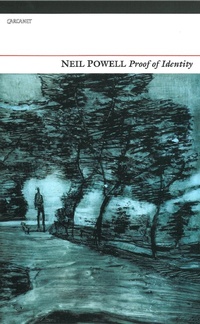
Proof of Identity
Published on 1. November 2012
68 pages
978-1-84777-655-6 (ISBN)
Description

Neil Powell's seventh Carcanet collection explores the deep roots of identity: family histories we inherit, memories we carry, the casual decisions and wrong turnings that add up to make us who we are.
At the heart of the book is a compelling narrative based on a journal kept by the poet's grandmother of her life in South Africa: a feckless husband, a 483-mile trek with horse and covered wagon, violence and poverty. There's also a shorter, teasingly fictional narrative and a sequence about the life of a grand piano. Other poems deal with childhood, leaving home and first love; a park in Kent and a wood in Suffolk; an old photograph of the Strand and Louis Armstrong's first solo; the London bombers of 2005; and, finally, two old friends recalled in very different elegies.
Meditative, wry, melancholy and celebratory, this is Neil Powell at his most versatile and memorable.
At the heart of the book is a compelling narrative based on a journal kept by the poet's grandmother of her life in South Africa: a feckless husband, a 483-mile trek with horse and covered wagon, violence and poverty. There's also a shorter, teasingly fictional narrative and a sequence about the life of a grand piano. Other poems deal with childhood, leaving home and first love; a park in Kent and a wood in Suffolk; an old photograph of the Strand and Louis Armstrong's first solo; the London bombers of 2005; and, finally, two old friends recalled in very different elegies.
Meditative, wry, melancholy and celebratory, this is Neil Powell at his most versatile and memorable.
Reviews / Votes
Voices from the past: poetry and all that jazz.One day in early April, 1923, seven jazz musicians in Richmond, Indiana, huddled around some recording apparatus and made musical history.
The young second coronet player was put at the back, so as not to drown out the trombonist and clarinet player.
As Suffolk poet Neil Powell writes; 'Then something happens: Louis takes a break./ The hot news from America fills our ears:/ A sound too proud and noble to mistake,/ Through all the wow and flutter of the years.'
The title of the track was Chimes Blues, the group was King Oliver's Creole Jazz Band and the moment - preserved for posterity - was Louis Armstrong's first recorded solo. 'Louis Takes a Break' is jazz-lover Powell's take on the occasion and, in a sense, the poem provides the signature tune of this, his seventh collection with Carcanet Press.
Poem after poem retrieves an object or moment from the past and 'through all the wow and flutter of the years' casts them in new, poetically resonant, light. But whereas Satchmo was the great showman, Powell has a quieter, albeit celebratory, presence. He delights in allowing the objects and anecdotes themselves to do much of the talking while he pulls the poetic strings with the eye and the ear of a skilled craftsman. Family history and memories loom large - turning points which are not recognised as such until gilded with narrative significance years after the event.
Born in London in 1948 and educated in Kent and at the University of Warwick, Powell worked as a teacher and owned a bookshop before becoming a full-time writer and editor.
At the centre of his new book is a long narrative, The Journal of Lily Lloyd, based on a notebook kept by his grandmother about her journey to and experience of life in South Africa. The poet retains as closely as possible the vocabulary of her journal, while casting it into 11-syllable lines. The result is a compelling 'first-person' account of poverty, a feckless husband and the vivid minutiae of day-to-day life minted afresh in the luminous context of an extended poem.
Powell is fascinated by the way the past speaks to us now. An old photo provides the inspiration for another poem, 'Strand, 1923', which shows crowds and open-topped buses. Its final image is beautifully rendered: 'And no-one has noticed the photographer -/ Except, from the back of a wagon,/ Propped among sacks and packages, the grocer's boy/ Smiles shyly at the camera and the future.'
The poet is content to let the image take the strain and doesn't burden the moment with any extended authorial reflection on the nature of time and poignancy of a face from the past smiling at us today. The rhyme of 'photographer' and 'future' is enough, poetically, to take the moment out of time and seal its significance.
More details
Language
English
Place of publication
United Kingdom
Publishing group
Carcanet Press Ltd
File size
0,48 MB
ISBN-13
978-1-84777-655-6 (9781847776556)
Copyright in bibliographic data and cover images is held by Nielsen Book Services Limited or by the publishers or by their respective licensors: all rights reserved.
Schweitzer Classification
Other editions
Additional editions
Neil Powell
Proof of Identity
Book
02/2012
Carcanet Press Ltd
€21.00
Article exhausted; check different version
Person
NEIL POWELL was born in London in 1948.He was educated at Sevenoaks School, where he founded and edited the award-winning magazine Verve and wrote on jazz as a 'young critic' for The Daily Telegraph; and at the University of Warwick, where he read English and American Literature (BA, 1966-9) followed by postgraduate research on English Literature (MPhil, 1969-71).Between 1967 and 1970 he was editor of Tracks, and in 1969, while still an undergraduate, won a Gregory Award.He taught at Kimbolton School and St Christopher School, Letchworth, where he became Head of English; he was the founder-owner of The Baldock Bookshop in Hertfordshire; and since 1990 he has been a full-time author and editor, living in Suffolk.
His books include eight collections of poetry - At the Edge (1977), A Season of Calm Weather (1982), True Colours (1991), The Stones on Thorpeness Beach (1994), Selected Poems (1998), A Halfway House (2004), Proof of Identity (2012) and Was and Is: Collected Poems (2017) - as well as Carpenters of Light (1979), Roy Fuller: Writer and Society (1995), The Language of Jazz (1997), George Crabbe: An English Life (2004), Amis & Son: Two Literary Generations (2008) and Benjamin Britten: A Life for Music (2013).He edited and introduced the Selected Poems of Fulke Greville (1990), the anthology Gay Love Poetry (1997), the Collected Poems of Donald Davie (2002) and the Collected Poems of Adam Johnson (2003).
He has contributed to numerous journals and newspapers including Agenda, Critical Quarterly, Encounter, Gay Times, The Guardian, The Independent, The Listener, Literary Review, The London Magazine, New Statesman, PN Review, Poetry Review, The Spectator, The Sunday Telegraph and The Times Literary Supplement; to reference books such as British Writers, The Cambridge Guide to Literature in English, The Dictionary of Literary Biography, The Oxford Companion to Twentieth-Century Poetry and The Oxford Dictionary of National Biography; to various anthologies; and to BBC Radio 3 and Radio 4.He was for fifteen years Co-ordinating Editor of PN Review.
Literary Agent Natasha Fairweather, Rogers Coleridge & White, 20 Powis Mews, London W11 1JN (020 7243 9517); natasha@rcwlitagency.com
His books include eight collections of poetry - At the Edge (1977), A Season of Calm Weather (1982), True Colours (1991), The Stones on Thorpeness Beach (1994), Selected Poems (1998), A Halfway House (2004), Proof of Identity (2012) and Was and Is: Collected Poems (2017) - as well as Carpenters of Light (1979), Roy Fuller: Writer and Society (1995), The Language of Jazz (1997), George Crabbe: An English Life (2004), Amis & Son: Two Literary Generations (2008) and Benjamin Britten: A Life for Music (2013).He edited and introduced the Selected Poems of Fulke Greville (1990), the anthology Gay Love Poetry (1997), the Collected Poems of Donald Davie (2002) and the Collected Poems of Adam Johnson (2003).
He has contributed to numerous journals and newspapers including Agenda, Critical Quarterly, Encounter, Gay Times, The Guardian, The Independent, The Listener, Literary Review, The London Magazine, New Statesman, PN Review, Poetry Review, The Spectator, The Sunday Telegraph and The Times Literary Supplement; to reference books such as British Writers, The Cambridge Guide to Literature in English, The Dictionary of Literary Biography, The Oxford Companion to Twentieth-Century Poetry and The Oxford Dictionary of National Biography; to various anthologies; and to BBC Radio 3 and Radio 4.He was for fifteen years Co-ordinating Editor of PN Review.
Literary Agent Natasha Fairweather, Rogers Coleridge & White, 20 Powis Mews, London W11 1JN (020 7243 9517); natasha@rcwlitagency.com
Content
Proof of Identity
The Lindshammar Pig
Hotel Codan
Me and Mr Jones
The Break
At the Piano
Kempas Highway, 1966
In Sudbourne Wood
Parkland
Knole
Blackborough Park
The Boy on the Bus
Strand, 1923
Louis Takes a Break
The Journal of Lily Lloyd
The Gardener
Shutting Down
A Huntingdonshire Elegy
Point-to-Point
The Lindshammar Pig
Hotel Codan
Me and Mr Jones
The Break
At the Piano
Kempas Highway, 1966
In Sudbourne Wood
Parkland
Knole
Blackborough Park
The Boy on the Bus
Strand, 1923
Louis Takes a Break
The Journal of Lily Lloyd
The Gardener
Shutting Down
A Huntingdonshire Elegy
Point-to-Point
