

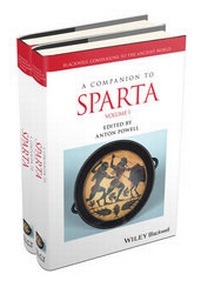
A Companion to Sparta
Description

More details
Other editions
Additional editions

Person
Anton Powell is Director of the Classical Press of Wales, and an internationally recognized authority on Sparta, Athens, and the Roman Revolution. He founded the International Sparta Seminar, and co-edited a succession of collective volumes which have contributed to the revival and reshaping of Spartan studies. Powell is the author of Athens and Sparta, Third Edition, and editor of Classical Sparta, Sparta at War, and Sparta: The Body Politic, among others.
Content
Foreword
Paul Cartledge
Clare College, Cambridge
'Sparta Lives'
'We think Sparta will be really popular across a wide range of territories .'. This quotation is not actually taken from the blurb of an optimistic academic publisher, as one might have thought, but from a promotional statement (in 2016) by a Casino slot games developer, Habanero.
Ancient Sparta does still achieve massive resonance in the modern world, in other words, but not always in the places and through the media that a scholar might perhaps ideally wish. The movie 300 is another prize exhibit in that same category. Happily, the two volumes to which I have the privilege to be writing this Foreword will go a long way towards righting the balance.
I begin by declaring an interest - my own, in studying this peculiar (in at least one sense) ancient community. This interest started with an undergraduate essay on the hoplite 'revolution' (if such it was) of the seventh century BC. In its original form this was written in 1968 for my New College Oxford tutor, Geoffrey de Ste. Croix, whom the magnificent editor of this Companion boldly but not implausibly styles the modern founder of the scholarly study of ancient Sparta. A much later version was published in the Journal of Hellenic Studies in 1977 and republished in German translation and with addenda in a splendid 1986 Wissenschaftliches Buchgesellschaft volume devoted to Sparta and edited by the eminent Karl Christ. At the back of that volume will be found a comprehensive, calibrated bibliography organized by topic; at its front, a remarkably comprehensive and insightful introduction to modern Spartan scholarship by the editor himself. The modern scholarly literature on Sparta going back to the work of J.C.F. Manso (1800-1805) is simply immense. It is beautifully if only partially placed in context by Elizabeth Rawson's The Spartan Tradition in European Thought (Oxford 1969, 1991), though 'European' for her includes 'North American'.
Ste. Croix was both a colleague and a sparring partner of George Forrest, one of the two examiners of my Oxford doctoral thesis on early Sparta c.950-650 BC, completed in 1975. (The other examiner, since this was a mainly archaeological thesis, was the distinguished Oxford art historian Professor Martin Robertson; my supervisor was John Boardman, then plain 'Mr', now Sir John.) In 1968 Forrest had published with Hutchinson a slim, streamlined volume entitled A History of Sparta 950-192 BC. It had been read for him in draft by an Oxonian Sparta expert of an earlier generation, H.T. Wade-Gery (one-time lover of historical novelist Naomi Mitchison, author of Black Sparta, 1928, and The Corn King and the Spring Queen, 1933). 'This account', its left-wing author confessed - or rather boasted, 'has not shown much sympathy with Sparta; sympathy is killed by the narrow-minded jealousy she showed for so long to anyone whose power looked like becoming greater than her own and by the utter inhumanity of her behaviour when her own power was supreme.' It is indeed hard to preserve a pose of objectivity when faced with the Spartan myth, mirage, legend or tradition.
Forrest's little book was reprinted in 1980 in what the new publisher (Duckworth) was pleased to call a 'second edition'. This actually came with only the addition of an intriguing new Preface in which the author was kind enough to refer to my 1979 monograph, the book of my DPhil thesis, as a 'major' work. But at the end of that Preface Forrest uttered a far more controversial - to me - opinion, that there existed some 'overall agreement' as to the 'kind of society' almost all students now believed Sparta to have been. Had he been writing that Preface after 1994 (and the second edition of the book was reprinted in 1995, by the Bristol Classical Press), I don't believe he could possibly have been so blandly confident. For in that year the redoubtable editorial duo of 'Powell & Hodkinson' (or, by alternation, 'Hodkinson & Powell') published the first of their long-running series of superbly edited collections on themes or aspects of ancient Spartan history that have been crucial in helping to radically transform our scholarly perceptions and representations of this extraordinary community. The present Companion is their worthy successor, and indeed rightly contains essays by several of the editor's previous contributors and collaborators.
By my reckoning eight of the twenty-five Companion authors are British or British-based, seven are from the USA, with six French, two Italians and one each German and Greek. Apart from anything else, this reminds us that there are distinct national traditions of Spartan scholarship: especially German (nicely recapitulated in the Christ volume); French (one thinks of the two foundational volumes of François Ollier on what he baptized 'le mirage spartiate'); Italian (I am proud to own what was once Wade-Gery's copy of Luigi Pareti's 1917 Storia di Sparta arcaica, to which Massimo Nafisso's La nascita del kosmos, also 1994, is a very worthy successor); and North American (Tom Figueira is a standout); but also Japanese (Mariko Sakurai), among others. It is of course invidious to single out any particular chapters of the present Companion for mention . but I'm going to do so anyhow: those of Hodkinson, Cavanagh, Powell (Chapter 11), van Wees, Flower, Millender (Chapter 19), and Rebenich.
And I shall proceed homerically, husteron proteron, starting with Stefan Rebenich's elegant and acute summation of 'The Reception of Sparta in Germany and German-speaking Europe' (Chapter 27). Reception studies are hot these days, but we Spartanists or Spartalogues were in on the act right from the very start. Hence all those books and articles on Sparta with 'myth' (Moses Finley), 'mirage' (Ollier), 'legend' (the Swede Eugene Napoleon Tigerstedt) or 'tradition' (Rawson) in their titles. The underlying reasons and motivations for Spartan reception-fixation are fairly obvious: the available written evidence not only is overwhelmingly non-Spartan but also deeply bifurcated either pro or con, with few or no shades of grey in between. Epigraphy can do something to help us correct for this imbalance, archaeology of various kinds an awful lot more. But there remains the fundamental problem of (to borrow the editor's eloquent formulation) 'Reconstructing (Spartan) History from Secrecy, Lies and Myth'. One way of avoiding the dilemma is by embracing it head on, as does Rebenich: all history, it's been claimed, is contemporary history - but there can be few more startling and unsettling illustrations of that useful nostrum than the reinvention of Sparta as the prototype of the new German National Socialist community of the 1920s and 1930s. Indeed, that reinvention has probably done more than anything else to ensure that at least for the foreseeable future Sparta is more likely to figure as a model or ideal of dystopia than of the (e)utopias of yesteryear.
One scholar who has never underestimated the potentially distorting power of the - predominantly, in this case, Athenocentric - Spartan tradition is the American Ellen Millender (Chapter 19). Building on research going back ultimately to her 1996 University of Pennsylvania doctoral dissertation, she brilliantly displays and explicates not only the fascination - and horror - the women of Sparta aroused in, say, Euripides and Aristotle but also the exceptional degree of economic independence and even political power that they were allowed or chose to enjoy and exploit. But before one rushes to feminist-inspired judgement, one must also factor in the overall conclusion she draws from her balanced and profound examination of the - often unsatisfactory - evidence: that 'Spartan women's lives did not significantly differ from those of their Athenian counterparts in terms of their fundamental roles and obligations as daughters, wives, and mothers'. Princesses, queens and priestesses were not, after all, 'typical' Spartan women.
Michael Flower (Chapter 16) too includes 'Women' as a special category in his chapter on Spartan religion. The ancient Greeks, notoriously, did not 'have a word for' religion: they spoke rather of 'the things of the god(s)' or of 'the divine'. Herodotus, a particularly well informed and committed observer of all things religious, from a specifically cross-cultural comparativist perspective, twice remarked in his Histories that the Spartans treated the things of the gods as more significant and serious than the things of men. Well, almost all Greeks collectively and individually did that, so he must have been trying to make a special point about just how exceptional was the Spartans' attitude to the religious factor in political, military, diplomatic and other public affairs. Flower takes that point to the full and produces a splendid synopsis of Spartan religiosity in all its peculiarity, showing beyond a peradventure that it 'comprised a coherent, interconnected, and mutually...
