

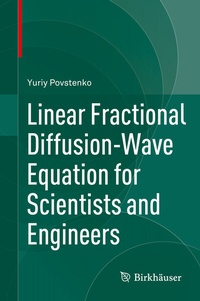
Linear Fractional Diffusion-Wave Equation for Scientists and Engineers
Description

This book systematically presents solutions to the linear time-fractional diffusion-wave equation. It introduces the integral transform technique and discusses the properties of the Mittag-Leffler, Wright, and Mainardi functions that appear in the solutions. The time-nonlocal dependence between the flux and the gradient of the transported quantity with the "long-tail" power kernel results in the time-fractional diffusion-wave equation with the Caputo fractional derivative. Time-nonlocal generalizations of classical Fourier's, Fick's and Darcy's laws are considered and different kinds of boundary conditions for this equation are discussed (Dirichlet, Neumann, Robin, perfect contact). The book provides solutions to the fractional diffusion-wave equation with one, two and three space variables in Cartesian, cylindrical and spherical coordinates.
The respective sections of the book can be used for university courses on fractional calculus, heat and mass transfer, transport processes in porous media and fractals for graduate and postgraduate students. The volume will also serve as a valuable reference guide for specialists working in applied mathematics, physics, geophysics and the engineering sciences.
Reviews / Votes
"This book can be seen as a handbook of the exact results for the time-fractional diffusion-wave equation, largely based on the author's investigations on this topic. . This book can be useful as a reference handbook for people interested in applications of fractional diffusion-wave equations in different fields of science . . I really appreciate the citations at the beginning of each section." (Roberto Garra, Mathematical Reviews, April, 2016)
"The book is written in the form close to hand-book type, i.e., the material is carefully collected, clearly presented and almost completely covers the aim of the subject. This makes the book basically self-contained and useful for a wide range of readers, including experts in mathematics and physics, as well as engineers with a sufficient level of mathematical education." (Sergei V. Rogosin, zbMATH 1331.35004, 2016)
More details
Other editions
Additional editions
Person
Yuriy Povstenko received an M.S. degree in Mechanics from Lviv State University, Ukraine, in 1971; a Candidate degree (Ph.D.) in Physics and Mathematics from the Institute of Mathematics, Ukrainian Academy of Sciences, Lviv, Ukraine, in 1977; and his Doctor degree in Physics and Mathematics from Saint Petersburg Technical University, Russia, in 1993. He is currently a Professor at Institute of Mathematics and Computer Science, Jan Dlugosz University in Czestochowa, Poland. His research interests include fractional calculus, generalized thermoelasticity, nonlocal elasticity, surface science and imperfections in solids. He is the author of 5 books and more than 200 scientific papers.
Content
1.Introduction.- 2.Mathematical Preliminaries.- 3.Physical Backgrounds.- 4.Equations with one Space Variable in Cartesian Coordinates.- 5.Equations with one Space Variable in Polar Coordinates.- 6.Equations with one Space Variable in Spherical Coordinates.- 7.Equations with two Space Variables in Cartesian Coordinates.- 8.Equations in Polar Coordinates.- 9.Axisymmetric equations in Cylindrical Coordinates.- 10.Equations with three Space Variables in Cartesian Coordinates.- 11.Equations with three space Variables in Cylindrical Coordinates.- 12.Equations with three space Variables in Spherical Coordinates.- Conclusions.- Appendix: Integrals.- References.
