

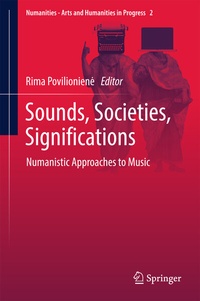
Sounds, Societies, Significations
Description

This edited book covers many topics in musicological literature, gathering various approaches to music studies that encapsulate the vivid relation music has to society. It focusses on repertoires and geographical areas that have not previously been well frequented in musicology. As readers will see, music has many roles to play in society. Music can be a generator of social phenomena, or a result of them; it can enhance or activate social actions, or simply co-habit with them. Above all, music has a stable position within society, in that it actively participates in it. Music can either describe or prescribe social aspects; musicians may have a certain position/role in society (e.g., the "popstar" as fashion leader, spokesman for political issues, etc.). Depending on the type of society, music may have a certain "meaning" or "function" (music does not mean the same thing everywhere in the world). Lastly, music can define a society, and it is not uncommon for it to best define a particular historical moment.
Case-studies in this work provide visibility for musical cultures that are rarely exposed in the dominant musicological discourse. Several contributions combine musicological analysis with "insider-musician" points of view. Some essays in the collection address the cultural clash between certain types of music/musicians and the respective institutional counterparts, while certain contributing authors draw on experimental research findings.
Throughout this book we see how musics are socially significant, and - at the same time - that societies are musically significant too. Thus the book will appeal to musicologists, cultural scholars and semioticians, amongst others.
More details
Other editions
Additional editions
Person
Content
Part I. Theoretical Reflections.- Chapter 1. Musical Signification: A Systematic, Analytical and Pedagogical Approach (Joan Grimalt).- Chapter 2. Popular Music, Politics, Ideologies: A Numanistic Model (Dario Martinelli).- Chapter 3. Music and Associations: Cultural Impact on Musical Perception (Ulrika Varankaite).- Chapter 4. Costin Miereanu and the Musical Labyrinth. Looking Through Converging Lenses (Oana Andreica).- Part II. Interfacing Musics and Societies.- Chapter 5. Musitecture: Musical Space, Spatial Music. Sonorous Thresholds in Time-Space Intersections (Gerard Guerra López).- Chapter 6. Musical Narrative in Representing "Hiroshima". A Case Study of Erkki Aaltonen's Second Symphony "Hiroshima" (1949) (Yumi Notohara).- Chapter 7. The Manifestation of Musical Criticism in the Lithuanian Press in the First Years of WWI (Rima Povilioniene).- Chapter 8. "Where"s the Orchestra?": The Sanremo Festival through the 1980s and the 1980s through the Sanremo Festival (Jacopo Conti).- Chapter 9. The Years of 883: Italian Pop at the Time of Commercial Broadcasting (Jacopo Tomatis).- Chapter 10. Political and Ethical Values of the Music of Manowar (Paolo Ribaldini).- Part III. Case Study: Polish Contemporary Music.- Chapter 11. "Via Crucis" and "Resurrectio" by PawelLukaszewski (Renata Borowiecka).- Chapter 12. Theme of Death in the Music of Pawel Lukaszewski (Renata Borowiecka).- Chapter 13. Stanislaw Moniuszko"sOEuvre as a Builder of National Identity During Partition Times (Magdalena Chrenkoff).- Chapter 14. The Diversity of Artistic Work as a Response to the Needs of Contemporary Culture: On Adam Walacinski's Oeuvre (Ewa Czachorowska-Zygor).- Chapter 15. "Thakurian Chants" for Mixed Choir and Orchestra, by Marek Stachowski (Agnieszka Draus).- Chapter 16. New Romanticism in Polish Music: Generation 51 - Knapik, Krzanowski, Lason (Kinga Kiwala).- Chapter 17. Religious Motifs and Existential Reflection in Zbigniew Bujarski"s Chamber Music (Ewa Wójtowicz).- Chapter 18.The Phenomenon of String Quartet in the Work of Krakow Composers from 1960s (Ewa Wojtowicz).
