

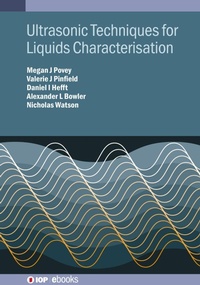
Ultrasonic and Multimodal Techniques for Liquids and Complex Fluids Characterisation
Description

This handbook provides readers with a practical, "how-to" guide to the use of ultrasound for the characterization of fluids. Intended as a basic introduction (suitable for undergraduate courses) and an advanced text (targeting postgraduate researchers and R&D scientists/engineers in industry), the text pulls together the very latest research and technology advances to create a unique reference source for readers in academia and industry.
Coverage spans the fundamental scientific concepts and techniques necessary to make successful ultrasound measurements, with a particular focus on ultrasound velocimetry. Key topics include measurements in water, its solutions and multiphase media. Later chapters deal with advanced techniques such as scattering, particle sizing and computer control/automation. The new edition includes fully updated content from the previous edition (published in 1997) plus new and extended sections on ultrasound attenuation spectroscopy, multiphase media and advanced ultrasound techniques.
More details
Other editions
Additional editions
Person
Content
-
Introduction
-
Elastic Theory and Fracture Mechanics
-
Theory of Acoustic Propagation in Soft Solids and the Link to Rheology
-
Implementation of Machine Learning Techniques in Ultrasound Measurement of Processes
-
Multi-modal Measurement - Optical, Electro-magnetic, Dielectric and Acoustic
-
Acoustic Processing of Soft Solids, High Power and Low Power
-
Conclusion and the future
