

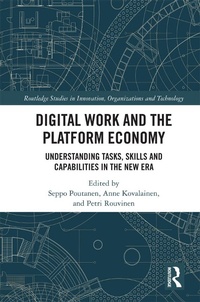
Digital Work and the Platform Economy
Understanding Tasks, Skills and Capabilities in the New Era
1st Edition
Published on 28. November 2019
246 pages
978-0-429-88609-6 (ISBN)
Description

"Uberization," "digitalization," "platform economy," "gig economy," and "sharing economy" are some of the buzzwords that characterize the current intense discussions about the development of the economy and work around the world, among both experts and laypersons. Immense changes in the ways goods are manufactured, business is done, work tasks are performed, education is accomplished, and so on, are clearly underway. This also means that demand for careful, first-rate social scientific analyses of the phenomena in question is rapidly growing.
This edited volume gathers distinguished researchers from economics, business studies, organization studies, medicine, social psychology, occupational health, pedagogics, and sociology to put particular work in both public and private sectors and education in both academic and vocational settings at the focus of the emerging digitalized platform economy. The authors anchor their analyses and conceptual and theoretical work in distinctive empirical developments that are taking place in one of the leading countries of digitalization processes: Finland. Finnish case studies reflect general global developments and show their particular, context-related actualization in multiple ways. This double exposure enables the authors of this multi- and interdisciplinary volume to advance conceptualization and theorization of the key phenomena in digitalizing platform societies in novel, creative, and groundbreaking directions. This book will without doubt be of great value to academic researchers and students in the fields of economics, business studies, work studies, social sciences, education, technology, digitalization, platforms, occupational health, entrepreneurship, and professions.
This edited volume gathers distinguished researchers from economics, business studies, organization studies, medicine, social psychology, occupational health, pedagogics, and sociology to put particular work in both public and private sectors and education in both academic and vocational settings at the focus of the emerging digitalized platform economy. The authors anchor their analyses and conceptual and theoretical work in distinctive empirical developments that are taking place in one of the leading countries of digitalization processes: Finland. Finnish case studies reflect general global developments and show their particular, context-related actualization in multiple ways. This double exposure enables the authors of this multi- and interdisciplinary volume to advance conceptualization and theorization of the key phenomena in digitalizing platform societies in novel, creative, and groundbreaking directions. This book will without doubt be of great value to academic researchers and students in the fields of economics, business studies, work studies, social sciences, education, technology, digitalization, platforms, occupational health, entrepreneurship, and professions.
More details
Series
Edition
1. Auflage
Language
English
Place of publication
London
United Kingdom
Publishing group
Taylor & Francis Ltd
Target group
College/higher education
Illustrations
6 Tables, black and white
ISBN-13
978-0-429-88609-6 (9780429886096)
Copyright in bibliographic data and cover images is held by Nielsen Book Services Limited or by the publishers or by their respective licensors: all rights reserved.
Schweitzer Classification
Other editions
Additional editions
Seppo Poutanen | Anne Kovalainen | Petri Rouvinen
Digital Work and the Platform Economy
Understanding Tasks, Skills and Capabilities in the New Era
Book
08/2021
1st Edition
Routledge
€65.30
Shipment within 10-20 days
Seppo Poutanen | Anne Kovalainen | Petri Rouvinen
Digital Work and the Platform Economy
Understanding Tasks, Skills and Capabilities in the New Era
Book
12/2019
1st Edition
Routledge
€206.40
Shipment within 10-20 days
Persons
Seppo Poutanen is Senior Research Fellow and Docent of Sociology at the University of Turku's School of Economics, Finland.
Anne Kovalainen is Professor at the University of Turku's School of Economics, Finland.
Petri Rouvinen is Senior Economist at Avance Attorneys Ltd.
Anne Kovalainen is Professor at the University of Turku's School of Economics, Finland.
Petri Rouvinen is Senior Economist at Avance Attorneys Ltd.
Content
List of Tables
List of Figures
List of Boxes
Contributor Biographies
I Introduction: Digital Work in Platform Economy
Seppo Poutanen, Anne Kovalainen, and Petri Rouvinen
II New facets of work and workers' life in the digital platform economy
1 Martin Kenney, Petri Rouvinen, and John Zysman: Employment, work, and value creation in the era of digital platforms
2 Anne Kovalainen, Steven P. Vallas, and Seppo Poutanen: Theorizing work in the contemporary platform economy
3 Annina Ropponen, Jari J. Hakanen, Mervi Hasu, and Laura Seppaenen: Workers' health, wellbeing, and safety in the digitalizing platform economy
III Challenges to skills and capabilities in the digital platform economy
4 Kaisa Hytoenen and Anne Kovalainen: Vocational education goes to industry: Future skills at work derive from novel models of cooperation
5 Aija Leiponen and Annu Kotiranta: Digital disruption in the making: Digitalization of Finnish employment agencies
6 Maija Vaehaemaeki, Tero Kuusi, Maarit Laiho, and Martti Kulvik: The road to productivity with automatization: Dialogue between the experienced and measured
7 Satu Aaltonen: The digitalization of migrants' labor market integration services: Boosting or hindering social inclusion?
IV Theoretical opportunities for understanding new emergent phenomena in the digital platform economy
8 Eveliina Saari, Mervi Hasu, Sari Kaepykangas, and Anne Kovalainen: Emergence of agentic professional competence in the digitalization of social services and healthcare
9 Laura Seppaenen and Seppo Poutanen: Cultural transition in the sharing economy: Introducing platform work with activity concepts
10 Seppo Poutanen: Ontologically sound basis for analyzing academia, digitalization, and entrepreneurship together: A solution to the sociomaterialistic puzzle of "strong relationality"
Index
List of Figures
List of Boxes
Contributor Biographies
I Introduction: Digital Work in Platform Economy
Seppo Poutanen, Anne Kovalainen, and Petri Rouvinen
II New facets of work and workers' life in the digital platform economy
1 Martin Kenney, Petri Rouvinen, and John Zysman: Employment, work, and value creation in the era of digital platforms
2 Anne Kovalainen, Steven P. Vallas, and Seppo Poutanen: Theorizing work in the contemporary platform economy
3 Annina Ropponen, Jari J. Hakanen, Mervi Hasu, and Laura Seppaenen: Workers' health, wellbeing, and safety in the digitalizing platform economy
III Challenges to skills and capabilities in the digital platform economy
4 Kaisa Hytoenen and Anne Kovalainen: Vocational education goes to industry: Future skills at work derive from novel models of cooperation
5 Aija Leiponen and Annu Kotiranta: Digital disruption in the making: Digitalization of Finnish employment agencies
6 Maija Vaehaemaeki, Tero Kuusi, Maarit Laiho, and Martti Kulvik: The road to productivity with automatization: Dialogue between the experienced and measured
7 Satu Aaltonen: The digitalization of migrants' labor market integration services: Boosting or hindering social inclusion?
IV Theoretical opportunities for understanding new emergent phenomena in the digital platform economy
8 Eveliina Saari, Mervi Hasu, Sari Kaepykangas, and Anne Kovalainen: Emergence of agentic professional competence in the digitalization of social services and healthcare
9 Laura Seppaenen and Seppo Poutanen: Cultural transition in the sharing economy: Introducing platform work with activity concepts
10 Seppo Poutanen: Ontologically sound basis for analyzing academia, digitalization, and entrepreneurship together: A solution to the sociomaterialistic puzzle of "strong relationality"
Index
