

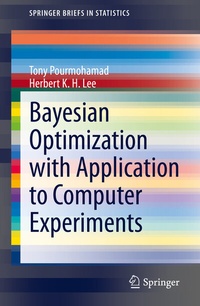
Bayesian Optimization with Application to Computer Experiments
Description

This book introduces readers to Bayesian optimization, highlighting advances in the field and showcasing its successful applications to computer experiments. R code is available as online supplementary material for most included examples, so that readers can better comprehend and reproduce methods.
Compact and accessible, the volume is broken down into four chapters. Chapter 1 introduces the reader to the topic of computer experiments; it includes a variety of examples across many industries. Chapter 2 focuses on the task of surrogate model building and contains a mix of several different surrogate models that are used in the computer modeling and machine learning communities. Chapter 3 introduces the core concepts of Bayesian optimization and discusses unconstrained optimization. Chapter 4 moves on to constrained optimization, and showcases some of the most novel methods found in the field. This will be a useful companion to researchers and practitioners workingwith computer experiments and computer modeling. Additionally, readers with a background in machine learning but minimal background in computer experiments will find this book an interesting case study of the applicability of Bayesian optimization outside the realm of machine learning.More details
Other editions
Additional editions
Persons
Tony Pourmohamad is a principal statistical scientist in the Department of Biostatistics at Genentech. Prior to joining Genentech, he received his Ph.D. from the Department of Statistics and Applied Mathematics at the University of California, Santa Cruz, where his research focused on constrained optimization for computer experiments. Nowadays, he spends most of his time at the intersection of clinical and nonclinical statistics at Genentech.
Herbert Lee is Professor of Statistics in the Baskin School of Engineering at the University of California, Santa Cruz. He currently also serves as Vice Provost for Academic Affairs. He received his Ph.D. from the Department of Statistics at Carnegie Mellon University and completed a postdoc at Duke University. His research interests include Bayesian statistics, computer simulation experiments, inverse problems, and spatial statistics.
Content
1. Computer experiments.- 2. Surrogate models.- 3. Unconstrained optimization.- 4. Constrained optimization.
