

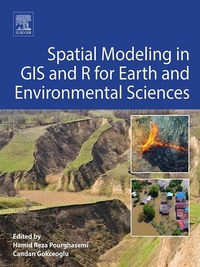
Spatial Modeling in GIS and R for Earth and Environmental Sciences
Published on 18. January 2019
798 pages
978-0-12-815695-7 (ISBN)
Description

Spatial Modeling in GIS and R for Earth and Environmental Sciences offers an integrated approach to spatial modelling using both GIS and R. Given the importance of Geographical Information Systems and geostatistics across a variety of applications in Earth and Environmental Science, a clear link between GIS and open source software is essential for the study of spatial objects or phenomena that occur in the real world and facilitate problem-solving. Organized into clear sections on applications and using case studies, the book helps researchers to more quickly understand GIS data and formulate more complex conclusions.
The book is the first reference to provide methods and applications for combining the use of R and GIS in modeling spatial processes. It is an essential tool for students and researchers in earth and environmental science, especially those looking to better utilize GIS and spatial modeling.
- Offers a clear, interdisciplinary guide to serve researchers in a variety of fields, including hazards, land surveying, remote sensing, cartography, geophysics, geology, natural resources, environment and geography
- Provides an overview, methods and case studies for each application
- Expresses concepts and methods at an appropriate level for both students and new users to learn by example
More details
Other editions
Additional editions
Hamid Reza Pourghasemi | Candan Gokceoglu
Spatial Modeling in GIS and R for Earth and Environmental Sciences
Book
01/2019
Elsevier
€179.51
Shipment within 15-20 days
Content
1. Spatial Analysis of Extreme Rainfall Values Based on Support Vector Machines Optimized by Genetic Algorithms: The Case of Alfeios Basin, Greece2. Remotely Sensed Spatial and Temporal Variations of Vegetation Indices Subjected to Rainfall Amount and Distribution Properties3. Numerical Recipes for Landslide Spatial Prediction by Using R-INLA: A Step-By-Step Tutorial4. An Integrative Approach of Geospatial Multi-Criteria Decision Analysis for Forest Operational Planning5. Parameters Optimization of KINEROS2 Using Particle Swarm Optimization Algorithm within R Environment for Rainfall-Runoff Simulation6. Land-Subsidence Spatial Modeling Using Random Forest Data Mining Technique7. GIS-Based SWARA and its Ensemble by RBF and ICA Data Mining Techniques for Determining Suitability of Existing Schools and Site Selection of New School Buildings8. Application of SWAT and MCDM Models for Identifying and Ranking the Suitable Sites for Subsurface Dams9. Habitat Suitability Mapping of Artemisia Aucheri Boiss Based on GLM Model in R10. Flood-Hazard Assessment Modeling Using Multi-Criteria Analysis and GIS: A Case Study: Ras Gharib Area, Egypt11. Landslide Susceptibility Survey Using Modelling Methods12. Prediction of Soil Disturbance Susceptibility Maps of Forest Harvesting Using R and GIS-Based Data Mining Techniques13. Spatial Modeling of Gully Erosion Using Linear and Quadratic Discriminant Analyses in GIS and R14. Artificial Neural Networks for Flood Susceptibility Mapping in Data-Scarce Urban Areas15. Modelling the Spatial Variability of Forest Fire Susceptibility Using Geographical Information Systems (GIS) and Analytical Hierarchy Process (AHP)16. Prioritization of Flood Inundation of Maharloo Watershed in Iran Using Morphometric Parameters Analysis and TOPSIS MCDM Model17. A Robust R-M-R (Remote Sensing - Spatial Modeling - Remote Sensing) Approach for Flood Hazard Assessment18. Prioritization of Effective Factors on Zataria Multiflora Habitat Suitability and Its Spatial Modeling19. Prediction of Soil Organic Carbon Using Regression Kriging Model and Remote Sensing Data20. 3D Reconstruction of Landslides for the Acquisition of Digital Databases and Monitoring Spatio-Temporal Dynamics of Landslides based on GIS Spatial Analysis and UAV Techniques21. A Comparative Study of Functional Data Analysis and Generalized Linear Model Data Mining Techniques for Landslide Spatial Modelling22. Regional Groundwater Potential Analysis Using Classification and Regression Trees23. Comparative Evaluation of Decision-Forest Algorithms in Object-Based Land Use and Land Cover Mapping24. Statistical Modelling of Landslides: Landslide Susceptibility and Beyond25. Assessing the Vulnerability of Groundwater to Salinization Using GIS-Based Data Mining Techniques in a Coastal Aquifer26. A Framework for Multiple Moving Objects Detection in Aerial Videos27. Modelling Soil Burn Severity Prediction for Planning Measures to Mitigate Post Wildfire Soil Erosion in NW Spain28. Factors Influencing Regional Scale Wildfire Probability in Iran: An Application of Random Forest and Support Vector Machine29. Land Use/Land Cover Change Detection and Urban Sprawl Analysis30. Spatial Modeling of Gully Erosion: A New Ensemble of CART and GLM Data Mining Algorithms31. Multi-Hazard Exposure Assessment on the Valjevo City Road Network32. Producing a Spatially Focused Landslide Susceptibility Map Using an Ensemble of Shannon's Entropy and Fractal Dimension (The Ziarat Watershed, Iran)33. A Conceptual Model on Relationship between Plant Spatial Distribution and Desertification Trend in Rangeland Ecosystems
