

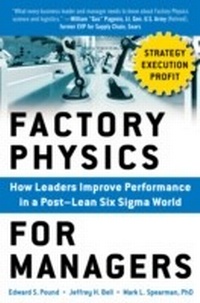
Factory Physics for Managers: How Leaders Improve Performance in a Post-Lean Six Sigma World
How Leaders Improve Performance in a Post-Lean Six Sigma World
1st Edition
Published on 11. March 2014
359 pages
978-0-07-182261-9 (ISBN)
Description

From the award-winning developers of Factory Physicsa powerful leadership guide for breakthrough performance A comprehensive guide that cuts through the hodgepodge of copycat initiatives, overblown buzzwords, confusing mathematics, and misguided software, Factory Physics for Managers is a breath of fresh air for operations managers and executives. Written by the leaders and experts behind the bestselling Factory Physics, its a brilliant crash course in the practical science of operations designed to help you: Achieve best possible profit, cash flow, and customer service Attain highest return with existing Lean, Six Sigma, and ERP initiatives Manage your capacity, inventory, response time, and variability with high predictability Simplify management of complexity using existing IT systems Use the fundamentals of science to ensure your operations success See your company and procedures more clearly Improve intuition, decision making, and strategy execution A strategy of imitation is not much of a strategy. Most every company uses the common continuous improvement initiatives. This highly accessible guide addresses but goes beyond other business approaches such as Lean, Six Sigma, and Theory of Constraints by offering a customizable plan that you can apply to any manufacturing-based industry or supply chain. Youll discover invaluable tools for developing operations strategy and driving execution by using practical science to assess your procedures, target problems, and find solutions. Youll learn essential life lessons from the bestand worstpractices of corporate leaders like Toyota and Boeing. Youll find ingenious new ways to improve your leadership by predictively managing the tradeoffs that every operation faceswhether its more or less inventory or capacity, higher or lower customer service, or more or fewer products. Using this approach, you can tackle these natural conflicts in business through a practical, comprehensive science of operations. Factory Physics for Managers makes it easier to choose and execute the best strategy for better productivityand even bigger profits. Praise for Factory Physics for Managers Factory Physics for Managers is a proven path to flawless execution and results. Leading vs. following in our industry is predicated on the relentless pursuit of putting order to chaos. Factory Physics science and CSUITE software have given our organization the ability to plan, predict, model, and execute based on explosive growth and rapid-fire, dynamic changes to our business model. In our case, history is not a good predictor of the future, so we need to deploy our resources wisely, and the Factory Physics approach has helped us do just that.Larry Doerr, COO, Stratasys Shows how the science behind Lean initiatives can greatly improve results in terms of productivity and resources.Bill Fierle, Vice President and General Manager, TopWorx, Emerson Brings powerful, accessible science to operations management. The Factory Physics playbook enables me to lead the harnessing of our data more effectively for modeling, planning, control, and feedback. Armed with the concepts, common language, and tools in this book, I can partner with operations leadership to impact the bottom line.Jeffrey Korman, CIO, Hu-Friedy Mfg LLC, Chicago
More details
Other editions
Additional editions
Edward Pound | Jeffrey Bell | Mark Spearman
Factory Physics for Managers: How Leaders Improve Performance in a Post-Lean Six Sigma World
Book
04/2014
McGraw-Hill Professional
€61.89
Article exhausted; check different version
Content
- Cover
- Title Page
- Copyright Page
- Dedication
- Contents
- Prologue
- The Book in Brief
- Why Is This Book Needed?
- Chapter 1 Science-Use It or Lose
- Of Theories and Buzzwords
- Toyota and Science
- How Toyota Did It
- Batch and Queue Production
- A Balanced Approach
- The Track Record: Lean and Six Sigma
- A Confused Landscape
- Boeing's Moving Assembly Line
- Looking Ahead
- Chapter 2 The Nature of Business-A Secret Hidden in Plain Sight
- Leading Performance Improvement More Productively
- Tradeoff Illustrations
- Leadership and Tradeoffs
- The Factory Physics Approach
- Chapter 3 Practical Science for Leaders
- Knowledge and Science
- Science, Math, Software, and Intuition
- Practical Theory
- The Value Stream: Demand, Stocks, and Production
- Buffers
- Types of Buffers
- Conceptual Illustrations: Something or Someone Is Always Waiting
- A Manager's World: Environment, Tactics, Controls, and Measures
- Putting Practical Science to Practice
- Definitions
- Factory Physics Science: As Simple as Possible but No Simpler
- Advancing the Practical Science of Management
- The VUT Equation
- Cycle Time versus Utilization Graph
- Production and Stocks
- Little's Law
- Production-Flow Graph
- Variance of Replenishment-Time Demand Equation
- Tradeoff Plot: Inventory versus Fill Rate Graph
- Efficient Frontiers
- Insights from the Tradeoff Plot
- Visual Management of Stock-Point Performance
- Stocks and Flows, the Lot-Size Graph
- Chapter 4 Practical Math for Managers
- Defining Terms
- Modeling Stocks
- A Perfect World
- Replenishment Times
- Demand
- Forecast Error and Lead Time
- Inventory Performance Measures
- Computing Inventory Policies
- Inventory in an Assembly System
- Modeling Flows
- Little's Law
- Capacity Analysis
- Overall Equipment Effectiveness
- Best-Case Performance
- Effect of Variability
- Measures of Variability
- Queuing Effects
- Total Cycle Time
- Raw Process Time
- Move Time
- Shift-Differential Time
- Batch Time
- Pull Systems
- Combining Stocks and Flows
- Cash-Flow Optimization
- Examples of Cash-Flow Optimization
- Conclusions
- Chapter 5 Profit, Cash Flow, and Factory Physics Science
- The Value-Added Fantasy
- Financial Statements and the Science of Operations
- Financial Performance Driven by the Science of Operations
- Contribution Margin at the Bottleneck
- When Lean Manufacturing Adds Cost
- Inventory Optimization
- Managing the Portfolio of Buffers
- Marketing and Operations Strategies Drive Financial Results
- Chapter 6 Operations Strategy and Planning
- Operations Strategy
- Strategy
- Tactics
- Controls
- Measures
- Execution
- Information Technology Control and Control Limits
- Factory Physics Sales and Operations Planning
- S&OP Event Sequence and Participants
- S&OP Meeting Practices
- S&OP+
- S&OP+ Process
- Chapter 7 Implementing Tactics, Controls, and Measures for Optimal Results
- Demand Tactics and Controls
- Describing and Forecasting Demand
- Lumpy Demand
- Inventory Tactics
- Inventory Strategy Considerations
- Capacity Considerations
- Current Performance versus Predicted Performance
- Strategic Options
- Tactics for Inventory Management
- Inventory Control
- Capacity Tactics
- Utilization
- WIP Control and CONWIP
- Virtual Queues and Due-Date Quoting
- Rework and Scrap
- Response-Time Stratagems
- Predictive Control Using MRP/ERP Systems
- Common Practices
- MRP for Inventory Control
- MRP for Production Control
- Dynamic Risk-Based Scheduling
- Dynamic Risk-Based Scheduling in Assemble-to-Order Environments
- Measures Alignment and Insight
- Chapter 8 Leadership, Measures, and Culture Change
- An Approach to Sustainable Leadership
- A High-Level Plan So That Strategies Can Be Shared and Understood
- Vision and Mission
- Critical Strategies
- Monthly or Quarterly Plans to Establish Prioritized Initiatives
- Inventory Optimization
- Utilization Targets
- Weekly Scheduling Meetings to Plan the Work
- WIP Caps
- Due-Date Quoting
- Weekly Operations Meetings to Check Progress
- Daily Mechanisms for Feedback
- Personal Plans So That Individuals Understand Their Roles
- Chapter 9 Examples from Industry
- Learning to See-Farther
- Beyond ABC-Optimal Inventory Policies
- Reducing Cycle Times in a Traditional Pharmaceutical Plant
- Restoring Customer Service in a Fabrication and Assembly Plant
- Increasing Throughput in a Biopharmaceutical Facility
- Dynamic Risk-Based Scheduling in the Textile Industry
- Chapter 10 Final Word on Factory Physics Science (for Now)
- Quick Wins
- Operations Strategy Alignment with Business Strategy
- Absolute Benchmarking
- High-Level Assessment of Utilization
- Bottleneck Analysis
- Potential for WIP Cap Deployment
- High-Level Analysis of Lead Times
- ERP/MRP Mechanics
- More Complex Implementations
- A Large Company Implementation
- Alternative Histories
- The Future
- Notes
- Acknowledgments
- Index
