

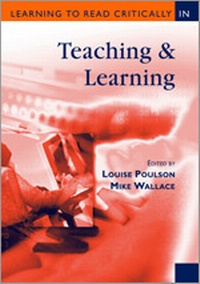
Learning to Read Critically in Teaching and Learning
1st Edition
Published on 23. September 2003
232 pages
978-1-4129-3321-6 (ISBN)
Description

`Learning to Read Critically in Teaching and Learning offers a contribution to the debates on curriculum and pedagogy. The title itself is especially noteworthy since it indicates quite clearly that the reader is being encouraged both to learn and to develop their critical faculties on the topic of teaching and learning. This is a clever multi-layering of meaning that reflects the aims of the book extremely well' - School Leadership & Management
This book combines a teaching text with exemplary reports of research and a literature review by international scholars. Part One offers ideas on: how to become a critical reader and self-critical writer of literature; how to apply these insights in planning a written assignment, dissertation or thesis.
The student is provided with a framework for the critical analysis of any text and shown how to incorporate it in a literature review.
Part Two presents accounts of leading-edge research from well-known contributors, offering insights into key issues in the field of teaching and learning. These accounts reflect diverse theoretical approaches, national contexts, topics, research designs, methods of data collection and analysis, and styles of reporting. The student is invited to practice literature review skills by applying the critical analysis questions to any research report.
Part Three is a critical literature review of a substantive issue in teaching and learning. It shows how a high-quality literature review may be constructed and addresses key issues in the field.
This book is essential for students on research-based masters and doctorate courses in teaching and learning; and for students undertaking research training in the humanities and social sciences.
This series, edited by Mike Wallace, supports research-based teaching on masters and taught doctorate courses in the humanities and social sciences fields of enquiry. Each book is a 'three in one' text designed to assist advanced course tutors and dissertation supervisors with key research-based teaching tasks and aims to:
* develop students' critical understanding of research literature
* increase students' appreciation of what can be achieved in small-scale investigations similar to those which they undertake for their dissertation
* present students with major findings, generalisations and concepts connected to their particular field.
This book combines a teaching text with exemplary reports of research and a literature review by international scholars. Part One offers ideas on: how to become a critical reader and self-critical writer of literature; how to apply these insights in planning a written assignment, dissertation or thesis.
The student is provided with a framework for the critical analysis of any text and shown how to incorporate it in a literature review.
Part Two presents accounts of leading-edge research from well-known contributors, offering insights into key issues in the field of teaching and learning. These accounts reflect diverse theoretical approaches, national contexts, topics, research designs, methods of data collection and analysis, and styles of reporting. The student is invited to practice literature review skills by applying the critical analysis questions to any research report.
Part Three is a critical literature review of a substantive issue in teaching and learning. It shows how a high-quality literature review may be constructed and addresses key issues in the field.
This book is essential for students on research-based masters and doctorate courses in teaching and learning; and for students undertaking research training in the humanities and social sciences.
This series, edited by Mike Wallace, supports research-based teaching on masters and taught doctorate courses in the humanities and social sciences fields of enquiry. Each book is a 'three in one' text designed to assist advanced course tutors and dissertation supervisors with key research-based teaching tasks and aims to:
* develop students' critical understanding of research literature
* increase students' appreciation of what can be achieved in small-scale investigations similar to those which they undertake for their dissertation
* present students with major findings, generalisations and concepts connected to their particular field.
More details
Series
Edition
First Edition
Language
English
Place of publication
London
United Kingdom
Publishing group
Sage Publications Ltd (Digital)
Target group
College/higher education
ISBN-13
978-1-4129-3321-6 (9781412933216)
Copyright in bibliographic data and cover images is held by Nielsen Book Services Limited or by the publishers or by their respective licensors: all rights reserved.
Schweitzer Classification
Other editions
Additional editions
Louise Poulson | Mike Wallace
Learning to Read Critically in Teaching and Learning
Book
09/2003
1st Edition
SAGE Publications Inc
€224.33
Article exhausted; check different version
Louise Poulson | Mike Wallace
Learning to Read Critically in Teaching and Learning
Book
09/2003
1st Edition
SAGE Publications Inc
€104.20
Shipment within 15-20 days
Persons
Mike Wallace is a Professor of Public Management at Cardiff Business School, Cardiff University. From 2009 to 2012 he was the Economic and Social Research Council's Strategic Adviser for Researcher Development. His research on managing change in the public services is reported in many books and academic journals. He is co-author, with Eric Hoyle, of the book Educational Leadership: Ambiguity, Professionals, and Managerialism (Sage, 2005), lead editor, with Michael Fertig and Eugene Schneller, of the book Managing Change in the Public Services (Blackwell, 2007), and lead co-author, with Michael Reed, Dermot O'Reilly, Jonathan Morris, Michael Tomlinson and Rosemary Deem, of the book Developing Public Service Leaders: Elite Orchestration, Change Agency, Leaderism, and Neoliberalization (Oxford University Press, 2023). His contribution to teaching at Cardiff centres on the design of postgraduate research programmes incorporating research methods training.
Content
PART ONE: BECOMING A CRITICAL CONSUMER OF THE LITERATURE
Critical Reading for Self-Critical Writing - Mike Wallace and Louise Poulson
Designing and Writing about Research - Louise Poulson and Mike Wallace
Developing a Critical Frame of Mind
PART TWO: MEETING THE CHALLENGE OF REPORTING RESEARCH
Changing Instructional and Assessment Practices through Professional Development - Hilda Borko with Kathryn Davinroy, Carribeth Bliem and Kathryn Cumbo
Learning from Homework - Martin Hughes and Pamela Greenhough
A Case Study
An Inquiry into the Moral Dimensions of Teaching - Gary Fenstermacher and Virginia Richardson
Investigating Formative Classroom Assessment - Harry Torrance and John Pryor
Participation and Control in Learning - Diane Reay and Madeleine Arnot
A Pedagogic Democratic Right?
Primary School Teachers' Theoretical Beliefs about Literacy - Louise Poulson and Elias Avramidis
An Exploratory Study
PART THREE: MEETING THE CHALLENGE OF REPORTING A REVIEW OF THE LITERATURE
Promoting Inclusive Education - Elias Avramidis and Brahm Norwich
A Review of Literature on Teachers' Attitudes towards Integration and Inclusion
Critical Reading for Self-Critical Writing - Mike Wallace and Louise Poulson
Designing and Writing about Research - Louise Poulson and Mike Wallace
Developing a Critical Frame of Mind
PART TWO: MEETING THE CHALLENGE OF REPORTING RESEARCH
Changing Instructional and Assessment Practices through Professional Development - Hilda Borko with Kathryn Davinroy, Carribeth Bliem and Kathryn Cumbo
Learning from Homework - Martin Hughes and Pamela Greenhough
A Case Study
An Inquiry into the Moral Dimensions of Teaching - Gary Fenstermacher and Virginia Richardson
Investigating Formative Classroom Assessment - Harry Torrance and John Pryor
Participation and Control in Learning - Diane Reay and Madeleine Arnot
A Pedagogic Democratic Right?
Primary School Teachers' Theoretical Beliefs about Literacy - Louise Poulson and Elias Avramidis
An Exploratory Study
PART THREE: MEETING THE CHALLENGE OF REPORTING A REVIEW OF THE LITERATURE
Promoting Inclusive Education - Elias Avramidis and Brahm Norwich
A Review of Literature on Teachers' Attitudes towards Integration and Inclusion
