

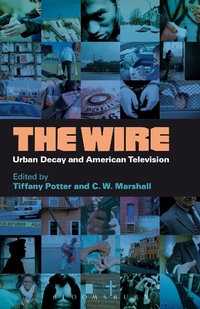
The Wire
Urban Decay and American Television
1st Edition
Published on 1. June 2010
264 pages
978-0-8264-3477-7 (ISBN)
Description

The first collection of critical essays on HBO's The Wire - the most brilliant and socially relevant television series in years
The Wire is about survival, about the strategies adopted by those living and working in the inner cities of America. It presents a world where for many even hope isn't an option, where life operates as day-to-day existence without education, without job security, and without social structures. This is a world that is only grey, an exacting autopsy of a side of American life that has never seen the inside of a Starbucks.
Over its five season, sixty-episode run (2002-2008), The Wire presented several overlapping narrative threads, all set in the city of Baltimore. The series consistently deconstructed the conventional narratives of law, order, and disorder, offering a view of America that has never before been admitted to the public discourse of the televisual. It was bleak and at times excruciating. Even when the show made metatextual reference to its own world as Dickensian, it was too gentle by half.
By focusing on four main topics (Crime, Law Enforcement, America, and Television), The Wire: Urban Decay and American Television examines the series' place within popular culture and its representation of the realities of inner city life, social institutions, and politics in contemporary American society. This is a brilliant collection of essays on a show that has taken the art of television drama to new heights.
The Wire is about survival, about the strategies adopted by those living and working in the inner cities of America. It presents a world where for many even hope isn't an option, where life operates as day-to-day existence without education, without job security, and without social structures. This is a world that is only grey, an exacting autopsy of a side of American life that has never seen the inside of a Starbucks.
Over its five season, sixty-episode run (2002-2008), The Wire presented several overlapping narrative threads, all set in the city of Baltimore. The series consistently deconstructed the conventional narratives of law, order, and disorder, offering a view of America that has never before been admitted to the public discourse of the televisual. It was bleak and at times excruciating. Even when the show made metatextual reference to its own world as Dickensian, it was too gentle by half.
By focusing on four main topics (Crime, Law Enforcement, America, and Television), The Wire: Urban Decay and American Television examines the series' place within popular culture and its representation of the realities of inner city life, social institutions, and politics in contemporary American society. This is a brilliant collection of essays on a show that has taken the art of television drama to new heights.
Reviews / Votes
Mentioned in 'In the Life of 'The Wire'' by Lorrie MooreMore details
Edition
1. Auflage
Language
English
Place of publication
New York
United States
Target group
Professional and scholarly
ISBN-13
978-0-8264-3477-7 (9780826434777)
Copyright in bibliographic data and cover images is held by Nielsen Book Services Limited or by the publishers or by their respective licensors: all rights reserved.
Schweitzer Classification
Other editions
Additional editions
Book
02/2010
Continuum International Publishing Group Ltd.
€45.30
Shipment within 15-20 days
Persons
Tiffany Potter, teaching in the Department of English, University of British Columbia, and holding a PhD in English Literature, focuses her research on cultural studies, with emphases on colonial and post-colonialism, feminism, the history of sexuality, and the historical literatures of anthropology and race. She has published extensively in many journals, including Early American Literature. C. W. Marshall is Professor of Greek, Department of Classical, Near Eastern, and Religious Studies and Distinguished Scholar in Residence, Peter Wall Institute for Advanced Studies, University of British Columbia, Canada. His publications include The Stagecraft and Performance of Roman Comedy (2006), Classics and Comics (2011) and No Laughing Matter (Bloomsbury, 2012).
Content
- Aafa Weaver, "Baltimore before The Wire"
- C.W. Marshall and Tiffany Potter, "'I am the American Dream': Modern Urban Tragedy and the Borders of Fiction"
A. Baltimore and its Institutions
- David Alff, "Yesterday's Tomorrow Today: Baltimore and the Promise of Reform"
- Peter Clandfield, "We ain't got no yard': Crime, Development and Urban Environment"
- Alisdair McMillan, "Heroism, Institutions, and the Police Procedural"
- Ryan Brooks, "Once That Tape Starts Rolling...': The Production of 'Real Police'"
- Lynne Viti, "I got the Shotgun, You got the Briefcase': Judging, Lawyering, and Ethics"
- Ralph Beliveau and Laura Bolf-Beliveau, "Posing Problems and Picking Fights: Critical Pedagogy and the Corner Boys"
B. In the Vacants
- James Peterson, "On the Corners of Black Masculinity: Hip Hop Culture and the Intersections of Inner City Manhood"
- Jason Read, "Stringer Bell's Lament: Violence and Legitimacy in Contemporary Capitalism"
- Stephen Lucasi, "Networks of (Af)filiation: Familialism and Anti-Corporatism"
- Courtney Marshall, "Barksdale Women: Crime, Empire, and the Production of Gender"
- Elizabeth Bonjean, "After the Towers Fell: Bodie Broadus and the Space of Memory"
C. Twenty-first Century Television
- Amanda Ann Klein, "The Dickensian Aspect': Melodrama, Viewer Engagement and the Socially Conscious Text"
- Ted Nannicelli, "'It's All Connected': Notes on the Teleplays"
- Kevin McNeilly, "Dislocating America: Agnieszka Holland Directs 'Moral Midgetry'"
- Kathleen LeBesco, "Social Justice and Audience Response to Omar Little"
Bibliography
Episode List
Notes on Contributors
Index
- C.W. Marshall and Tiffany Potter, "'I am the American Dream': Modern Urban Tragedy and the Borders of Fiction"
A. Baltimore and its Institutions
- David Alff, "Yesterday's Tomorrow Today: Baltimore and the Promise of Reform"
- Peter Clandfield, "We ain't got no yard': Crime, Development and Urban Environment"
- Alisdair McMillan, "Heroism, Institutions, and the Police Procedural"
- Ryan Brooks, "Once That Tape Starts Rolling...': The Production of 'Real Police'"
- Lynne Viti, "I got the Shotgun, You got the Briefcase': Judging, Lawyering, and Ethics"
- Ralph Beliveau and Laura Bolf-Beliveau, "Posing Problems and Picking Fights: Critical Pedagogy and the Corner Boys"
B. In the Vacants
- James Peterson, "On the Corners of Black Masculinity: Hip Hop Culture and the Intersections of Inner City Manhood"
- Jason Read, "Stringer Bell's Lament: Violence and Legitimacy in Contemporary Capitalism"
- Stephen Lucasi, "Networks of (Af)filiation: Familialism and Anti-Corporatism"
- Courtney Marshall, "Barksdale Women: Crime, Empire, and the Production of Gender"
- Elizabeth Bonjean, "After the Towers Fell: Bodie Broadus and the Space of Memory"
C. Twenty-first Century Television
- Amanda Ann Klein, "The Dickensian Aspect': Melodrama, Viewer Engagement and the Socially Conscious Text"
- Ted Nannicelli, "'It's All Connected': Notes on the Teleplays"
- Kevin McNeilly, "Dislocating America: Agnieszka Holland Directs 'Moral Midgetry'"
- Kathleen LeBesco, "Social Justice and Audience Response to Omar Little"
Bibliography
Episode List
Notes on Contributors
Index
