

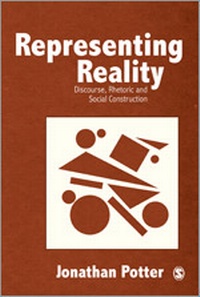
Representing Reality
Discourse, Rhetoric and Social Construction
1st Edition
Published on 13. August 1996
264 pages
978-0-85702-295-0 (ISBN)
Description

`This is an admirable book which can be recommended to students with confidence, and is likely also to become an indispensable source of reference for those researching fact construction' - Discourse & Society
How is reality manufactured? The idea of social construction has become a commonplace of much social research, yet precisely what is constructed, and how, and even what constructionism means, is often unclear or taken for granted. In this major work, Jonathan Potter offers a fascinating tour of the central themes raised by these questions.
Representing Reality overviews the different traditions in constructionist thought. Points are illustrated throughout with varied and engaging examples taken from newspaper stories, relationship counselling sessions, accounts of the paranormal, social workers' assessments of violent parents, informal talk between programme makers, political arguments and everyday conversations. Ranging across the social and human sciences, this book provides a lucid introduction to several key strands of work that have overturned the way we think about facts and descriptions, including: the sociology of scientific knowledge; conversation analysis and ethnomethodology; and semiotics, post-structuralism and postmodernism.
How is reality manufactured? The idea of social construction has become a commonplace of much social research, yet precisely what is constructed, and how, and even what constructionism means, is often unclear or taken for granted. In this major work, Jonathan Potter offers a fascinating tour of the central themes raised by these questions.
Representing Reality overviews the different traditions in constructionist thought. Points are illustrated throughout with varied and engaging examples taken from newspaper stories, relationship counselling sessions, accounts of the paranormal, social workers' assessments of violent parents, informal talk between programme makers, political arguments and everyday conversations. Ranging across the social and human sciences, this book provides a lucid introduction to several key strands of work that have overturned the way we think about facts and descriptions, including: the sociology of scientific knowledge; conversation analysis and ethnomethodology; and semiotics, post-structuralism and postmodernism.
Reviews / Votes
`Since the publication of Potter & Wetherell's influential Discourse and Social Psychology, which laid the ground-plan for their version of discourse analysis, work has continued apace... As a progress report, the present text provides a valuable up-date, summarizing the main lines of development and usefully pulling together material heretofore only available from a disparate range of sources... As an introduction to this type of analysis, this is an admirable book which can be recommended to students with confidence, and is likely also to become an indispensable source of reference for those researching fact construction' - Discourse & Society`Potter leaves the reader wanting more-which is a pretty good place to leave a reader' - Language in Society
More details
Language
English
Place of publication
London
United Kingdom
Target group
College/higher education
Professional and scholarly
ISBN-13
978-0-85702-295-0 (9780857022950)
Copyright in bibliographic data and cover images is held by Nielsen Book Services Limited or by the publishers or by their respective licensors: all rights reserved.
Schweitzer Classification
Other editions
Additional editions
Book
08/1996
1st Edition
SAGE Publications Inc
€113.90
Shipment within 15-20 days
Person
Jonathan Potter is Professor of Discourse Analysis and Dean of the School of Social, Political and Geographical Sciences at Loughborough University. He has studied topics such as scientific argumentation, current affairs television, riots, racism, relationship counselling and child protection helplines. His main focus recently has been on the study of helpline interaction, on interaction during family mealtimes, on the conceptualization of cognition in interaction research, and on issues of psychology and institutions. He a world authority on qualitative methods and has written on discourse analysis and discursive psychology, focus groups, the study of psychological issues. Recently has raised questions about the over-reliance of social scientists on open-ended qualitative interviews. He has taught workshops and short courses on analysis in 10 different countries.
Content
Introduction
Social Studies of Science
Ethnomethodology and Conversation Analysis
Semiology - Post-Structuralism - Postmodernism
Discourse and Construction
Interests and Category Entitlements
Constructing Out-there-ness
Working Up Representations
Criticizing Facts
Social Studies of Science
Ethnomethodology and Conversation Analysis
Semiology - Post-Structuralism - Postmodernism
Discourse and Construction
Interests and Category Entitlements
Constructing Out-there-ness
Working Up Representations
Criticizing Facts
