

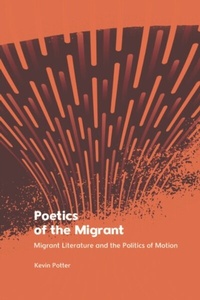
Poetics of the Migrant
Description

Introduces a new concept of ''kinopoetics'' to transform how we read migrancy and literary form
- Coins a new concept and offers a 'poetics' (i.e. a method and theory) of migrancy and literary form that adheres to a movement-oriented perspective
- Synthesises a variety of fields in order to interest readers not only in literary studies, but cultural theory, philosophy, political science, linguistic, and border studies, and the synergies between them
- Remains in dialogue with the dominant strands of migrant literary studies, showing how they can be expanded and enhanced through a philosophy of movement
Since the 1980s, readers and scholars alike have celebrated migrant literature for not only depicting migration, but for inspiring reflections on class, race, gender, nations, and mobility. But, beyond depicting migration, is it possible for migrant literature to be a force of movement itself? Poetics of the Migrant calls upon the philosophy of movement and a counter-history of migration to invent a theory and method for analysing migrant literature. The text uncovers patterns of movement that migrant texts enact and create - in other words, a movement-oriented poetics. Poetics of the Migrant understands movement as the defining force of human history; and the migrant is the primary figure of cultural and political transformation. Migrant literature makes it possible to transform how we process and interpret social history through social motion. Perhaps, from here, we can imagine a different world: one where movement and migrancy are legible and thinkable.
More details
Other editions
Additional editions
Content
- Intro
- Acknowledgements
- Introduction: Toward a Movement-Oriented Poetics
- Part I
- 1. How Kinopoetics Works
- 2. Movement Interventions
- Part II
- 3. Destructive Kinopoetics
- 4. Wandering Kinopoetics
- 5. Stuttering Kinopoetics
- Conclusion
- References
- index
