

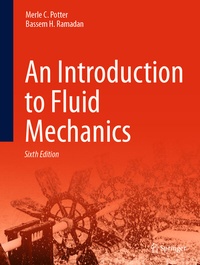
An Introduction to Fluid Mechanics
Description

This textbook can be used for the first required course in fluid mechanics. It can be used in any curriculum: mechanical, civil, chemical, aerospace, or a general required course for all engineers. The course can be taught using the more conventional elemental approach for pipe flow, channel flow, and flow between cylinders. This textbook adopts a judicious approach, minimizing mathematical intricacies to ensure that the book is accessible for all students. The text has been designed to allow students to better understand the fundamentals, aided by numerous examples and home problems. Students often find it quite difficult to understand many concepts encountered in fluid mechanics, such as laminar flow, the entrance region, the separated region, and turbulence. The book ensures that these concepts are presented correctly and in an easy-to-understand format. To mention a few, the turbulent entrance region is only for large Reynolds numbers although not many texts mention this, the separated region and the wake are often confused, and laminar flow and turbulent flow definitions usually lack clarity. This book elucidates derivations and phenomena in a manner that renders them comparably more comprehensible than those presented in other textbooks. This book uses a student-friendly format to ensure easy understanding.
More details
Other editions
Additional editions
Persons
Dr. Merle Potter joined Michigan State University (MSU) in 1965 after earning his Ph.D. in Engineering Mechanics from the University of Michigan. He also earned degrees in mechanical engineering and aerospace engineering. He spent two summers at each of the following research facilities: Stanford University, the NASA Glenn Research Center, and DOE's Oak Ridge National Lab. He conducted research in fluid mechanics and energy analysis of buildings. He has received research grants that supported both of his M.S. and Ph.D. theses. He also developed undergraduate and graduate courses in fluid mechanics, thermodynamics, and applied mathematics at MSU. As chairman of the college's curriculum committee, he led the college to develop a new undergraduate program in Applied Engineering Sciences. He authored or co-authored more than 35 books, including 7 textbooks, 5 Schaum's Outlines, and numerous exam review books for engineers. He is a recipient of numerous awards including the James Harry Potter Gold Medal.
Dr. Bassem Ramadan joined Kettering University in 1998 and has been the Department Head of Mechanical Engineering since 2016. He received his Ph.D. and M.S. degrees in Mechanical Engineering from Michigan State University. Prior to joining Kettering University, he was an adjunct professor at Michigan State University, where he taught courses in mechanical engineering and conducted engine research at the Engine Research Laboratory. His significant contributions are in the application of computational fluid dynamics to internal combustion engines and in modeling and understanding fluid flow in engineering applications. He has won numerous funded research proposals that supported more than 50 M.S. theses. He is a fellow of ASME and is the recipient of the Outstanding Teaching Award, Distinguished Researcher, Outstanding Applied Researcher, and Outstanding New Researcher Awards from Kettering University. He is a member of ASME, SAE, ASEE, and ACS.
Content
Basic Considerations.- Fluid Statics.- Introduction To Fluids In Motion.- The Integral Forms Of The Fundamental Laws.- Dimensional Analysis And Similitude.
