

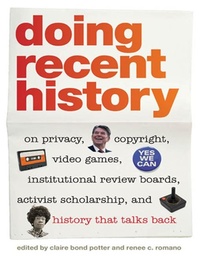
Doing Recent History
Description

Recent history-the very phrase seems like an oxymoron. Yet historians have been writing accounts of the recent past since printed history acquired a modern audience, and in the last several years interest in recent topics has grown exponentially. With subjects as diverse as Walmart and disco, and personalities as disparate as Chavez and Schlafly, books about the history of our own time have become arguably the most exciting and talked-about part of the discipline.
Despite this rich tradition and growing popularity, historians have engaged in little discussion about the specific methodological, political, and ethical issues related to writing about the recent past. The twelve essays in this collection explore the challenges of writing histories of recent events where visibility is inherently imperfect, hindsight and perspective are lacking, and historiography is underdeveloped.
Those who write about events that have taken place since 1970 encounter exciting challenges that are both familiar and foreign to scholars of a more distant past, including suspicions that their research is not historical enough, negotiation with living witnesses who have a very strong stake in their own representation, and the task of working with new electronic sources. Contributors to this collection consider a wide range of these challenges. They question how sources like television and video games can be better utilized in historical research, explore the role and regulation of doing oral histories, consider the ethics of writing about living subjects, discuss how historians can best navigate questions of privacy and copyright law, and imagine the possibilities that new technologies offer for creating transnational and translingual research opportunities. Doing Recent History offers guidance and insight to any researcher considering tackling the not-so-distant past.
More details
Other editions
Additional editions

Persons
CLAIRE BOND POTTER is a professor of history at The New School. She is author of War on Crime: Bandits, G-Men, and the Politics of Mass Culture and also the blog Tenured Radical.
Renee C. Romano (Editor)
RENEE C. ROMANO is an associate professor of history and African American studies at Wesleyan University and the author of Race Mixing.
Content
- Cover
- Contents
- Acknowledgments
- INTRODUCTION: Just over Our Shoulder: The Pleasures and Perils of Writing the Recent Past
- PART 1 Framing the Issues
- Not Dead Yet: My Identity Crisis as a Historian of the Recent Past
- Working without a Script: Reflections on Teaching Recent American History
- PART 2 Access to the Archives
- Opening Archives on the Recent American Past: Reconciling the Ethics of Access and the Ethics of Privacy
- Who Owns Your Archive? Historians and the Challenge of Intellectual Property Law
- PART 3 Working with Living Subjects
- The Berkeley Compromise: Oral History, Human Subjects, and the Meaning of "Research"
- The Presence of the Past: Iconic Moments and the Politics of Interviewing in Birmingham
- When Radical Feminism Talks Back: Taking an Ethnographic Turn in the Living Past
- PART 4 Technology and the Practice of Recent History
- Do Historians Watch Enough TV? Broadcast News as a Primary Source
- Playing the Past: The Video Game Simulation as Recent American History
- Eternal Flames: The Translingual Imperative in the Study of World War II Memories
- PART 5 Crafting Narratives
- When the Present Disrupts the Past: Narrating Home Care
- "Cult" Knowledge: The Challenges of Studying New Religious Movements in America
- Contributors
- Index
- A
- B
- C
- D
- E
- F
- G
- H
- I
- J
- K
- L
- M
- N
- O
- P
- Q
- R
- S
- T
- U
- V
- W
- Y
- Z
