

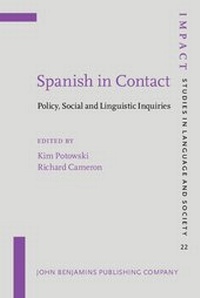
Spanish in Contact
Policy, Social and Linguistic Inquiries
1st Edition
Published on 16. July 2007
XX, 398 pages
978-90-272-9246-9 (ISBN)
Description

This volume, covering a range of topics such as Spanish as a heritage language in the United States, policy issues, pragmatics and language contact, sociolinguistic variation and contact, and Bozal (Creole) Spanish, will serve the interests of linguists, educators, and policy makers alike. It provides cutting edge research on varieties of Spanish spoken by children, teenagers, and adults in places as diverse as Chicago, New York, New Mexico, and Houston; Valencia and Galicia; the Andean highlands; and the border between Haiti and the Dominican Republic. The emphasis is on spoken Spanish, although researchers also investigate code-switching in the lyrics of bachata songs and the presence of creole in Cuban and Brazilian literature. This collection will be of interest wherever Spanish is spoken.
More details
Other editions
Additional editions
Book
07/2007
John Benjamins Publishing Co
€116.60
Shipment within 10-15 days
Persons
Content
- Spanish in Contact
- Editorial page
- Title page
- LCC data
- Table of contents
- Introduction
- Past publications resulting from this conference
- Heritage Spanish in the Unites States
- Subjects in early dual language development
- 1. Introduction
- 2. Monolingual acquisition
- 3. Subjects in Spanish and English
- 4. The data
- 4.1. Mean Length of Utterance (MLU)
- 4.2. Utterances included in the analyses
- 5. Analysis
- 6. Discussion and conclusion
- References
- Interpreting mood distinctions in Spanish as a heritage language
- 1. Introduction
- 2. Linguistic background: Mood
- 3. L1 acquisition and loss of subjunctive
- 4. The study
- 5. Results
- 5.1. Group results
- 5.2. Results by Proficiency
- 5.3. Individual results
- 6. Conclusion
- References
- Appendix
- Anglicismos en el léxico disponible de los adolescentes hispanos de Chicago
- 1. Introducción
- 2. Antecedentes
- 3. Perfil hispano de Chicago
- 4. Bases de la investigación y objetivos
- 5. Estudio de una escuela secundaria de Chicago. Cuestiones metodológicas
- 6. El anglicismo en el léxico disponible en Chicago
- 7. Conclusiones
- References
- Education and policy issues
- Teaching Spanish in the U.S.
- 1. Mapping the geography of Spanish-language teaching in the U.S.
- 2. Instructional practices that support differentiated instruction
- 2.1. Stations
- 2.2. Centers
- 2.3. Agendas
- 2.4. Learning contracts
- 2.5. Multiple-entry journals/reading logs
- 3. Sample applications of DT in the SNS classroom
- 3.1. Sample station activities
- 3.2. Sample center activities
- 3.3. Agendas and learning contracts
- 3.4. Multiple-entry journals/reading logs
- 4. Closing remarks
- References
- The politics of English and Spanish aquí y allá
- 1. Introduction
- 2. Bilingualism in Puerto Rico
- 3. English and Americanization
- 4. Bilingualism and class
- 5. Language and recent party politics in Puerto Rico
- 6. Multilingualism in the United States
- 7. Bilingualism and stateside Puerto Ricans
- 8. Spanish and Puerto Rican identity
- 9. Bilingualism and class
- 10. Enhancing bilingualism in Puerto Rico
- 11. Enhancing bilingualism in the United States
- 12. Conclusion
- References
- Language attitudes and the lexical de-Castilianization of Valencian
- 1. Introduction: The importance of heeding speakers' attitudes in language planning
- 2. Speakers' attitudes and the lexical de-Castilianization of Valencian
- 3. The HSM-MEE interface: A persuasive model aimed at changing linguistic behavior
- 4. The HSM-MEE interface at work in the Valencian scenario
- 4.1. Heuristics # 1: Experts are right
- 4.2. Heuristics # 2: Consensus implies correctness
- 4.3. The role of the MEE
- 5. Conclusions
- References
- Are Galicians bound to diglossia?
- 1. Introduction
- 2. Theoretical framework
- 2.1. Diglossia: The sociolinguistic legacy of Galicia
- 2.2. The functional and social revitalization of Galician
- 2.3. Galician as a symbol of identity: Loyalty and conflict
- 3. The nature and purpose of the standard norm
- 4. Standardized Galician: Uses and reactions
- 4.1. Educational system
- 4.2. Governmental uses
- 4.3. Media
- 4.4. The standard among the older and younger speakers
- 5. Conclusions
- References
- Pragmatics and contact
- Addressing peers in a Spanish-English bilingual classroom1
- 1. Introduction
- 2. Data and methodology
- 3. Analysis
- 3.1. The 4th graders
- 3.2. The 5th graders
- 4. Conclusion
- References
- Style variation in Spanish as a heritage language
- 1. Introduction
- 2. Working assumptions: Register and style
- 3. Discourse particles
- 3.1. Como `as/like'
- 3.2. Punctors
- 4. Hypotheses
- 5. Methodology
- 5.1. Speakers
- 5.2. Data collection
- 6. Results
- 6.1. Como
- 6.2. So, así que and entonces
- 6.3. Punctors
- 7. Discussion
- 7.1. Use of como by HLS
- 7.2. Use of so, así que and entonces by HLS
- 7.3. Use of punctors by HLS
- 8. Conclusions
- References
- ``Baby I'm sorry, te juro, I'm sorry''
- 1. Introducción
- 2. El cambio de código en letras de canciones
- 3. Corpus - el grupo bachatero Aventura
- 4. Marco teórico
- 5. Subjetivización versus objetivización en la letra de una bachata actual
- 6. Discusión
- 7. Resumen
- References
- Cross-linguistic influence of the Cuzco Quechua epistemic system on Andean Spanish
- 1. Introduction
- 2. Literature Review
- 2.1. Disagreement: The semantics of Quechua epistemics
- 2.2. Reinterpretation of the Spanish present perfect and past perfect verb tenses
- 2.3. Dice epistemic calque
- 2.4. Pues epistemic calque
- 2.5. Siempre calque
- 3. Data and methodology
- 4. Analysis
- 4.1. Reinterpretation of the Spanish present and past perfect verb tenses
- 4.2. Dice epistemic calque
- 4.3. Pues epistemic calque
- 4.4. Six other epistemic calque strategies for Quechua -mi/-n
- 5. Conclusion
- References
- La negación en la frontera domínico-haitiana
- 1. Introducción
- 2. La negación en el créole haitiano (CH)
- 3. Metodología de la investigación
- 4. Análisis de los datos
- 5. Hipótesis pragmática
- 6. Conclusiones
- References
- Variation and contact
- On the development of contact varieties
- 1. Introduction
- 2. Linguistic analysis
- 3. Sociohistorical perspective
- 4. Concluding remarks
- References
- Linguistic and social predictors of copula use in Galician Spanish
- 1. Introduction
- 2. The changing status of estar in Spanish
- 2.1. Summary of previous research
- 2.2. Factors that influence language variation
- 3. The current study
- 3.1. Research questions
- 3.2. Participants
- 3.3. Instruments and procedures
- 3.4. Coding and analysis
- 4. Results
- 4.1. Differences between participant groups
- 4.2. The role of individual factors in copula selection
- 5. Discussion
- 6. Conclusions and future directions
- References
- Apuntes preliminares sobre el contacto lingüístico y dialectal en el uso pronominal del español en Nueva York
- 1. Introducción
- 2. El corpus
- 2.1. Los informantes
- 2.2. Verbos calificados y descalificados
- 2.3. Un ejemplo extraído de nuestras desgrabaciones
- 2.4. Configuración del corpus utilizado en esta investigación
- 3. Diferencias dialectales entre los recién llegados a Nueva York
- 3.1. Los recién llegados
- 3.2. Diferencias entre los recién llegados según el país de origen
- 3.3. Diferencias entre los recién llegados según la región de origen
- 3.4. Resumen y conclusiones en cuanto al español de los recién llegados a Nueva York
- 4. Contacto interlingüístico en Nueva York
- 4.1. Resultados extraíbles del análisis de la tasa pronominal
- 4.2. Comparación entre hablantes recién llegados y de segunda generación
- 4.3. Comparación entre los recién llegados y los criados en NY, y entre los recién llegados y los nacidos en NY
- 4.4. Comparación entre los recién llegados y los inmigrantes
- 4.5. Estudios anteriores sobre el contacto interlingüístico en el uso del pronombre sujeto
- 5. Contacto interdialectal
- 6. Resumen y conclusiones
- References
- Is the past really the past in narrative discourse?
- 1. Introduction
- 2. Brief description of the participants
- 3. Defining tense and narrative
- 4. The hypotheses
- 5. The analysis and results
- 6. Conclusion
- References
- The impact of linguistic constraints on the expression of futurity in the Spanish of New York Colombians1
- 1. Introduction
- 2. Methodology
- 3. Results
- 3.1. Distribution of variants
- 3.2. Factors significant in the occurrence of the variants
- 4. Discussion
- 5. Conclusions
- References
- Quantitative evidence for contact-induced accommodation
- 1. Introduction
- 2. /s/ reduction
- 3. Data and methodology
- 4. Demographics
- 5. Language attitudes
- 6. Quantitative analysis
- 7. Conclusion
- References
- Está muy diferente a como era antes
- 1. Introduction
- Research questions
- 2. The corpus
- 3. Methodology
- 3.1. Examples
- 4. Results
- 5. Conclusions and future directions
- References
- Bozal Spanish
- Where and how does bozal Spanish survive?
- 1. Introduction
- 2. Remaining enclaves of post-bozal speech
- 3. Ritualized folkloric imitations that include bozal speech
- 4. Individual and collective recollections of former bozal speech
- 5. Descendents of return-diaspora bozal speakers
- 6. Conclusions
- References
- The appearance and use of bozal language in Cuban and Brazilian neo-African literature
- 1. Sociolinguistic antecedents
- 2. Neo-Black-African and the poets
- 2.1. Linguistic aspects
- 3. The neo-black-African poetic work
- 3.1. Brazil
- 3.2. Cuba
- 4. Conclusion
- References
- Index
- The series IMPACT: Studies in language and society
