

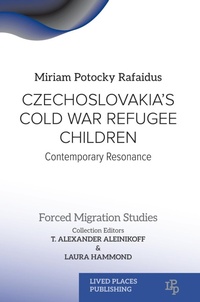
Czechoslovakia's Cold War Refugee Children
Description

What can the lived experiences of Czechoslovak Cold War refugee children tell us about the lifetime impact of childhood forced migration?
This is the story of author Miriam Potocky Rafaidus and more than thirty other Czechoslovak Cold War refugee children. Miriam shares her lived experience, as well as archival oral histories, to ultimately answer the question: does anyone ever stop being a refugee?
These testimonies from some of the earliest and youngest refugees in contemporary history will illuminate an underexamined group and explore what lessons can be learned applying to refugee children and youth of today and tomorrow.
Engaging with themes such as memory, trauma, and ethnic identity, this book is ideal reading for students of Forced Migration and Refugee Studies, Ethnic Studies, Gerontology, Contemporary History, Immigration History, Developmental Psychology, Exile Studies, Anthropology, and Sociology.
More details
Other editions
Additional editions
Person
Miriam Potocky PhD is a researcher at the International Rescue Committee. She was previously a tenured professor of social work for 25 years.
Content
- Front Cover
- Half-Title
- Title Page
- Copyright Information
- Dedication
- Epigraph
- Abstract
- Acknowledgments
- Table of Contents
- Learning objectives
- Foreword
- 1 A childhood disrupted: A journey through forced migration and identity
- Childhood forced migration and human development
- The Cold War and Czechoslovakia
- Czechoslovak forced migration during the Cold War
- Summary and conclusions
- 2 Echoes of home: Childhood memories before displacement
- Introduction
- Early childhood
- War
- Social class
- Communist ideology
- 1968 invasion
- Summary and conclusions
- 3 Crossing borders: The journey of displacement
- Introduction
- Departure
- Border crossing
- Transit
- Transatlantic passage
- Arrival
- Summary and conclusions
- 4 Czechlish: Growing up bilingual and bicultural
- Introduction
- What's in a name?
- Home life and ethnic communities
- Economic struggles
- Parentification
- Initial adjustment to environment and school
- Summary and conclusions
- 5 Inherited shadows: Historical trauma
- Introduction
- My father
- My mother
- Others' mothers and fathers
- Discovery and identity
- Intergenerational trauma and the legacy of silence
- Survival and guilt
- Impact of loss and the burden of history
- Communist trauma?
- Summary and conclusions
- 6 Returned Czechs: Retracing roots
- Introduction
- Return journeys
- Navigating bicultural identity
- Prague Spring and Soviet invasion
- Velvet revolution
- Preserving heritage
- Confronting trauma and finding peace
- Gratitudes and regrets
- Summary and conclusions
- 7 Am I still a refugee?: The lifelong journey
- Recommended assignments
- References
- Czech out these movies
- Participant biographies
- Index
