

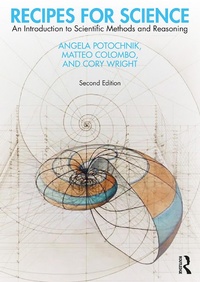
Recipes for Science
An Introduction to Scientific Methods and Reasoning
2nd Edition
Published on 22. April 2024
378 pages
978-1-000-99535-0 (ISBN)
Description

Scientific literacy is an essential aspect of any undergraduate education. Recipes for Science responds to this need by providing an accessible introduction to the nature of science and scientific methods appropriate for any beginning college student. The book is adaptable to a wide variety of different courses, such as introductions to scientific reasoning, methods courses in scientific disciplines, science education, and philosophy of science.
Special features of Recipes for Science include contemporary and historical case studies from many fields of physical, life, and social sciences; visual aids to clarify and illustrate ideas; text boxes to explore related topics; plenty of exercises to support student recall and application of concepts; suggestions for further readings at the end of each chapter; a glossary with helpful definitions of key terms; and a companion website with course syllabi, internet resources, PowerPoint presentations, lecture notes, additional exercises, and original short videos on key topics.
Key Updates to the Second Edition
13 short chapters of uniform length that make it easier to adapt to a college semester
Case studies and examples featuring new research and important historical research across many fields of science
Added discussion of timely topics, including large research collaborations, trust and distrust of science, machine learning and other technology-driven advances, diversity in science, and connections to indigenous knowledge
Streamlined and simplified discussion of some topics, such as experimentation and statistical hypothesis-testing
Exercises that are clearly aligned with learning goals and sorted into types: Recall, Apply, and Think
Additional online exercises and a series of original videos on key topics
Exercise solutions available on an instructor-only section of the website
Special features of Recipes for Science include contemporary and historical case studies from many fields of physical, life, and social sciences; visual aids to clarify and illustrate ideas; text boxes to explore related topics; plenty of exercises to support student recall and application of concepts; suggestions for further readings at the end of each chapter; a glossary with helpful definitions of key terms; and a companion website with course syllabi, internet resources, PowerPoint presentations, lecture notes, additional exercises, and original short videos on key topics.
Key Updates to the Second Edition
13 short chapters of uniform length that make it easier to adapt to a college semester
Case studies and examples featuring new research and important historical research across many fields of science
Added discussion of timely topics, including large research collaborations, trust and distrust of science, machine learning and other technology-driven advances, diversity in science, and connections to indigenous knowledge
Streamlined and simplified discussion of some topics, such as experimentation and statistical hypothesis-testing
Exercises that are clearly aligned with learning goals and sorted into types: Recall, Apply, and Think
Additional online exercises and a series of original videos on key topics
Exercise solutions available on an instructor-only section of the website
Reviews / Votes
Praise for the Second Edition:"Everyone should learn scientific thinking -the courage to know. This wonderful book paves the way and inspires a love for science with the help of stimulating examples and helpful exercises. A treasure for a better world in which people long for facts and objective arguments." -- Gerd Gigerenzer, Max Planck Institute for Human Development, Berlin, Germany
More details
Edition
2nd edition
Language
English
Place of publication
London
United Kingdom
Publishing group
Taylor & Francis Ltd
Target group
College/higher education
Illustrations
62 Line drawings, black and white; 21 Halftones, black and white; 83 Illustrations, black and white
ISBN-13
978-1-000-99535-0 (9781000995350)
Copyright in bibliographic data and cover images is held by Nielsen Book Services Limited or by the publishers or by their respective licensors: all rights reserved.
Schweitzer Classification
Other editions
Additional editions
Angela Potochnik | Matteo Colombo | Cory Wright
Recipes for Science
An Introduction to Scientific Methods and Reasoning
Book
04/2024
2nd Edition
Routledge
€57.00
Shipment within 10-20 days
Angela Potochnik | Matteo Colombo | Cory Wright
Recipes for Science
An Introduction to Scientific Methods and Reasoning
Book
04/2024
2nd Edition
Routledge
€260.41
Shipment within 10-20 days
Persons
Angela Potochnik is Professor of Philosophy and Founding Director of the Center for Public Engagement with Science at the University of Cincinnati, USA.
Matteo Colombo is Associate Professor in the Department of Philosophy at Tilburg University in the Netherlands.
Cory Wright is Professor of Philosophy at California State University Long Beach, USA.
Matteo Colombo is Associate Professor in the Department of Philosophy at Tilburg University in the Netherlands.
Cory Wright is Professor of Philosophy at California State University Long Beach, USA.
Content
Introduction Chapter 1 What Is Science and Why Does It Matter? -- based on 1.1 and 1.2 Chapter 2 The Aims of Science -- based on 1.3 and values discussion in Ch. 8, with more emphasis on the breadth of scientific aims and the diversity of recipes [include discussion of norms of inquiry + explanation from 8.1 + bias/misconduct? Chapter 3 Experiment -- based on 2.1 and 2.2; including examples of large collaborative experiments, experimenters' regress, and experimenting with living entities Chapter 4 Non-Experimental Methods -- based in part on 2.3; observational research, qualitative research, big data, any other variation from experiment Chapter 5 Modeling -- based on Ch. 3; examples of trade-offs and multiple models for same target Chapter 6 Deductive Reasoning -- based on 4.1 and 4.2; streamlined, eliminating System 1 vs 2 discussion Chapter 7 Inductive and Abductive Reasoning -- based on 4.3 Chapter 8 Probabilistic Reasoning -- based on 5.1 and 5.2; add discussion of different interpretations of probability Chapter 9 Descriptive Statistics -- based on 5.3; add discussion of communication of risk Chapter 10 Inferential Statistics -- based on Ch. 6, streamlined and focused more on basic applicable concepts Chapter 11 Causal Reasoning -- based on Ch. 7 Chapter 12 Explanations and Theories -- based on 8.1 and some of 8.2; adding discussion of reduction Chapter 13 Scientific Change -- based on some of 8.2 and 8.3, theory change and realism; new methods in science; current challenges for science Chapter 14 Science and Society - based on diversity in science and values discussions in Ch. 8, include more content about science's role in society, funding sources, participatory research Glossary
