

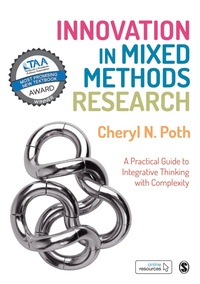
Innovation in Mixed Methods Research
A Practical Guide to Integrative Thinking with Complexity
1st Edition
Published on 15. October 2018
384 pages
978-1-5264-5371-6 (ISBN)
Description

Explaining both why and how to use mixed methods for discovering solutions to complex research problems, this guide gives readers the tools to adapt approaches to suit their own research conditions. Written in a warm, encouraging tone and packed with helpful diagrams and visual organizers, it provides an easy-to-follow map to the mixed methods process, covering everything from 'what is mixed methods research?' to framing, integrating, and describing a complexity-sensitive mixed methods approach.
Features include:
Key questions to navigate the important concepts of each chapter
Practice alerts to provide practical tips on working in the field
Chapter check-ins to assess development of key skills
Further reading to expand and deepen knowledge of mixed methods practices
An annotated glossary to get to grips with foundational terms and revise for exams
Supported throughout by real-world examples and advice from the author and other mixed methods experts, this book helps readers succeed in their projects and think innovatively about the methods they use.
Features include:
Key questions to navigate the important concepts of each chapter
Practice alerts to provide practical tips on working in the field
Chapter check-ins to assess development of key skills
Further reading to expand and deepen knowledge of mixed methods practices
An annotated glossary to get to grips with foundational terms and revise for exams
Supported throughout by real-world examples and advice from the author and other mixed methods experts, this book helps readers succeed in their projects and think innovatively about the methods they use.
Reviews / Votes
Big data and increasingly sophisticated research challenges mean that we can no longer rely on 'off the shelf' methodologies. This book is essential reading for anyone engaging in mixed methods work, offering a positive call to action and essential guidance. -- Lorraine Sheridan Cogent, practical, and based on extensive experience-this book will be especially useful to researchers navigating the space between the ideal research designs they were taught and the realities on the ground. -- Arden M. Morris Poth's framing of complex mixed methods problems reflects the importance of visualising and mapping out complex situations in research. This book acts as a particularly useful tool for developing this key skill as a mixed method researcher. -- Rebecca Johnson Professor Poth's new book takes the reader on a journey of discovery into the world of mixed methods. This easy to read resource provides the nuances required to undertake good mixed methods studies. The book is a must-have for novice and seasoned researchers alike. -- Vanessa Scherman Dr. Poth provides a helpful balance of theoretical and practical guidance for new scholars seeking to pursue mixed methods research. Her book, which provides concrete examples illustrating the steps involved in navigating complex research projects, is an invaluable resource for students. -- Btissam El Hassar Balancing theory, her experiences, and diverse examples spanning social sciences, Dr. Poth simultaneously initiates readers to mixed methods and explores design complexities that will illuminate many emerging and established scholars. Her accessible, thorough, well-paced text accounts for what, why, and how. Eschewing prescription, she welcomes adaptation in mixed methods research. -- Michael A. Thier Mixed methods research is well established in the literature yet there exists much diversity across many areas and a lack of consensus within the field... This textbook provides a comprehensive introduction into the field. -- Journal of Consumer Policy This book is a good guide for anyone doing complex, multi-phase research, where there are interlinking social and institutional uncertainties and imperfect knowledge about their nature and solutions[...]
Poth describes six adaptive practices to help researchers respond to unfolding conditions in complex social research. She says that the traditional mixed methods approach is limiting and that we need to be more flexible when research is complex, multi-layered and when there are many uncertainties. -- Imogen Birch * SRA Research Matters *
More details
Edition
1. Auflage
Language
English
Place of publication
London
United Kingdom
Target group
College/higher education
Product notice
Reflowable
File size
8,80 MB
ISBN-13
978-1-5264-5371-6 (9781526453716)
Copyright in bibliographic data and cover images is held by Nielsen Book Services Limited or by the publishers or by their respective licensors: all rights reserved.
Schweitzer Classification
Other editions
Additional editions
Cheryl N. Poth
Innovation in Mixed Methods Research
A Practical Guide to Integrative Thinking with Complexity
Book
11/2018
1st Edition
SAGE Publications Ltd
€84.50
Shipment within 15-20 days
Cheryl N. Poth
Innovation in Mixed Methods Research
A Practical Guide to Integrative Thinking with Complexity
Book
11/2018
1st Edition
SAGE Publications Ltd
€168.10
Shipment within 15-20 days
Person
Cheryl N. Poth, PhD, is a Professor in the Faculty of Education and faculty member of the
research-intensive Centre for Research and Applied Measurement and Evaluation at the
University of Alberta. In this role, she has developed and taught graduate-level research methods
and program evaluation courses in addition to supervising and mentoring students, faculty,
and local as well as global community members in qualitative, quantitative, and mixed methods
research. She is the author of over 50 peer-reviewed journal articles, three books as well as
numerous book chapters. Her work has been recognized by the American Educational Research
Association with the Division D Significant Contributions to Research Methodology Award
in 2023 (with Peggy Shannon-Baker) and by the Textbook & Academic Authors Association
with the Most Promising New Textbook Award in 2020 and the McGuffey Longevity Award
for Qualitative Research book in 2018 (with John Creswell). She served as Editor of the SAGE
Handbook of Mixed Methods Research (2023) and as Guest Coeditor of several journal special
issues, including the International Journal of Qualitative Methods. In addition to more than
40 invited talks and 150 conference presentations, she has led research methods workshops
with diverse audiences on four continents. She served as an Advisory Board Member of the
International Institute of Qualitative Methodology (2014-2020); the President of the Mixed
Methods International Research Association (2017-2018); a Research Fellow at the University
of South Africa (2018-2020); a Helen Glass Scholar in the College of Nursing within the Rady
Faculty of Health Sciences at the University of Manitoba (2022); and as a MERIT Visiting
Professor in the Faculty of Health Sciences at McMaster University (2023-2025). In 2009, she
cofounded the interdisciplinary Alberta Clinical and Community-Based Evaluation Research
Team to advance innovative community-university research partnership supports for program
planning and impact assessments of service delivery for individuals with complex needs. She
serves as the Methodologist on several cross-disciplinary research teams and has led federally,
provincially, and locally funded research projects. She is an Associate Editor of the Journal of
Mixed Methods Research and is an editorial board member of several journals. Updates on her
work can be found on her website at https://sites.google.com/ualberta.ca/cheryl-poth/.
research-intensive Centre for Research and Applied Measurement and Evaluation at the
University of Alberta. In this role, she has developed and taught graduate-level research methods
and program evaluation courses in addition to supervising and mentoring students, faculty,
and local as well as global community members in qualitative, quantitative, and mixed methods
research. She is the author of over 50 peer-reviewed journal articles, three books as well as
numerous book chapters. Her work has been recognized by the American Educational Research
Association with the Division D Significant Contributions to Research Methodology Award
in 2023 (with Peggy Shannon-Baker) and by the Textbook & Academic Authors Association
with the Most Promising New Textbook Award in 2020 and the McGuffey Longevity Award
for Qualitative Research book in 2018 (with John Creswell). She served as Editor of the SAGE
Handbook of Mixed Methods Research (2023) and as Guest Coeditor of several journal special
issues, including the International Journal of Qualitative Methods. In addition to more than
40 invited talks and 150 conference presentations, she has led research methods workshops
with diverse audiences on four continents. She served as an Advisory Board Member of the
International Institute of Qualitative Methodology (2014-2020); the President of the Mixed
Methods International Research Association (2017-2018); a Research Fellow at the University
of South Africa (2018-2020); a Helen Glass Scholar in the College of Nursing within the Rady
Faculty of Health Sciences at the University of Manitoba (2022); and as a MERIT Visiting
Professor in the Faculty of Health Sciences at McMaster University (2023-2025). In 2009, she
cofounded the interdisciplinary Alberta Clinical and Community-Based Evaluation Research
Team to advance innovative community-university research partnership supports for program
planning and impact assessments of service delivery for individuals with complex needs. She
serves as the Methodologist on several cross-disciplinary research teams and has led federally,
provincially, and locally funded research projects. She is an Associate Editor of the Journal of
Mixed Methods Research and is an editorial board member of several journals. Updates on her
work can be found on her website at https://sites.google.com/ualberta.ca/cheryl-poth/.
Content
Part I: Getting Started with Essential Foundations
Chapter 1: Embracing Complexity in Mixed Methods Research
Purpose and Need for the Book
Positioning Myself
Defining Conditions of Complexity and Innovations for Practice
Audiences for the Book
Organization and Learning Features
Selection of Six Featured Mixed Methods Studies
Chapter 2: Positioning Demand for Innovation in Complex Mixed Methods Research
Why Use Mixed Methods Research?
What Distinguishes Mixed Methods Research?
Key Practice Dilemmas Under Highly Complex Conditions
Demand for Innovations and Innovators in Mixed Methods Research
Survey of Six Featured Mixed Methods Studies
Chapter 3: Advancing Integrative Thinking with Complexity in Mixed Methods Research
Why Integrative Thinking with Complexity in Mixed Methods Research?
Examples of Complex Adaptive Systems Under Study
Opportunities Afforded by Complexity Science for Mixed Methods Researchers
Indicators of Integrative Thinking with Complexity in Mixed Methods Research
Indicators of Six Featured Mixed Methods Studies
Guiding Practices for Integrative Thinking with Complexity in Mixed Methods Research
Part II: Realizing Innovation in Guiding Practices
Chapter 4: Diagnosing Complexity of Mixed Methods Research Conditions
Why Diagnose Complexity of Mixed Methods Research Conditions?
Diagnosing Opportunities and Hazards for Mixed Methods Researchers
Guiding Procedures for Diagnosing Five Complexity Dimensions of Research Conditions
Features that Engage Readers with Research Conditions
Innovations in Diagnosing Complexity of Mixed Methods Research Conditions
Chapter 5: Framing Intentions of Complex Mixed Methods Research Problems
Why Frame Intentions of Complex Mixed Methods Research Problems?
Framing Opportunities and Hazards for Mixed Methods Researchers
An Iterative Process for Framing Complex Mixed Methods Research Problems
Features that Engage Readers with Complex Research Problems
Innovations in Framing Complex Mixed Methods Research Problems
Chapter 6: Defining Systems of Complex Mixed Methods Research Contexts
Why Define Systems of Complex Mixed Methods Research Contexts?
Defining Opportunities and Hazards for Mixed Methods Researchers
Relational Systems Approach to Defining Complex Mixed Methods Research Contexts
Features that Engage Readers with Complex Research Contexts
Innovations in Defining Complex Mixed Methods Research Contexts
Chapter 7: Describing Designs of Complex Mixed Methods Research Integrations
Why Describe Designs of Complex Mixed Methods Research Integrations?
Describing Opportunities and Hazards for Mixed Methods Researchers
A Descriptive Design Approach for Complex Mixed Methods Research Integrations
Features that Engage Readers with Complex Mixed Methods Research Integrations
Innovations in Describing Complex Mixed Methods Research Integrations
Chapter 8: Developing Capacity for Complex Mixed Methods Research Interactions
Why Develop Capacity in Complex Mixed Methods Research Interactions?
Developing Opportunities and Hazards for Mixed Methods Researchers
A Strategy for Developing Complex Mixed Methods Research Interactions
Features that Engage Readers with Complex Mixed Methods Research Interactions
Innovations in Developing Complex Mixed Methods Research Interactions
Chapter 9: Generating Evidence of Complex Mixed Methods Research Outcomes
Why Generate Evidence of Complex Mixed Methods Research Outcomes?
Generating Opportunities and Hazards for Mixed Methods Researchers
A Generative Evidence Approach for Complex Mixed Methods Research Outcome
Features that Engage Readers with Complex Mixed Methods Research Outcomes
Innovations in Generating Evidence of Complex Mixed Methods Research Outcomes
Part III: Onward Considerations for Adaptive Practices
Chapter 10: Realizing Complexity-Sensitive Mixed Methods Research
The Case for Complexity-Sensitive Mixed Methods Research
Potential Challenges for Complexity-Sensitive Mixed Methods Researchers
Some Final Guiding Words
Chapter 1: Embracing Complexity in Mixed Methods Research
Purpose and Need for the Book
Positioning Myself
Defining Conditions of Complexity and Innovations for Practice
Audiences for the Book
Organization and Learning Features
Selection of Six Featured Mixed Methods Studies
Chapter 2: Positioning Demand for Innovation in Complex Mixed Methods Research
Why Use Mixed Methods Research?
What Distinguishes Mixed Methods Research?
Key Practice Dilemmas Under Highly Complex Conditions
Demand for Innovations and Innovators in Mixed Methods Research
Survey of Six Featured Mixed Methods Studies
Chapter 3: Advancing Integrative Thinking with Complexity in Mixed Methods Research
Why Integrative Thinking with Complexity in Mixed Methods Research?
Examples of Complex Adaptive Systems Under Study
Opportunities Afforded by Complexity Science for Mixed Methods Researchers
Indicators of Integrative Thinking with Complexity in Mixed Methods Research
Indicators of Six Featured Mixed Methods Studies
Guiding Practices for Integrative Thinking with Complexity in Mixed Methods Research
Part II: Realizing Innovation in Guiding Practices
Chapter 4: Diagnosing Complexity of Mixed Methods Research Conditions
Why Diagnose Complexity of Mixed Methods Research Conditions?
Diagnosing Opportunities and Hazards for Mixed Methods Researchers
Guiding Procedures for Diagnosing Five Complexity Dimensions of Research Conditions
Features that Engage Readers with Research Conditions
Innovations in Diagnosing Complexity of Mixed Methods Research Conditions
Chapter 5: Framing Intentions of Complex Mixed Methods Research Problems
Why Frame Intentions of Complex Mixed Methods Research Problems?
Framing Opportunities and Hazards for Mixed Methods Researchers
An Iterative Process for Framing Complex Mixed Methods Research Problems
Features that Engage Readers with Complex Research Problems
Innovations in Framing Complex Mixed Methods Research Problems
Chapter 6: Defining Systems of Complex Mixed Methods Research Contexts
Why Define Systems of Complex Mixed Methods Research Contexts?
Defining Opportunities and Hazards for Mixed Methods Researchers
Relational Systems Approach to Defining Complex Mixed Methods Research Contexts
Features that Engage Readers with Complex Research Contexts
Innovations in Defining Complex Mixed Methods Research Contexts
Chapter 7: Describing Designs of Complex Mixed Methods Research Integrations
Why Describe Designs of Complex Mixed Methods Research Integrations?
Describing Opportunities and Hazards for Mixed Methods Researchers
A Descriptive Design Approach for Complex Mixed Methods Research Integrations
Features that Engage Readers with Complex Mixed Methods Research Integrations
Innovations in Describing Complex Mixed Methods Research Integrations
Chapter 8: Developing Capacity for Complex Mixed Methods Research Interactions
Why Develop Capacity in Complex Mixed Methods Research Interactions?
Developing Opportunities and Hazards for Mixed Methods Researchers
A Strategy for Developing Complex Mixed Methods Research Interactions
Features that Engage Readers with Complex Mixed Methods Research Interactions
Innovations in Developing Complex Mixed Methods Research Interactions
Chapter 9: Generating Evidence of Complex Mixed Methods Research Outcomes
Why Generate Evidence of Complex Mixed Methods Research Outcomes?
Generating Opportunities and Hazards for Mixed Methods Researchers
A Generative Evidence Approach for Complex Mixed Methods Research Outcome
Features that Engage Readers with Complex Mixed Methods Research Outcomes
Innovations in Generating Evidence of Complex Mixed Methods Research Outcomes
Part III: Onward Considerations for Adaptive Practices
Chapter 10: Realizing Complexity-Sensitive Mixed Methods Research
The Case for Complexity-Sensitive Mixed Methods Research
Potential Challenges for Complexity-Sensitive Mixed Methods Researchers
Some Final Guiding Words
