

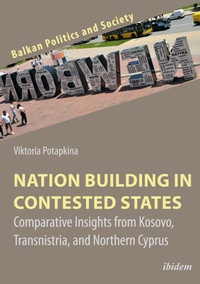
Nation Building in Contested States
Comparative Insights from Kosovo, Transnistria, and Northern Cyprus
Published on 22. April 2020
344 pages
978-3-8382-7381-5 (ISBN)
Description

This study provides an overview of current nation building processes in contested states. With a specific focus on the Turkish Republic of Northern Cyprus, Pridnestrovian Moldavian Republic, and Kosovo, original data is presented, collected in English in a single work for the first time. Viktoria Potapkina presents an analysis and comparison of contested states from an internal perspective, looking at the processes that help legitimize such entities from within and creating support for their ongoing existence.
The work strives to fill a gap in the literature on contested states, as well as to contribute to the overall understanding of nation and state building, state formation, and sovereignty. It provides a new way of looking at the puzzle that contested states are, offering insight into why they still exist in their current forms.
The work strives to fill a gap in the literature on contested states, as well as to contribute to the overall understanding of nation and state building, state formation, and sovereignty. It provides a new way of looking at the puzzle that contested states are, offering insight into why they still exist in their current forms.
More details
Series
Edition
New edition
Language
English
Place of publication
Berlin
Germany
Target group
Professional and scholarly
Edition type
New edition
Illustrations
Illustrations
File size
3,53 MB
ISBN-13
978-3-8382-7381-5 (9783838273815)
Copyright in bibliographic data and cover images is held by Nielsen Book Services Limited or by the publishers or by their respective licensors: all rights reserved.
Schweitzer Classification
Other editions
Additional editions
Viktoria Potapkina
Nation Building in Contested States
Comparative Insights from Kosovo, Transnistria, and Northern Cyprus
Book
04/2020
ibidem
€39.90
Shipment within 10-15 days
Persons
Content
- Intro
- Acknowledgments
- Contents
- List of Maps
- 1. Introduction
- Placing the Work in Context
- The State & State Formation
- State Building
- Sovereignty, Recognition and Contested States
- Self-Determination
- Nations and Nationalism
- Nation Building
- National Symbols
- The National Myth
- Applying Existing Theory
- 2. Mapping Out Contested States
- General Overview
- Case Selection
- Conclusion
- 3. Case Study 1: Turkish Republic of Northern Cyprus
- Historical Outline: Cyprus, "the Cyprus Problem" and TRNC
- The Creation of a "Usable Past" The Creation of a "Usable Past"
- Perceptions of History and History Books
- National Holidays
- A Political Culture Based on the "Usable Past"
- Flag, Coat of Arms, Anthem and Currency
- Passports and Visas
- Transformation of Cultural Landscapes and Public Spaces
- The Creation of Institutions and Traditions
- Museums
- Representation Abroad and Contact with Other States
- Civil Society
- Conclusion
- 4. Case Study 2: Pridnestrovian Moldavian Republic
- Historical Outline: the Region of Transnistria
- The Creation of a "Usable Past"
- Perceptions of History and History Books
- National Holidays
- A Political Culture Based on the "Usable Past"
- Flag, Coat of Arms, Anthem and Currency
- Passports and Visas
- Transformation of Cultural Landscapes and Public Spaces
- The Creation of Institutions and Traditions
- Museums
- Representation Abroad and Contact with Other States
- Civil Society
- Conclusion
- 5. Case Study 3: Republic of Kosovo
- Historical Outline
- The Creation of a "Usable Past"
- Perceptions of History and History Books
- National Holidays
- A Political Culture Based on the Usable Past
- Flag, Coat of Arms, Anthem and Currency
- Passports & Visas
- Transformations of Cultural Landscapes & Public Spaces
- The Creation of Institutions and Traditions
- Museums
- Representation Abroad and Contact with Other States
- Civil Society
- Conclusion
- 6. Towards A Model Of Nation Building In Contested States: Comparison And Analysis
- A Political Culture Based on a "Usable Past"
- Historical Development
- Perceptions of History and History Books
- National Holidays
- National Symbols
- Currency
- Passports, Visas & Dual Citizenship
- The Creation of Institutions and Traditions
- Transformation of Cultural Landscapes and Public Spaces
- Museums
- Civil Society
- In Conclusion: A Look at the Final Scores
- 7. Conclusion
- Bibliography
- Appendices
