


Postphenomenological Methodologies
New Ways in Mediating Techno-Human Relationships
Lexington Books (Publisher)
1st Edition
Published on 15. August 2018
296 pages
978-1-4985-4524-2 (ISBN)
Description

This edited volume is the first publication to tackle the issue of researching human-technology relations from a methodological postphenomenological perspective. While the 'traditional' phenomenology of the 20th century, with figures like Husserl, Heidegger and Merleau-Ponty, provided valuable insights into the formal structures of essence, being and embodiment, etc. their mode of philosophizing mostly involved abstract 'pure' thinking. Although rooted in this tradition, the postphenomenological approach to the study of human-technology relations emphasizes the "empirical turn" and interdisciplinary work in the field of philosophy - and reaches out to other disciplines like anthropology, education, media studies, and science and technology studies (STS).
The contributors discuss what it means for the field of postphenomenology to be empirically based and what kind of methodology is required in order for researchers to go out and study human-technology relations in this perspective. In many disciplines, methodology refers to the analytical approach taken - e.g. the analytical concepts you employ to make an analysis; in postphenomenology, these might include concepts such as multistability, variation, or mediation. In a discipline like anthropology, it also refers to reflections over the methods researchers use to approach an empirical field. Methods can include interviews of different kinds, participant observations, surveys, and auto-ethnography. Furthermore, methodology can include ethical issues tied to doing research in an empirical field. These practical aspects are not separate from, but rather connected to, theoretical approaches. This book ties together the methods, ethics, and theories of postphenomenology in a groundbreaking volume on methodology. With postphenomenological studies of education, digital media, biohacking, health, robotics, and skateboarding as points of reference, the authors of this volume, in twelve chapters, provide new perspectives on what a comprehensive postphenomenological research methodology must consist of.
The contributors discuss what it means for the field of postphenomenology to be empirically based and what kind of methodology is required in order for researchers to go out and study human-technology relations in this perspective. In many disciplines, methodology refers to the analytical approach taken - e.g. the analytical concepts you employ to make an analysis; in postphenomenology, these might include concepts such as multistability, variation, or mediation. In a discipline like anthropology, it also refers to reflections over the methods researchers use to approach an empirical field. Methods can include interviews of different kinds, participant observations, surveys, and auto-ethnography. Furthermore, methodology can include ethical issues tied to doing research in an empirical field. These practical aspects are not separate from, but rather connected to, theoretical approaches. This book ties together the methods, ethics, and theories of postphenomenology in a groundbreaking volume on methodology. With postphenomenological studies of education, digital media, biohacking, health, robotics, and skateboarding as points of reference, the authors of this volume, in twelve chapters, provide new perspectives on what a comprehensive postphenomenological research methodology must consist of.
More details
Series
Edition
1. Auflage
Language
English
Place of publication
New York
United States
Publishing group
Bloomsbury Publishing Plc
Target group
Professional and scholarly
Illustrations
16 b/w illustrations;
ISBN-13
978-1-4985-4524-2 (9781498545242)
Copyright in bibliographic data and cover images is held by Nielsen Book Services Limited or by the publishers or by their respective licensors: all rights reserved.
Schweitzer Classification
Other editions
Additional editions
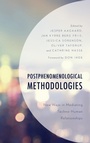
Jesper Aagaard | Jan Kyrre Berg Friis | Jessica Sorenson
Postphenomenological Methodologies
New Ways in Mediating Techno-Human Relationships
Book
08/2018
Lexington Books
€143.30
Shipment within 15-20 days
Persons
Jesper Aagaard is assistant professor in the Department of Psychology and Behavioral Sciences at Aarhus University.
Jan Kyrre Berg Friis is course manager of theory of science at Copenhagen University.
Jessica Sorenson is research assistant at the Future, Technology, Culture, and Learning program at Aarhus University.
Oliver Tafdrup is doctoral fellow at the Future, Technology, Culture, and Learning program at Aarhus University.
Cathrine Hasse is professor of cultural anthropology and learning at Aarhus University.
Jan Kyrre Berg Friis is course manager of theory of science at Copenhagen University.
Jessica Sorenson is research assistant at the Future, Technology, Culture, and Learning program at Aarhus University.
Oliver Tafdrup is doctoral fellow at the Future, Technology, Culture, and Learning program at Aarhus University.
Cathrine Hasse is professor of cultural anthropology and learning at Aarhus University.
Content
Foreword - Don Ihde
Introduction - Jesper Aagaard, Jan Kyrre Berg Friis, Oliver Tafdrup & Cathrine Hasse
Part I: Educational Technologies
Chapter 1: Doing Postphenomenology in Education - Catherine Adams and Joni Turville
Chapter 2: Inviting and Interacting: Postphenomenology and the Microsociology of Education - Tobias Röhl
Chapter 3: Entering the Portal: Media Technologies and Experiential Transportation - Jesper Aagaard
Part II: Self-Tracking & Imaging Technologies
Chapter 4: Human Technology Relationships in the Digital Age: The Collapse of Metaphore in Biohacking - Moa Petersén
Chapter 5: Service Interfaces in Human Technology Relations: A Case Study of Self-Tracking Technologies - Fernando Secomandi
Chapter 6: From Camera Obscura to fMRI: How Brain Imaging Technologies Mediate Free Will - Ciano Aydin
Part III: Robotic Technologies
Chapter 7: Paleoanthropology and Social Robotics: Old and New Ways in Mediating Alerity Relations - Michael Funk
Chapter 8: Lost in Tra
Introduction - Jesper Aagaard, Jan Kyrre Berg Friis, Oliver Tafdrup & Cathrine Hasse
Part I: Educational Technologies
Chapter 1: Doing Postphenomenology in Education - Catherine Adams and Joni Turville
Chapter 2: Inviting and Interacting: Postphenomenology and the Microsociology of Education - Tobias Röhl
Chapter 3: Entering the Portal: Media Technologies and Experiential Transportation - Jesper Aagaard
Part II: Self-Tracking & Imaging Technologies
Chapter 4: Human Technology Relationships in the Digital Age: The Collapse of Metaphore in Biohacking - Moa Petersén
Chapter 5: Service Interfaces in Human Technology Relations: A Case Study of Self-Tracking Technologies - Fernando Secomandi
Chapter 6: From Camera Obscura to fMRI: How Brain Imaging Technologies Mediate Free Will - Ciano Aydin
Part III: Robotic Technologies
Chapter 7: Paleoanthropology and Social Robotics: Old and New Ways in Mediating Alerity Relations - Michael Funk
Chapter 8: Lost in Tra
