

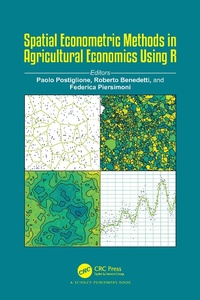
Spatial Econometric Methods in Agricultural Economics Using R
1st Edition
Published on 22. December 2021
286 pages
978-1-4987-6683-8 (ISBN)
Description

Modern tools, such as GIS and remote sensing, are increasingly used in the monitoring of agricultural resources. The developments in GIS technology offer growing opportunities to agricultural economics analysts dealing with large and detailed spatial databases, allowing them to combine spatial information from different sources and to produce different models. The availability of these valuable sources of information makes the advanced models suggested in the spatial statistic and econometric literature applicable to agricultural economics.
This book aims at supporting stakeholders to design spatial surveys for agricultural data and/or to analyse the geographically collected data.
This book attempts to describe the main typology of agricultural data and the most appropriate methods for the analysis, together with a detailed description of the available data sources and their collection methods. Topics such as spatial interpolation, point patterns, spatial autocorrelation, survey data analysis, small area estimation, regional data modelling, and spatial econometrics techniques are covered jointly with issues arising from the integration of several data types.
The theory of spatial methods is complemented by real and/or simulated examples implemented through the open-source software R.
This book aims at supporting stakeholders to design spatial surveys for agricultural data and/or to analyse the geographically collected data.
This book attempts to describe the main typology of agricultural data and the most appropriate methods for the analysis, together with a detailed description of the available data sources and their collection methods. Topics such as spatial interpolation, point patterns, spatial autocorrelation, survey data analysis, small area estimation, regional data modelling, and spatial econometrics techniques are covered jointly with issues arising from the integration of several data types.
The theory of spatial methods is complemented by real and/or simulated examples implemented through the open-source software R.
More details
Edition
1. Auflage
Language
English
Place of publication
London
United Kingdom
Publishing group
Taylor & Francis Ltd
Target group
College/higher education
Illustrations
9 Tables, black and white; 8 Illustrations, color; 35 Illustrations, black and white
ISBN-13
978-1-4987-6683-8 (9781498766838)
Copyright in bibliographic data and cover images is held by Nielsen Book Services Limited or by the publishers or by their respective licensors: all rights reserved.
Schweitzer Classification
Other editions
Additional editions
Paolo Postiglione | Roberto Benedetti | Federica Piersimoni
Spatial Econometric Methods in Agricultural Economics Using R
Book
02/2023
1st Edition
CRC Press
€88.90
Shipment within 10-20 days
Paolo Postiglione | Roberto Benedetti | Federica Piersimoni
Spatial Econometric Methods in Agricultural Economics Using R
Book
12/2021
1st Edition
CRC Press
€192.60
Shipment within 15-20 days
Persons
Paolo Postiglione is Professor in Economic Statistics at University of Chieti-Pescara (Italy). He received a Ph.D. in Statistics from the University of Chieti-Pescara in 1998. His research interests mainly concern regional quantitative analysis, spatial statistics and econometrics, spatial concentration, regional economic convergence, agricultural statistics, and spatial sampling.
Roberto Benedetti is Professor in Economic Statistics at University of Chieti-Pescara (Italy). He obtained a Ph.D. in Methodological Statistics in 1994 from "La Sapienza" University of Rome (Italy). His current research interests focus on agricultural statistics, sample design, small area estimation, and spatial data analysis.
Federica Piersimoni is Senior Researcher at Processes Design and Frames Service in the Methodological Department of the Italian National Statistical Institute, since 1996. Her main research interests concern disclosure control and sample design.
Roberto Benedetti is Professor in Economic Statistics at University of Chieti-Pescara (Italy). He obtained a Ph.D. in Methodological Statistics in 1994 from "La Sapienza" University of Rome (Italy). His current research interests focus on agricultural statistics, sample design, small area estimation, and spatial data analysis.
Federica Piersimoni is Senior Researcher at Processes Design and Frames Service in the Methodological Department of the Italian National Statistical Institute, since 1996. Her main research interests concern disclosure control and sample design.
Content
1. Basic Concepts 2. Spatial Sampling Designs 3. Including Spatial Information in Estimation from Complex Survey Data 4. Yield Prediction in Agriculture: A Comparison Between Regression Kriging and Random Forest 5. Land Cover/Use Analysis and Modelling 6. Statistical Systems in Agriculture 7. Exploring Spatial Point Patterns in Agriculture 8. Spatial Analysis of Farm Data 9. Spatial Econometric Modelling of Farm Data 10. Areal Interpolation Methods: The Bayesian Interpolation Method 11. Small Area Estimation of Agricultural Data 12. Cross-sectional Spatial Regression Models for Measuring Agricultural ?-convergence 13. Spatial Panel Regression Models in Agriculture
