

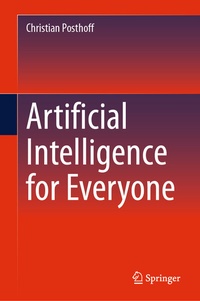
Artificial Intelligence for Everyone
Description

This book demystifies the topic of Artificial Intelligence for readers of varying backgrounds. The content should enable many people to discuss and follow ongoing developments in an informed way, to draw conclusions for their own life and workplace and to acquire the necessary new knowledge. The book strives to provide basic knowledge that will objectify the discussions and relieve some of the creepiness of utopian films. It must also be understood that research results are a necessary condition for progress; they are not sufficient until they can be translated into practice embedded in programs. This difficult relationship between theory and practice has been known for a long time.
More details
Other editions
Additional editions
Person
Christian Posthoff studied Mathematics at the University of Leipzig. From 1968 to 1972, he worked as a programmer and in the field of Operations Research; simultaneously, he did his Ph.D. in 1975 with the thesis "Application of Mathematical Methods in Communicative Psychotherapy". In 1972, he began working at the Department of Information Technology at the Chemnitz University of Technology; up to 1983, his research activities concentrated on logic design. Important results have been algorithms and programs for solving Boolean equations with a high number of variables and the Boolean Differential Calculus (a generalized differential and integral calculus for Boolean rings) for the analytical treatment of different problems in the field of logic design. These results have been collected in a monograph "Binary Dynamic Systems", and allowed the habilitation (Dr.-Ing. habil.) at the Faculty of Electrical Engineering in 1979 and the promotion to Associate Professor. In 1983, he was promoted to Full Professor of Computer Science in the Department of Computer Science at the same university, and since 1983, he was Head of the Institute of Theoretical Computer Science and Artificial Intelligence and Research Director of the Department of Computer Science. His research activities included the application of fuzzy logics for the modeling of human-like "thinking" methods, learning from examples, the construction of intelligent tutoring systems, the parallelization of inference mechanisms, systems of diagnosis and configuration. He received the Scientific Award of the Chemnitz University of Technology four times.
In 1994, he moved to the Chair of Computer Science at The University of The West Indies, St. Augustine, Trinidad & Tobago. From 1996 to 2002 he was Head of the Department of Mathematics & Computer Science. He mainly focused on the development of Computer Science education at the undergraduate and graduate levels to attain international standard. Twenty years later it can be said that these intentions were very successfully fulfilled. In 2001, he received the Vice-Chancellor's Award of Excellence. From 2010 - 2012 he spent two years at St. Georges University in Grenada with the same goals. Since his return to Germany (now retired) he devoted his efforts to the interdisciplinary research and education in several areas (Computer Science - Mathematics - Applications in different fields). He is the author or co-author of more than 25 books and many publications in journals and conference proceedings.
Content
Introduction.- How to define intelligence.- The Historical Development.- Mathematics on the Computer.- Polynomial and Exponential Complexity.- Game Theory Cybernetics and Information Theory.- Machine Learning and Neural Networks.- Other Applications.- Digitization.- Image processing.- Robotics.- Artificial Intelligence in Finance.- Artificial Intelligence and Education.- Artificial Intelligence in the Arts.- Artificial Intelligence in Law.- The Development in South and Central America and the Caribbean.- Future Developments.
