

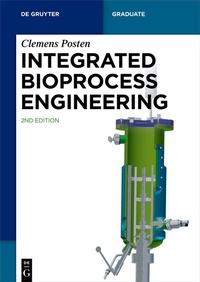
Integrated Bioprocess Engineering
Description

Bioprocess engineering employs microorganisms to produce biological products for medical and industrial applications. The book covers engineering tasks around- the cultivation process in bioreactors including media design, feeding strategies, or cell harvesting. All aspects are described from the conceptual considerations to technical realization and provide insight by detailed explanations, drawings, formulas, and example processes.
More details
Other editions
Additional editions
Person
Clemens Posten studied biology and electrical engineering in Bochum and Hannover (Germany) achieving two diploma degrees (1983). This choice was based on his passion for combining science and engineering. His doctoral thesis at the Institute of Automatic Control dealt with "modeling and automation of ethanol production using the anaerobic bacterium Zymomonas mobils". Incidentally, this topic has become topical again today. This not only allowed him to pursue his interests further, but also to immerse himself in online and offline computer applications in biotechnology, a new topic at the time.
He was able to acquire further knowledge in this direction through theoretical expertise during his post-doc at the "Institute for System Dynamics" in Hamburg and his work as head of the "Modeling and Automation" working group at the GBF in Braunschweig (1989-1995). During these activities he got to know numerous practical bioprocesses and maintained close contacts to industry until today. In fact, his extensive knowledge of bioprocess engineering dates back to this time.
Due to his numerous publications, he was appointed to the new professorship of "Bioprocess Engineering" (1995) in the faculty of process engineering. In teaching, he was entrusted with the international study course "Biotechnology" at the "École supérieure" in Strasbourg and as co-founder in the study course "Bioengineering" in Karlsruhe (today KIT). He pursued the communication of his knowledge and his great overview with the same passion as science. Many students chose his institute to write their theses.
During this time, numerous including industry-related projects (about 2 Mill ? last 5 years) were acquired and successfully carried out by his employees, including, of course, their own doctorates. The results are recorded in more than 200 peer-reviewed publications, 5 books, and 5 patents. Prof. Posten also became further known through his active memberships in scientific associations (IFAC, esbes, dechema, eaba) and editorial boards of highly ranked journals.
His scientific interests continue to focus on bioprocess engineering in the fields of particle biotechnology and photo-biotechnology. Design of photo-bioreactors, modelling, control, and optimization of photo-bioprocesses, interaction between reactor and cell physiology are practical spin-offs. Now he continues his career and his passion sharing his knowledge as co-founder of the consultant firm bio-compete.
Content
- Intro
- Preface to 2⊃&nd&/sup& ed - a small vote for this book
- Contents
- Chapter 1 Introduction - a thread through this book
- Chapter 2 Biosystems - microorganisms and other biocatalysts
- Chapter 3 Media - supplying microorganisms with a comfortable environment and building blocks for growth
- Chapter 4 Kinetics - finding quantities for bioprocess reactions
- Chapter 5 Bioreactors - designing a home for the bioreaction
- Chapter 6 Not always so simple - the batch process reconsidered
- Chapter 7 Little by little, one goes far - the fed-batch process
- Chapter 8 Bioseparation - the art of selectively directing particles and molecules
- Chapter 9 Continuously operating bioprocesses - production under steady-state conditions
- Chapter 10 Measuring principles - how to put an end to the blind flight
- Chapter 11 The practice of fermentation - a step-by-step guide through the workflow
- Chapter 12 Modeling - the art and handcraft of mathematically describing bioprocesses
- Acknowledgments - dedicated to all the people who supported me
- Copyrights - pictures provided with courtesy and accepted with thanks
- Index
