

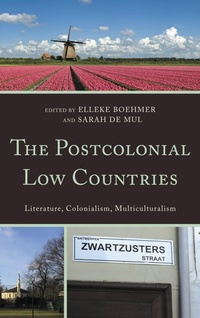
The Postcolonial Low Countries
Literature, Colonialism, and Multiculturalism
Lexington Books (Publisher)
1st Edition
Published on 1. June 2012
1 pages
979-8-8818-8577-9 (ISBN)
Description

The Postcolonial Low Countries is the first book to bring together critical and comparative approaches to the emergent field of neerlandophone postcolonial studies. The collection of essays ranges across the cultures and literatures of the Netherlands and Belgium and establishes an encounter between postcolonial theoretical discourses from both within and without the region. Each one of the contributions puts under pressure the definitive concepts of postcolonial studies in its more conventional anglophone or francophone formation, as well as perceptions of the Low Countries, Belgium and the Netherlands, as lying outside or to the side of the postcolonial domain.
In the Low Countries, local and regional issues concerning multiculturalism and colonial belatedness have raised important questions about the possible grounds on which postcolonial critical concepts might be not only translated but also generated afresh, to suit these paradoxically new contexts. As The Postcolonial Low Countries incisively demonstrates, the Low Countries demand a careful rearticulation of such postcolonial 'readymades' as hybridity, accommodation and creolization.
Gathering together contributions from both internationally renowned scholars and newly established researchers in the field, The Postcolonial Low Countries maps previously underexplored national and transnational literary critical trajectories. The book challenges in boundary shifting ways current readings of the so-described multicultural and postcolonial Netherlands and Belgium.
In the Low Countries, local and regional issues concerning multiculturalism and colonial belatedness have raised important questions about the possible grounds on which postcolonial critical concepts might be not only translated but also generated afresh, to suit these paradoxically new contexts. As The Postcolonial Low Countries incisively demonstrates, the Low Countries demand a careful rearticulation of such postcolonial 'readymades' as hybridity, accommodation and creolization.
Gathering together contributions from both internationally renowned scholars and newly established researchers in the field, The Postcolonial Low Countries maps previously underexplored national and transnational literary critical trajectories. The book challenges in boundary shifting ways current readings of the so-described multicultural and postcolonial Netherlands and Belgium.
More details
Edition
1. Auflage
Language
English
Place of publication
United States
Publishing group
Bloomsbury Publishing Plc
Target group
Professional and scholarly
ISBN-13
979-8-8818-8577-9 (9798881885779)
Copyright in bibliographic data and cover images is held by Nielsen Book Services Limited or by the publishers or by their respective licensors: all rights reserved.
Schweitzer Classification
Other editions
Additional editions
Elleke Boehmer | Sarah De Mul
The Postcolonial Low Countries
Literature, Colonialism, and Multiculturalism
Book
05/2012
Lexington Books
€138.30
Shipment within 10-20 days
Persons
Professor of World Literature in English at the University of Oxford, bilingual in Dutch and English, Elleke Boehmer is interested in the postcolonial debates that draw together Britain and the Netherlands. She is the author of four acclaimed novels, Screens again the Sky (short-listed David Hyam Prize, 1990), An Immaculate Figure (1993), Bloodlines (short-listed SANLAM award, 2000), and Nile Baby (2008), as well as the short-story collection Sharmilla and Other Portraits (2010). Her other books include Colonial and Postcolonial Literature (1995, 2005), Empire, the National and the Postcolonial, 1890-1920 (2002), Stories of Women (2005), and the biography Nelson Mandela (2008). She edited Robert Baden-Powell's Scouting for Boys (2004), and the anthology Empire Writing (1998), and co-edited JM Coetzee in Writing and Theory (2009), Terror and the Postcolonial (2009), and The Indian Postcolonial (2010). She is currently working on a memoir fiction part set in the Netherlands.
Sarah De Mul received her PhD at the University of Amsterdam and previously held a NWO Rubicon fellowship at the University of Leiden. She is currently FWO-Postdoctoral Fellow at K. U. Leuven University and Lecturer at the Open University the Netherlands. De Mul wrote a study of colonialism and memory in contemporary women's travel writing (Colonial Memory, Amsterdam University Press, 2011) and a Dutch-languagemonograph on multiculturalism in Flanders Een leeuw in een kooi. (Meulenhoff-Manteau, 2009, together with K. Arnhaut, S. Bracke, B. Ceuppens, N. Fadil; M. Kanmaz). She is co-editor of Commitment and Complicity in Cultural Theory and Practice (Palgrave Macmillan, 2009, with B. O. Firat and S. van Wichelen) and Literature, Language, and Multiculturalism in Scandinavia and the Low Countries (Amsterdam/New York: Rodopi, 2012, with W. Behschnitt and L. Minnaard). Her publications and research interests are situated in the field of comparative postcolonial studies with a particular focus on literatures in Dutch and English. Her current projects explore postcolonialism and transnationalism in the Low Countries, migrant writing in Flanders and European (colonial) writing about Africa/the Congo during the fin de siècle.
Sarah De Mul received her PhD at the University of Amsterdam and previously held a NWO Rubicon fellowship at the University of Leiden. She is currently FWO-Postdoctoral Fellow at K. U. Leuven University and Lecturer at the Open University the Netherlands. De Mul wrote a study of colonialism and memory in contemporary women's travel writing (Colonial Memory, Amsterdam University Press, 2011) and a Dutch-languagemonograph on multiculturalism in Flanders Een leeuw in een kooi. (Meulenhoff-Manteau, 2009, together with K. Arnhaut, S. Bracke, B. Ceuppens, N. Fadil; M. Kanmaz). She is co-editor of Commitment and Complicity in Cultural Theory and Practice (Palgrave Macmillan, 2009, with B. O. Firat and S. van Wichelen) and Literature, Language, and Multiculturalism in Scandinavia and the Low Countries (Amsterdam/New York: Rodopi, 2012, with W. Behschnitt and L. Minnaard). Her publications and research interests are situated in the field of comparative postcolonial studies with a particular focus on literatures in Dutch and English. Her current projects explore postcolonialism and transnationalism in the Low Countries, migrant writing in Flanders and European (colonial) writing about Africa/the Congo during the fin de siècle.
Content
Chapter 1. Introduction: Postcolonialism and the Low Countries, Elleke Boehmer and Sarah De Mul
Part 1: Towards a Neerlandophone Postcolonial Studies
Chapter 2. Postcolonial Studies in the context of the 'diasporic' Netherlands, Elleke Boehmer and Frances Gouda
Chapter 3. Polderpoko: why it cannot exist, Isabel Hoving
Chapter 4. The "Ends" of Postcolonialism, Theo D'haen
Chapter 5. "Is the headscarf oppressive or emancipatory?" Field notes on the gendrification of the 'multicultural debate', Sarah Bracke and Nadia Fadil
Part 2: Postcolonial Memory
Chapter 6. (Un)happy Endings: Nostalgia in post-imperial and postmemory Dutch films, Pamela Pattynama
Chapter 7. Transnational Contact-Narratives: Dutch Post-Coloniality from a Turkish-German Viewpoint, Liesbeth Minnaard
Chapter 8. Representing post-apartheid South Africa: mothers, motherlands and mother tongues in the work of selected Afrikaans women writers, Louise Viljoen
Chapter 9. The Holocaust as a Paradigm for the Congo Atrocities: Adam Hochschil
Part 1: Towards a Neerlandophone Postcolonial Studies
Chapter 2. Postcolonial Studies in the context of the 'diasporic' Netherlands, Elleke Boehmer and Frances Gouda
Chapter 3. Polderpoko: why it cannot exist, Isabel Hoving
Chapter 4. The "Ends" of Postcolonialism, Theo D'haen
Chapter 5. "Is the headscarf oppressive or emancipatory?" Field notes on the gendrification of the 'multicultural debate', Sarah Bracke and Nadia Fadil
Part 2: Postcolonial Memory
Chapter 6. (Un)happy Endings: Nostalgia in post-imperial and postmemory Dutch films, Pamela Pattynama
Chapter 7. Transnational Contact-Narratives: Dutch Post-Coloniality from a Turkish-German Viewpoint, Liesbeth Minnaard
Chapter 8. Representing post-apartheid South Africa: mothers, motherlands and mother tongues in the work of selected Afrikaans women writers, Louise Viljoen
Chapter 9. The Holocaust as a Paradigm for the Congo Atrocities: Adam Hochschil
