

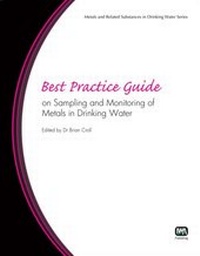
Best Practice Guide on Sampling and Monitoring of Metals in Drinking Water
1st Edition
Published on 15. January 2012
156 pages
978-1-78040-079-2 (ISBN)
Description

Part of Metals and Related Substances in Drinking Water Set - buy all five books together to save over 30%!
There is increasing concern regarding the presence of metals, particularly heavy metals in drinking water. In addition to the well-known toxic effects of lead, which are discussed at length in the Best Practice Guide on the Control of Lead in Drinking Water (in this series of Guides), the latest WHO guide values for maximum mean concentrations of arsenic, nickel and others in drinking water have been lowered compared to previous versions. European Union, USA and National standards for drinking water have followed the trend based largely on the same toxicological information.
There is currently growing interest in the presence of hexavalent chromium in drinking water following its finding in some drinking waters in the USA above the national upper limit for total chromium and research suggesting that this limit needs to be considerably lowered. Some metals, particularly iron and manganese are associated with the production of discoloured (dirty) water in distribution systems and are therefore very important to the production of water with acceptable aesthetic qualities. Others (iron and aluminium) are key to the treatment of raw waters to drinking water standards. In most cases it is not possible to continuously monitor waters for metals and suitable sampling programmes must be designed and carried out to give results representative of the true water quality.
The Best Practice Guide on Sampling and Monitoring of Metals in Drinking Water gives guidance on the design and quality control of sampling programmes for metals in Raw waters, in the water treatment works, in the drinking water distribution system and at the consumers tap. It also gives guidance on the analytical methods that can be used for the analysis of metals and quality control of those methods. Sampling programmes on the same water will vary according to the purpose for which they are carried out and the statistical techniques used to determine and design the different types of programme are outlined. Finally some case studies of optimisation of sampling are set out.
Best Practice Guide on Sampling and Monitoring of Metals in Drinking Water is a valuable text for scientists, engineers and quality managers working in drinking water supply, laboratory managers and scientists who carry out sampling and analysis, and water industry consultants. It is also an excellent resource for post graduate and research workers in the field of drinking water.
Editor: Dr Adam Postawa, AGH University, Krakow, Poland
There is increasing concern regarding the presence of metals, particularly heavy metals in drinking water. In addition to the well-known toxic effects of lead, which are discussed at length in the Best Practice Guide on the Control of Lead in Drinking Water (in this series of Guides), the latest WHO guide values for maximum mean concentrations of arsenic, nickel and others in drinking water have been lowered compared to previous versions. European Union, USA and National standards for drinking water have followed the trend based largely on the same toxicological information.
There is currently growing interest in the presence of hexavalent chromium in drinking water following its finding in some drinking waters in the USA above the national upper limit for total chromium and research suggesting that this limit needs to be considerably lowered. Some metals, particularly iron and manganese are associated with the production of discoloured (dirty) water in distribution systems and are therefore very important to the production of water with acceptable aesthetic qualities. Others (iron and aluminium) are key to the treatment of raw waters to drinking water standards. In most cases it is not possible to continuously monitor waters for metals and suitable sampling programmes must be designed and carried out to give results representative of the true water quality.
The Best Practice Guide on Sampling and Monitoring of Metals in Drinking Water gives guidance on the design and quality control of sampling programmes for metals in Raw waters, in the water treatment works, in the drinking water distribution system and at the consumers tap. It also gives guidance on the analytical methods that can be used for the analysis of metals and quality control of those methods. Sampling programmes on the same water will vary according to the purpose for which they are carried out and the statistical techniques used to determine and design the different types of programme are outlined. Finally some case studies of optimisation of sampling are set out.
Best Practice Guide on Sampling and Monitoring of Metals in Drinking Water is a valuable text for scientists, engineers and quality managers working in drinking water supply, laboratory managers and scientists who carry out sampling and analysis, and water industry consultants. It is also an excellent resource for post graduate and research workers in the field of drinking water.
Editor: Dr Adam Postawa, AGH University, Krakow, Poland
Reviews / Votes
"Sampling plays a crucial role in a Drinking Water Safety Plan, the risk management plan of a drinking water treatment plant. This Best Practice Guide on the Sampling and Monitoring of Metals in Drinking Water gives the state-of-the-art tools to develop a sampling and monitoring programme for both operational and compliance monitoring." DR EDDO HOEKSTRA, Institute for Health and Consumer Protection, Joint Research Centre of the European CommissionMore details
Series
Language
English
Place of publication
London
United Kingdom
Target group
College/higher education
Professional and scholarly
File size
4,70 MB
ISBN-13
978-1-78040-079-2 (9781780400792)
Copyright in bibliographic data and cover images is held by Nielsen Book Services Limited or by the publishers or by their respective licensors: all rights reserved.
Schweitzer Classification
Other editions
Additional editions
Book
01/2012
IWA Publishing
€105.42
Shipment within 3-4 weeks
Content
Contents: Introduction, Basic principles of sampling, Quality assurance of sampling procedures, Analytical methods for metals in water, Analytical quality control, Monitoring metals in raw water resources, Monitoring metals in water treatment, Monitoring metals in distribution systems, Monitoring metals in drinking water at the consumers tap, Statistical tools for the evaluation of results, Developing monitoring strategies, Case studies
