

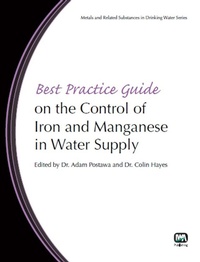
Best Practice Guide on the Control of Iron and Manganese in Water Supply
Published on 14. August 2013
146 pages
978-1-78040-074-7 (ISBN)
Description

This Best Practice Guide on the Control of Iron and Manganese in Water Supply is one of a series produced by the International Water Association's Specialist Group on Metals and Related Substances in Drinking Water.
Iron and manganese are often found in soft upland water sources associated with natural organic matter and are also commonly found in the groundwater abstracted from confined and unconfined aquifers. The presence of iron and manganese in water is one of the most frequent reasons for customers' complaint due to aesthetic issues (yellow, brown and black or stains on laundry and plumbing fixtures). These two metals can be removed fairly readily by physico-chemical treatment. The municipal treatment systems deployed derive benefit from their larger scale, particularly in relation to control, but the processes used are less suitable for the numerous small supplies that are the most common water supplies throughout Europe, especially in rural areas. One important source of iron in drinking water is from old corroded cast-iron water mains, historically the material used most commonly in supply networks. Replacement and refurbishment is very expensive and the major challenge is how best to prioritize available expenditure.
The purpose for this Best Practice Guide on the Control of Iron and Manganese in Water Supply is to give readers the broad view of a problem based on state-of-the-art compilation of the range of scientific, engineering, regulatory and operational issues concerned with the control of iron and manganese in drinking water. The Guide is of interest to water utility practitioners, health agencies and policy makers, as well as students on civil engineering and environmental engineering courses.
Authors: Dr Adam Postawa, AGH University of Science and Technology, Faculty of Geology, Geophysics and Environment Protection, Krakow, Poland and Dr Colin R Hayes, University of Swansea, UK, Chair of IWA Specialist Group on Metals and Related Substances in Drinking Water.
Iron and manganese are often found in soft upland water sources associated with natural organic matter and are also commonly found in the groundwater abstracted from confined and unconfined aquifers. The presence of iron and manganese in water is one of the most frequent reasons for customers' complaint due to aesthetic issues (yellow, brown and black or stains on laundry and plumbing fixtures). These two metals can be removed fairly readily by physico-chemical treatment. The municipal treatment systems deployed derive benefit from their larger scale, particularly in relation to control, but the processes used are less suitable for the numerous small supplies that are the most common water supplies throughout Europe, especially in rural areas. One important source of iron in drinking water is from old corroded cast-iron water mains, historically the material used most commonly in supply networks. Replacement and refurbishment is very expensive and the major challenge is how best to prioritize available expenditure.
The purpose for this Best Practice Guide on the Control of Iron and Manganese in Water Supply is to give readers the broad view of a problem based on state-of-the-art compilation of the range of scientific, engineering, regulatory and operational issues concerned with the control of iron and manganese in drinking water. The Guide is of interest to water utility practitioners, health agencies and policy makers, as well as students on civil engineering and environmental engineering courses.
Authors: Dr Adam Postawa, AGH University of Science and Technology, Faculty of Geology, Geophysics and Environment Protection, Krakow, Poland and Dr Colin R Hayes, University of Swansea, UK, Chair of IWA Specialist Group on Metals and Related Substances in Drinking Water.
More details
Series
Language
English
Place of publication
London
United Kingdom
Target group
College/higher education
Professional and scholarly
File size
2,35 MB
ISBN-13
978-1-78040-074-7 (9781780400747)
Copyright in bibliographic data and cover images is held by Nielsen Book Services Limited or by the publishers or by their respective licensors: all rights reserved.
Schweitzer Classification
Other editions
Additional editions
Adam Postawa | Colin Hayes | Alessandra Criscuoli
Best Practice Guide on the Control of Iron and Manganese in Water Supply
Book
08/2013
IWA Publishing
€113.00
Shipment within 3-4 weeks
