

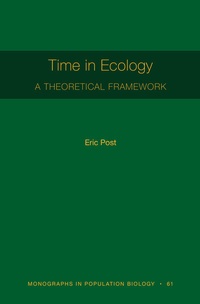
Time in Ecology
A Theoretical Framework
1st Edition
Published on 14. January 2019
248 pages
978-0-691-18549-1 (ISBN)
Description

Ecologists traditionally regard time as part of the background against which ecological interactions play out. In this book, Eric Post argues that time should be treated as a resource used by organisms for growth, maintenance, and offspring production.
Post uses insights from phenology-the study of the timing of life-cycle events-to present a theoretical framework of time in ecology that casts long-standing observations in the field in an entirely new light. Combining conceptual models with field data, he demonstrates how phenological advances, delays, and stasis, documented in an array of taxa, can all be viewed as adaptive components of an organism's strategic use of time. Post shows how the allocation of time by individual organisms to critical life history stages is not only a response to environmental cues but also an important driver of interactions at the population, species, and community levels.
To demonstrate the applications of this exciting new conceptual framework, Time in Ecology uses meta-analyses of previous studies as well as Post's original data on the phenological dynamics of plants, caribou, and muskoxen in Greenland.
Post uses insights from phenology-the study of the timing of life-cycle events-to present a theoretical framework of time in ecology that casts long-standing observations in the field in an entirely new light. Combining conceptual models with field data, he demonstrates how phenological advances, delays, and stasis, documented in an array of taxa, can all be viewed as adaptive components of an organism's strategic use of time. Post shows how the allocation of time by individual organisms to critical life history stages is not only a response to environmental cues but also an important driver of interactions at the population, species, and community levels.
To demonstrate the applications of this exciting new conceptual framework, Time in Ecology uses meta-analyses of previous studies as well as Post's original data on the phenological dynamics of plants, caribou, and muskoxen in Greenland.
All prices
More details
Other editions
Additional editions
Book
02/2019
Princeton University Press
€48.00
Shipment within 10-20 days
Book
02/2019
Princeton University Press
€133.50
Shipment within 10-20 days
Person
Eric Post is professor of climate change ecology and fellow of the John Muir Institute at the University of California, Davis. He is the author of Ecology of Climate Change: The Importance of Biotic Interactions (Princeton) and the coeditor of Wildlife Conservation in a Changing Climate.
Content
- Cover
- Title
- Copyright
- Dedication
- Contents
- Acknowledgments
- Introduction. A Framework for the Role of Time in Ecology
- 1. What Is Time?
- Philosophical Views of Time: Idealism, Relationism, and Realism
- A-Series, B-Series, and the Flow of Time
- Space-Time and Astrophysical Theories of Time
- 2. Phenological Advance, Stasis, and Delay
- Phenology versus Seasonality
- Ubiquitous Variability in Phenological Trends
- Phenological Dynamics across Taxa, Latitude, and Time
- Variation in Rates of Land-surface Warming across Latitude and Time
- 3. Ecological Time
- Time as a Resource in Ecology
- Scales of Time in the Domain of Phenology
- Timing and Duration of Life History Events
- The Adaptive Value of Phenological Advance, Stasis, and Delay
- Parallels and Contrasts between the Notions of Space and Time as Resources
- Three Forms of Time: Cosmological, Recurrent, and Relative Ecological Time
- The Space-Time Continuum in a Life History Context
- Fragmentation of Time
- 4. The Phenological Niche
- The Absolute Phenological Niche
- The Relative Phenological Niche
- Mutualisms and the Relative Phenological Niche
- Biodiversity Implications of Phenological Niche Conservatism in Specialist Associations
- Biodiversity Implications of Phenological Niche Conservatism in Generalist Associations
- 5. The Phenological Community
- The Compositional versus Phenological Community
- Phenological Community Dynamics and Species' Rank Order
- Niche Packing and Changes in the Availability of Ecological Time
- 6. Use of Time in the Phenology of Horizontal Species Interactions
- Timing and Duration: Responses to Potentially Distinct Selection Pressures
- Variation in Timing within and among Individuals and Species
- Variation in Timing among Species within Communities
- Empirical Applications to Horizontal Phenological Communities
- Indices of Phenological Overlap among Species
- 7. Use of Time in the Phenology of Vertical Species Interactions
- The Use of Time in Bitrophic-level Systems
- Applications to Mutualisms
- The Use of Time in Tritrophic-level Systems
- Phenological Cascades
- Empirical Assessment of Phenological Dynamics in Bitrophic-level Systems
- An Empirical Example of a Phenological Cascade
- Additional Examples of Changes in the Use of Time in Tritrophic-level Systems
- Final Considerations of the Use of Time in Pollinator-Plant Associations
- 8. Limitations and Extension to Tropical Systems
- Seasonal and Interannual Phenological Dynamics in Tropical Systems
- Partitioning of Time in Phenological Communities in the Tropics
- Availability of Time Related to Energy Input
- 9. The More General Role of Time in Ecology
- Appendix A. Online Resources of Relevance to Phenology
- Appendix B. Sources Used in the Meta-analysis in Chapter 2
- References
- Index

