

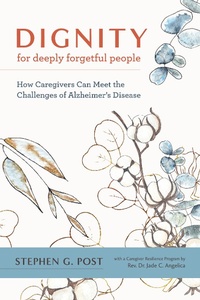
Dignity for Deeply Forgetful People
How Caregivers Can Meet the Challenges of Alzheimer's Disease
Published on 26. July 2022
288 pages
978-1-4214-4251-8 (ISBN)
Description

For caregivers of deeply forgetful people: a book that combines new ethics guidelines with an innovative program on how to communicate and connect with people with Alzheimer's.
How do we approach a "deeply forgetful" loved one so as to notice and affirm their continuing self-identity? For three decades, Stephen G. Post has worked around the world encouraging caregivers to become more aware of-and find renewed hope in-surprising expressions of selfhood despite the challenges of cognitive decline.
In this book, Post offers new perspectives on the worth and dignity of people with Alzheimer's and related disorders despite the negative influence of "hypercognitive" values that place an ethically unacceptable emphasis on human dignity as based on linear rationality and strength of memory. This bias, Post argues, is responsible for the abusive exclusion of this population from our shared humanity. With vignettes and narratives, he argues for a deeper dignity grounded in consciousness, emotional presence, creativity, interdependence, music, and a self that is not "gone" but "differently abled." Post covers key practical topics such as:
understanding the experience of dementia
noticing subtle expressions of continuing selfhood, including "paradoxical lucidity"
perspectives on ethical quandaries from diagnosis to terminal care and everything in between, as gleaned from the voices of caregivers
how to communicate optimally and use language effectively
the value of art, poetry, symbols, personalized music, and nature in revealing self-identity
the value of trained "dementia companion" dogs
At a time when medical advances to cure these conditions are still out of reach and the most recent drugs have shown limited effectiveness, Post argues that focusing discussion and resources on the relational dignity of these individuals and the respite needs of their caregivers is vital. Grounding ethics on the equal worth of all conscious human beings, he provides a cautionary perspective on preemptive assisted suicide based on cases that he has witnessed. He affirms vulnerability and interdependence as the core of the human condition and celebrates caregivers as advocates seeking social and economic justice in an American system where they and their loved ones receive only leftover scraps. Racially inclusive and grounded in diversity, Dignity for Deeply Forgetful People also includes a workshop appendix focused on communication and connection, "A Caregiver Resilience Program," by Rev. Dr. Jade C. Angelica.
How do we approach a "deeply forgetful" loved one so as to notice and affirm their continuing self-identity? For three decades, Stephen G. Post has worked around the world encouraging caregivers to become more aware of-and find renewed hope in-surprising expressions of selfhood despite the challenges of cognitive decline.
In this book, Post offers new perspectives on the worth and dignity of people with Alzheimer's and related disorders despite the negative influence of "hypercognitive" values that place an ethically unacceptable emphasis on human dignity as based on linear rationality and strength of memory. This bias, Post argues, is responsible for the abusive exclusion of this population from our shared humanity. With vignettes and narratives, he argues for a deeper dignity grounded in consciousness, emotional presence, creativity, interdependence, music, and a self that is not "gone" but "differently abled." Post covers key practical topics such as:
understanding the experience of dementia
noticing subtle expressions of continuing selfhood, including "paradoxical lucidity"
perspectives on ethical quandaries from diagnosis to terminal care and everything in between, as gleaned from the voices of caregivers
how to communicate optimally and use language effectively
the value of art, poetry, symbols, personalized music, and nature in revealing self-identity
the value of trained "dementia companion" dogs
At a time when medical advances to cure these conditions are still out of reach and the most recent drugs have shown limited effectiveness, Post argues that focusing discussion and resources on the relational dignity of these individuals and the respite needs of their caregivers is vital. Grounding ethics on the equal worth of all conscious human beings, he provides a cautionary perspective on preemptive assisted suicide based on cases that he has witnessed. He affirms vulnerability and interdependence as the core of the human condition and celebrates caregivers as advocates seeking social and economic justice in an American system where they and their loved ones receive only leftover scraps. Racially inclusive and grounded in diversity, Dignity for Deeply Forgetful People also includes a workshop appendix focused on communication and connection, "A Caregiver Resilience Program," by Rev. Dr. Jade C. Angelica.
More details
Language
English
Place of publication
Baltimore
United States
Target group
Professional and scholarly
Illustrations
1 s/w Zeichnung, 2 s/w Abbildungen
1 Line drawings, black and white; 2 Illustrations, black and white
File size
2,71 MB
ISBN-13
978-1-4214-4251-8 (9781421442518)
DOI
10.56021/9781421442518
Copyright in bibliographic data and cover images is held by Nielsen Book Services Limited or by the publishers or by their respective licensors: all rights reserved.
Schweitzer Classification
Other editions
Additional editions
Stephen G. Post | Jade C. Angelica
Dignity for Deeply Forgetful People
How Caregivers Can Meet the Challenges of Alzheimer's Disease
Book
07/2022
Johns Hopkins University Press
€66.00
Shipment within 10-20 days
Stephen G. Post | Jade C. Angelica
Dignity for Deeply Forgetful People
How Caregivers Can Meet the Challenges of Alzheimer's Disease
Book
07/2022
Johns Hopkins University Press
€25.50
Shipment within 10-20 days
Persons
Stephen G. Post is the director of the Center for Medical Humanities, Compassionate Care, and Bioethics at the Renaissance School of Medicine at Stony Brook University. He is the author of The Moral Challenge of Alzheimer Disease: Ethical Issues from Diagnosis to Dying.
Content
Preface
Chapter One. In Praise of Caregivers and Dignity
Chapter Two. Hope in Caring for Deeply Forgetful People: Why It Matters and Where to Find It
Chapter Three. Answers to Sixteen Questions Caregivers Ask from Diagnosis to Dying
Chapter Four. The Seventeenth Question: Preemptive Physician-Assisted Suicide (PPAS) for Alzheimer's Disease: A Caution
Chapter Five. A Caregiver's Ethical Purpose: Preserving Dignity, Ten Manifestations of Care, and Respect for the Whole Story of a Life
Chapter Six. Respecting the Preferences of Deeply Forgetful People in Health Care and Research
Chapter Seven. "Is Grandma Still There?" The Mystery of Continuing Self-Identity
An Epilogue. North Wind
A Caregiver Resilience Program: Meeting Alzheimer's: Learning to Communicate and Connect
by Rev. Dr. Jade C. Angelica
References
Acknowledgments
Index
Chapter One. In Praise of Caregivers and Dignity
Chapter Two. Hope in Caring for Deeply Forgetful People: Why It Matters and Where to Find It
Chapter Three. Answers to Sixteen Questions Caregivers Ask from Diagnosis to Dying
Chapter Four. The Seventeenth Question: Preemptive Physician-Assisted Suicide (PPAS) for Alzheimer's Disease: A Caution
Chapter Five. A Caregiver's Ethical Purpose: Preserving Dignity, Ten Manifestations of Care, and Respect for the Whole Story of a Life
Chapter Six. Respecting the Preferences of Deeply Forgetful People in Health Care and Research
Chapter Seven. "Is Grandma Still There?" The Mystery of Continuing Self-Identity
An Epilogue. North Wind
A Caregiver Resilience Program: Meeting Alzheimer's: Learning to Communicate and Connect
by Rev. Dr. Jade C. Angelica
References
Acknowledgments
Index
