

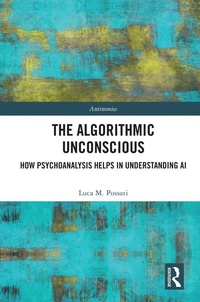
The Algorithmic Unconscious
How Psychoanalysis Helps in Understanding AI
1st Edition
Published on 25. February 2021
156 pages
978-1-000-34531-5 (ISBN)
Description

This book applies the concepts and methods of psychoanalysis to the study of artificial intelligence (AI) and human-AI interaction. It develops a new, more fruitful approach for applying psychoanalysis to AI and machine behavior. It appeals to a broad range of scholars: philosophers working on psychoanalysis, technology, AI ethics, and cognitive sciences, psychoanalysts, psychologists, and computer scientists.
The book is divided into four parts. The first part (Chapter 1) analyzes the concept of "machine behavior." The second part (Chapter 2) develops a reinterpretation of some fundamental Freudian and Lacanian concepts through Bruno Latour's actor-network theory. The third part (Chapters 3 and 4) focuses on the nature and structure of the algorithmic unconscious. The author claims that the unconscious roots of AI lie in a form of projective identification, i.e., an emotional and imaginative exchange between humans and machines. In the fourth part of the book (Chapter 5), the author advances the thesis that neuropsychoanalysis and the affective neurosciences can provide a new paradigm for research on artificial general intelligence.
The Algorithmic Unconscious explores a completely new approach to AI, which can also be defined as a form of "therapy." Analyzing the projective identification processes that take place in groups of professional programmers and designers, as well as the "hidden" features of AI (errors, noise information, biases, etc.), represents an important tool to enable a healthy and positive relationship between humans and AI. Psychoanalysis is used as a critical space for reflection, innovation, and progress.
The book is divided into four parts. The first part (Chapter 1) analyzes the concept of "machine behavior." The second part (Chapter 2) develops a reinterpretation of some fundamental Freudian and Lacanian concepts through Bruno Latour's actor-network theory. The third part (Chapters 3 and 4) focuses on the nature and structure of the algorithmic unconscious. The author claims that the unconscious roots of AI lie in a form of projective identification, i.e., an emotional and imaginative exchange between humans and machines. In the fourth part of the book (Chapter 5), the author advances the thesis that neuropsychoanalysis and the affective neurosciences can provide a new paradigm for research on artificial general intelligence.
The Algorithmic Unconscious explores a completely new approach to AI, which can also be defined as a form of "therapy." Analyzing the projective identification processes that take place in groups of professional programmers and designers, as well as the "hidden" features of AI (errors, noise information, biases, etc.), represents an important tool to enable a healthy and positive relationship between humans and AI. Psychoanalysis is used as a critical space for reflection, innovation, and progress.
Reviews / Votes
"In this illuminating book, Luca M. Possati explores the unconscious dimension of Artificial Intelligence. Its main thesis is that in the age of big data and self-learning neural networks 'machine behavior' has become dark and impenetrable and is in need for interpretation. Combining Lacanian psychoanalysis and Latour's actor-network theory the author offers an original and timely analysis of how we project our deepest desires in AI technologies and pleas for a new 'subcortical AI'."- Jos de Mul, Erasmus School of Philosophy, Erasmus University Rotterdam, The Netherlands
More details
Series
Edition
1. Auflage
Language
English
Place of publication
London
United Kingdom
Publishing group
Taylor & Francis Ltd
Target group
College/higher education
Illustrations
2 Tables, black and white; 17 Line drawings, black and white; 17 Illustrations, black and white
ISBN-13
978-1-000-34531-5 (9781000345315)
Copyright in bibliographic data and cover images is held by Nielsen Book Services Limited or by the publishers or by their respective licensors: all rights reserved.
Schweitzer Classification
Other editions
Additional editions
Book
08/2022
1st Edition
Routledge
€64.70
Shipment within 15-20 days
Book
02/2021
1st Edition
Routledge
€205.80
Shipment within 15-20 days
Person
Luca M. Possati is a researcher in philosophy at the University of Porto, Portugal. His fields of investigation are philosophy of technology and artificial intelligence. He is the author of many studies in phenomenology and the history of philosophy.
Content
Introduction
1. Why an Algorithmic Unconscious for AI?
2. The Unconscious and Technology
3. The Difficulty of Being AI
4. Errors, Noise, Bias, and Sleeping
5. A Freudian Computer: Neuropsychoanalysis and Affective Neuroscience as a Framework to Understand Artificial General Intelligence
6. Conclusions: Toward an Ethnographic and Psychoanalytic Study of AI
1. Why an Algorithmic Unconscious for AI?
2. The Unconscious and Technology
3. The Difficulty of Being AI
4. Errors, Noise, Bias, and Sleeping
5. A Freudian Computer: Neuropsychoanalysis and Affective Neuroscience as a Framework to Understand Artificial General Intelligence
6. Conclusions: Toward an Ethnographic and Psychoanalytic Study of AI
