

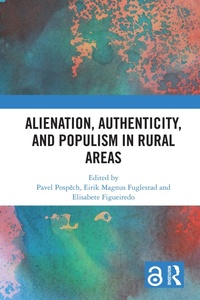
Alienation, Authenticity, and Populism in Rural Areas
Description

This book captures the complex relationships between rurality and populism with a focus on the processes of alienation and on the contemporary search for authenticity. It explores these relationships using case studies from different national and cultural contexts.
Populist movements are growing stronger around the world. While their tactics and their rhetoric vary, there are also common themes - notably, the promise to speak on behalf of those "left behind" in the contemporary developments. This book helps readers understand how rurality, peripherality and lives of rural people are used and exploited by populist movements around the world. Ten years after the "left behind" populations became a hot topic in academia, the book reviews the current state of affairs, and links its strong empirical focus with the concepts of alienation and authenticity to provide an understanding of the new populist zeitgeist.
This is important reading for anyone interested in the current rise of populist movements across the world, as well as for students of contemporary rural societies. It is a useful resource for scholars and lecturers, as well as students in sociology, politics and human and social geography.
More details
Other editions
Additional editions
Persons
Pavel Pospech is Associate Professor in the Department of Sociology at Masaryk University, Czech Republic, and Faculty Fellow of the Yale Center for Cultural Sociology. His work lies at the intersections of cultural sociology, rural sociology and social theory. His research has appeared in the American Journal of Cultural Sociology, European Journal of Social Theory, Sociology Compass, Journal of Rural Studies, Sociologia Ruralis, Ethnic and Racial Studies and other outlets. He co-edited the volume Politics and Policies of Rural Authenticity (Routledge, 2021).
Eirik Magnus Fuglestad is a sociologist at Ruralis-Institute for Rural and Regional Research in Trondheim, Norway. His research covers a broad array of fields in rural studies from agricultural development to rural politics, including resistance and populism, social sustainability and resource use.
Elisabete Figueiredo is a rural sociologist and Associate Professor with Habilitation in the Department of Social, Political and Territorial Sciences and a researcher at the Governance, Competitiveness and Public Policies Research Centre (GOVCOPP) of the University of Aveiro. She has developed research on social representations of rural territories, rural development policies, impacts of rural tourism on local communities, traditional food products and social perceptions of the environment.
Content
Populism, rurality and the long ten years since 2016 PART I Populism and rural areas 1 Looking for rural populism in Norway: The search for a spectre 2 Reviving Rural Portugal? CHEGA's narratives on rural territories and agriculture 3 Where the shoe pinches for the American right 4 The rural reawakening: A bonapartist counter-revolution to end the final victory of neoliberalism, or to perpetuate it 5 Right-wing and left-wing populists on the fields: Strategies and challenges in rural policy-making in Greece and Turkey PART II Authenticity and alienation 6 The cage and the market: Alienation and ambivalences in Italian 2024 farmers' protests 7 Peasant farming as everyday resistance in rural Norway 8 The rural-urban divide: In politics versus on the ground 9 Model villages and the performance of authenticity 10 Tractors and trowels: Alienation, authenticity and the search for rural revival 11 Perceptions of the rural gap in Spain: Between consciousness and alienation 12 Poor young agricultural workers in Chile and Uruguay between 2010 and 2018
