

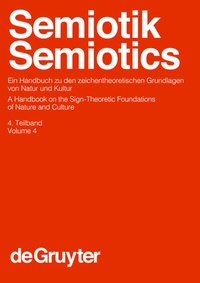
Semiotik / Semiotics
1st Edition
Published on 14. July 2008
XVI, 534 pages
978-3-11-019428-9 (ISBN)
Description

Keine ausfuehrliche Beschreibung fuer "SEMIOTIK (POSNER U.A.) 4.TLBD HSK 13.4 E-BOOK" verfuegbar.
Reviews / Votes
"Es ist an der Zeit, insbesondere Roland Posner, der, wie Insider wissen, den Löwenanteil der editorischen Arbeit trug, den Dank der semiotic community und aller darüber hinaus an der Materie Interessierten auszusprechen - für eine Leistung, die wohl den Ausdruck 'Jahrhundertwerk' verdient."Erhard Albrecht in: European Journal for Semiotic Studies 1/2004 "Der Bd. bietet einen vorzüglichen, geradezu enzyklopädischen Überblick über die einzelwissenschaftlichen Ausprägungen der Semiotik."Christian Begemann in: Germanistik 3-4/2005More details
Series
Language
English
German
Place of publication
Berlin/Boston
Germany
Publishing group
de Gruyter Mouton
Target group
Professional and scholarly
US School Grade: College Graduate Student
Illustrations
XVI, Seite 3345-3878
File size
23,69 MB
ISBN-13
978-3-11-019428-9 (9783110194289)
Schweitzer Classification
Other editions
Additional editions
Roland Posner | Klaus Robering | Thomas A. Sebeok
Semiotik / Semiotics
Book
05/2004
1st Edition
De Gruyter Mouton
€900.00
Shipment within 7-9 days
Roland Posner | Klaus Robering | Thomas A. Sebeok
Semiotik / Semiotics
Book
01/2004
1st Edition
De Gruyter Mouton
€939.00
Article exhausted; check different version
Content
1 - Inhalt / Contents [Seite 5]
2 - XV. Ausgewählte Gegenstände der Semiotik Selected Topics of Semiotics [Seite 17]
2.1 - 159. Geschichte der Kommunikationstechniken [Seite 17]
2.1.1 - 1. Einleitung [Seite 17]
2.1.2 - 2. Schrift [Seite 18]
2.1.3 - 3. Technische Medien [Seite 22]
2.1.4 - 4. Literatur (in Auswahl) [Seite 26]
2.2 - 160. Divination and futurology [Seite 29]
2.2.1 - 1. Divination, futurology, and semiotics [Seite 29]
2.2.2 - 2. Divination as a meta-semiosic system [Seite 31]
2.2.3 - 3. Themes of divination [Seite 32]
2.2.4 - 4. A meta-divination session [Seite 33]
2.2.5 - 5. The discourse element in the meta-system of divination [Seite 34]
2.2.6 - 6. The semiotic implications of the language of divination [Seite 35]
2.2.7 - 7. The basic stages of astrology [Seite 35]
2.2.8 - 8. The social context of divination [Seite 37]
2.2.9 - 9. Motivation, imagination, and magic [Seite 38]
2.2.10 - 10. Selected references [Seite 41]
2.3 - 161. Work [Seite 43]
2.3.1 - 1. Introduction [Seite 43]
2.3.2 - 2. Characteristics of work language [Seite 44]
2.3.3 - 3. A classification of communicative functions [Seite 44]
2.3.4 - 4. Perspective [Seite 45]
2.3.5 - 5. Utterances and actions [Seite 48]
2.3.6 - 6. Actions without utterances [Seite 50]
2.3.7 - 7. Selected references [Seite 51]
2.4 - 162. Semiotik des Sports [Seite 53]
2.4.1 - 1. Klassifikation der Zeichen auf der Ereignisebene [Seite 53]
2.4.2 - 2. Zugeschriebene Bedeutungen [Seite 55]
2.4.3 - 3. Probleme der Zeicheninterpretation des Sports [Seite 58]
2.4.4 - 4. Literatur (in Auswahl) [Seite 60]
2.5 - 163. Interspecific communication [Seite 63]
2.5.1 - 1. Definition [Seite 63]
2.5.2 - 2. Interspecific communication and evolution [Seite 63]
2.5.3 - 3. Motivations and modalities of interspecific communication [Seite 64]
2.5.4 - 4. The meta-communication condition [Seite 66]
2.5.5 - 5. Selected references [Seite 68]
2.6 - 164. Gerontology and geriatrics [Seite 69]
2.6.1 - 1. Age as a variable in gerontology [Seite 69]
2.6.2 - 2. A semiotics of old age [Seite 71]
2.6.3 - 3. Derivative interpretations of old age [Seite 74]
2.6.4 - 4. The expression plane of old age [Seite 75]
2.6.5 - 5. Summary of a semiotics of old age [Seite 75]
2.6.6 - 6. Selected references [Seite 76]
2.7 - 165. Tourism [Seite 80]
2.7.1 - 1. Tourism and traveling [Seite 80]
2.7.2 - 2. The touristic sight and the problem of authenticity [Seite 80]
2.7.3 - 3. The tourist [Seite 81]
2.7.4 - 4. The semiotics of tourist art [Seite 84]
2.7.5 - 5. Semiotic consequences of tourism [Seite 87]
2.7.6 - 6. The contribution of semiotics to the study of tourism [Seite 88]
2.7.7 - 7. Selected references [Seite 91]
2.8 - 166. Geschäftsleben [Seite 93]
2.8.1 - 1. Kommunikation im Geschäftsleben [Seite 93]
2.8.2 - 2. Konsumgüter und ihre Verwender als Interpretate [Seite 97]
2.8.3 - 3. Unternehmen als Interpretate [Seite 103]
2.8.4 - 4. Zur Anwendung semiotischer Erkenntnisse [Seite 105]
2.8.5 - 5. Literatur (in Auswahl) [Seite 105]
2.9 - 167. Ideology [Seite 108]
2.9.1 - 1. Origins of the term "ideology" [Seite 108]
2.9.2 - 2. Ideology as false thought and worldview [Seite 108]
2.9.3 - 3. The relation between signs and ideology [Seite 109]
2.9.4 - 4. On the definition of "ideology" [Seite 110]
2.9.5 - 5. For a semiotic interpretation of ideology [Seite 111]
2.9.6 - 6. Sign, ideology, and stereotype [Seite 112]
2.9.7 - 7. Ideology as social planning [Seite 113]
2.9.8 - 8. Ideology as the interpretant sign [Seite 113]
2.9.9 - 9. Ideology and the interpretative surplus [Seite 114]
2.9.10 - 10. Back to the problem of the definition of ideology [Seite 114]
2.9.11 - 11. Signs as elements of mediation between production mode and ideology [Seite 116]
2.9.12 - 12. Selected references [Seite 117]
2.10 - 168. Körpersignale in menschlicher Interaktion [Seite 120]
2.10.1 - 1. Einleitung [Seite 120]
2.10.2 - 2. Rahmenbedingungen [Seite 120]
2.10.3 - 3. Die äußere Botschaft: optische Signale [Seite 128]
2.10.4 - 4. Die äußere Botschaft: akustische Signale [Seite 139]
2.10.5 - 5. Die innere Botschaft [Seite 140]
2.10.6 - 6. Die Funktion von Signalen [Seite 141]
2.10.7 - 7. Manipulation und Kommunikation [Seite 146]
2.10.8 - 8. Programmierte Bedeutung und programmierte Wahrnehmung [Seite 153]
2.10.9 - 9. Literatur (in Auswahl) [Seite 154]
2.11 - 169. Multimediale Kommunikation [Seite 159]
2.11.1 - 1. Problemaufriß: Motive und Ausgangsfragen [Seite 159]
2.11.2 - 2. Begriff: Medium und Kommunikation [Seite 160]
2.11.3 - 3. Analyse: Empirie und Methodologie [Seite 162]
2.11.4 - 4. Theorie: Kode-Verhältnisse und intermediale Relationen [Seite 163]
2.11.5 - 5. Praxis: Anwendungsbereiche und Entwicklungsperspektiven [Seite 165]
2.11.6 - 6. Aktuelle Entwicklungen: Medienkultur und Medienökologie im Wandel [Seite 168]
2.11.7 - 7. Ausblick [Seite 170]
2.11.8 - 8. Literatur (in Auswahl) [Seite 171]
2.12 - 170. Pictograms [Seite 176]
2.12.1 - 1. Introduction [Seite 176]
2.12.2 - 2. Pictograms are not pictures [Seite 176]
2.12.3 - 3. Pictograms semiotically defined [Seite 177]
2.12.4 - 4. Pictogram systems [Seite 177]
2.12.5 - 5. Pictograms and other signs [Seite 179]
2.12.6 - 6. Precursors of pictograms [Seite 180]
2.12.7 - 7. Selected references [Seite 181]
2.13 - 171. Zeichennormung für Handwerk und Industrie [Seite 182]
2.13.1 - 1. Einleitung [Seite 182]
2.13.2 - 2. Funktion und Geschichte der Markenzeichen [Seite 183]
2.13.3 - 3. Zeichennormung für die Wirtschaft [Seite 228]
2.13.4 - 4. Literatur (in Auswahl) [Seite 237]
2.14 - 172. Fakes in arts and crafts [Seite 243]
2.14.1 - 1. Preliminary definitions [Seite 243]
2.14.2 - 2. Replicability of objects [Seite 244]
2.14.3 - 3. Forgery and false identification [Seite 245]
2.14.4 - 4. A pragmatics of false identification [Seite 246]
2.14.5 - 5. The fake as a fake sign [Seite 248]
2.14.6 - 6. Criteria for acknowledging authenticity [Seite 249]
2.14.7 - 7. Conclusions [Seite 250]
2.14.8 - 8. Selected references [Seite 251]
2.15 - 173. Ciphers and other secret codes [Seite 252]
2.15.1 - 1. Cryptology [Seite 252]
2.15.2 - 2. Cryptography [Seite 253]
2.15.3 - 3. Cryptanalysis [Seite 261]
2.15.4 - 4. Notes for a semiotic analysis of cryptologic communication [Seite 262]
2.15.5 - 5. Selected references [Seite 264]
2.16 - 174. Translation [Seite 266]
2.16.1 - 1. What is translation? [Seite 266]
2.16.2 - 2. Towards a global hypothetical model of translation processes [Seite 273]
2.16.3 - 3. Selected references [Seite 282]
2.17 - 175. Universal languages and language planning [Seite 286]
2.17.1 - 1. Introduction [Seite 286]
2.17.2 - 2. Parameters and typologies [Seite 287]
2.17.3 - 3. Language elevation [Seite 294]
2.17.4 - 4. History [Seite 297]
2.17.5 - 5. Conclusion [Seite 302]
2.17.6 - 6. Selected references [Seite 303]
2.18 - 176. Extraterrestrial communication [Seite 306]
2.18.1 - 1. Background [Seite 306]
2.18.2 - 2. Interstellar communication [Seite 308]
2.18.3 - 3. The challenge [Seite 314]
2.18.4 - 4. Selected references [Seite 314]
3 - XVI. Anhang Appendix [Seite 316]
3.1 - 177. Semiotic organizations [Seite 316]
3.1.1 - 1. International Associations [Seite 316]
3.1.2 - 2. National associations, regional organizations, research centers, university institutes [Seite 325]
3.2 - 178. Semiotic reference works and periodicals [Seite 364]
3.2.1 - 1. Reference works [Seite 364]
3.2.2 - 2. IASS - AIS proceedings [Seite 365]
3.2.3 - 3. Semiotics around the world - reports, bibliographies, and yearbooks (references for Art. 177) [Seite 365]
3.2.4 - 4. Book series [Seite 373]
3.2.5 - 5. Journals [Seite 381]
3.2.6 - 6. E-mail lists and newsletters [Seite 397]
3.3 - 179. Personenindex Index of persons [Seite 399]
3.3.1 - A [Seite 399]
3.3.2 - B [Seite 402]
3.3.3 - C [Seite 410]
3.3.4 - D [Seite 415]
3.3.5 - E [Seite 418]
3.3.6 - F [Seite 420]
3.3.7 - G [Seite 424]
3.3.8 - H [Seite 428]
3.3.9 - I [Seite 434]
3.3.10 - J [Seite 435]
3.3.11 - K [Seite 437]
3.3.12 - L [Seite 442]
3.3.13 - M [Seite 447]
3.3.14 - N [Seite 453]
3.3.15 - O [Seite 454]
3.3.16 - P [Seite 456]
3.3.17 - Q [Seite 460]
3.3.18 - R [Seite 461]
3.3.19 - S [Seite 465]
3.3.20 - T [Seite 474]
3.3.21 - U [Seite 476]
3.3.22 - V [Seite 477]
3.3.23 - W [Seite 479]
3.3.24 - X [Seite 483]
3.3.25 - Y [Seite 483]
3.3.26 - Z [Seite 483]
3.4 - 180. Sachindex Index of subjects [Seite 485]
3.4.1 - A [Seite 485]
3.4.2 - B [Seite 490]
3.4.3 - C [Seite 492]
3.4.4 - D [Seite 496]
3.4.5 - E [Seite 500]
3.4.6 - F [Seite 503]
3.4.7 - G [Seite 505]
3.4.8 - H [Seite 508]
3.4.9 - I [Seite 510]
3.4.10 - J [Seite 513]
3.4.11 - K [Seite 513]
3.4.12 - L [Seite 516]
3.4.13 - M [Seite 518]
3.4.14 - N [Seite 523]
3.4.15 - O [Seite 525]
3.4.16 - P [Seite 527]
3.4.17 - Q [Seite 532]
3.4.18 - R [Seite 532]
3.4.19 - S [Seite 535]
3.4.20 - T [Seite 542]
3.4.21 - U [Seite 545]
3.4.22 - V [Seite 546]
3.4.23 - W [Seite 547]
3.4.24 - X [Seite 549]
3.4.25 - Y [Seite 549]
3.4.26 - Z [Seite 549]
2 - XV. Ausgewählte Gegenstände der Semiotik Selected Topics of Semiotics [Seite 17]
2.1 - 159. Geschichte der Kommunikationstechniken [Seite 17]
2.1.1 - 1. Einleitung [Seite 17]
2.1.2 - 2. Schrift [Seite 18]
2.1.3 - 3. Technische Medien [Seite 22]
2.1.4 - 4. Literatur (in Auswahl) [Seite 26]
2.2 - 160. Divination and futurology [Seite 29]
2.2.1 - 1. Divination, futurology, and semiotics [Seite 29]
2.2.2 - 2. Divination as a meta-semiosic system [Seite 31]
2.2.3 - 3. Themes of divination [Seite 32]
2.2.4 - 4. A meta-divination session [Seite 33]
2.2.5 - 5. The discourse element in the meta-system of divination [Seite 34]
2.2.6 - 6. The semiotic implications of the language of divination [Seite 35]
2.2.7 - 7. The basic stages of astrology [Seite 35]
2.2.8 - 8. The social context of divination [Seite 37]
2.2.9 - 9. Motivation, imagination, and magic [Seite 38]
2.2.10 - 10. Selected references [Seite 41]
2.3 - 161. Work [Seite 43]
2.3.1 - 1. Introduction [Seite 43]
2.3.2 - 2. Characteristics of work language [Seite 44]
2.3.3 - 3. A classification of communicative functions [Seite 44]
2.3.4 - 4. Perspective [Seite 45]
2.3.5 - 5. Utterances and actions [Seite 48]
2.3.6 - 6. Actions without utterances [Seite 50]
2.3.7 - 7. Selected references [Seite 51]
2.4 - 162. Semiotik des Sports [Seite 53]
2.4.1 - 1. Klassifikation der Zeichen auf der Ereignisebene [Seite 53]
2.4.2 - 2. Zugeschriebene Bedeutungen [Seite 55]
2.4.3 - 3. Probleme der Zeicheninterpretation des Sports [Seite 58]
2.4.4 - 4. Literatur (in Auswahl) [Seite 60]
2.5 - 163. Interspecific communication [Seite 63]
2.5.1 - 1. Definition [Seite 63]
2.5.2 - 2. Interspecific communication and evolution [Seite 63]
2.5.3 - 3. Motivations and modalities of interspecific communication [Seite 64]
2.5.4 - 4. The meta-communication condition [Seite 66]
2.5.5 - 5. Selected references [Seite 68]
2.6 - 164. Gerontology and geriatrics [Seite 69]
2.6.1 - 1. Age as a variable in gerontology [Seite 69]
2.6.2 - 2. A semiotics of old age [Seite 71]
2.6.3 - 3. Derivative interpretations of old age [Seite 74]
2.6.4 - 4. The expression plane of old age [Seite 75]
2.6.5 - 5. Summary of a semiotics of old age [Seite 75]
2.6.6 - 6. Selected references [Seite 76]
2.7 - 165. Tourism [Seite 80]
2.7.1 - 1. Tourism and traveling [Seite 80]
2.7.2 - 2. The touristic sight and the problem of authenticity [Seite 80]
2.7.3 - 3. The tourist [Seite 81]
2.7.4 - 4. The semiotics of tourist art [Seite 84]
2.7.5 - 5. Semiotic consequences of tourism [Seite 87]
2.7.6 - 6. The contribution of semiotics to the study of tourism [Seite 88]
2.7.7 - 7. Selected references [Seite 91]
2.8 - 166. Geschäftsleben [Seite 93]
2.8.1 - 1. Kommunikation im Geschäftsleben [Seite 93]
2.8.2 - 2. Konsumgüter und ihre Verwender als Interpretate [Seite 97]
2.8.3 - 3. Unternehmen als Interpretate [Seite 103]
2.8.4 - 4. Zur Anwendung semiotischer Erkenntnisse [Seite 105]
2.8.5 - 5. Literatur (in Auswahl) [Seite 105]
2.9 - 167. Ideology [Seite 108]
2.9.1 - 1. Origins of the term "ideology" [Seite 108]
2.9.2 - 2. Ideology as false thought and worldview [Seite 108]
2.9.3 - 3. The relation between signs and ideology [Seite 109]
2.9.4 - 4. On the definition of "ideology" [Seite 110]
2.9.5 - 5. For a semiotic interpretation of ideology [Seite 111]
2.9.6 - 6. Sign, ideology, and stereotype [Seite 112]
2.9.7 - 7. Ideology as social planning [Seite 113]
2.9.8 - 8. Ideology as the interpretant sign [Seite 113]
2.9.9 - 9. Ideology and the interpretative surplus [Seite 114]
2.9.10 - 10. Back to the problem of the definition of ideology [Seite 114]
2.9.11 - 11. Signs as elements of mediation between production mode and ideology [Seite 116]
2.9.12 - 12. Selected references [Seite 117]
2.10 - 168. Körpersignale in menschlicher Interaktion [Seite 120]
2.10.1 - 1. Einleitung [Seite 120]
2.10.2 - 2. Rahmenbedingungen [Seite 120]
2.10.3 - 3. Die äußere Botschaft: optische Signale [Seite 128]
2.10.4 - 4. Die äußere Botschaft: akustische Signale [Seite 139]
2.10.5 - 5. Die innere Botschaft [Seite 140]
2.10.6 - 6. Die Funktion von Signalen [Seite 141]
2.10.7 - 7. Manipulation und Kommunikation [Seite 146]
2.10.8 - 8. Programmierte Bedeutung und programmierte Wahrnehmung [Seite 153]
2.10.9 - 9. Literatur (in Auswahl) [Seite 154]
2.11 - 169. Multimediale Kommunikation [Seite 159]
2.11.1 - 1. Problemaufriß: Motive und Ausgangsfragen [Seite 159]
2.11.2 - 2. Begriff: Medium und Kommunikation [Seite 160]
2.11.3 - 3. Analyse: Empirie und Methodologie [Seite 162]
2.11.4 - 4. Theorie: Kode-Verhältnisse und intermediale Relationen [Seite 163]
2.11.5 - 5. Praxis: Anwendungsbereiche und Entwicklungsperspektiven [Seite 165]
2.11.6 - 6. Aktuelle Entwicklungen: Medienkultur und Medienökologie im Wandel [Seite 168]
2.11.7 - 7. Ausblick [Seite 170]
2.11.8 - 8. Literatur (in Auswahl) [Seite 171]
2.12 - 170. Pictograms [Seite 176]
2.12.1 - 1. Introduction [Seite 176]
2.12.2 - 2. Pictograms are not pictures [Seite 176]
2.12.3 - 3. Pictograms semiotically defined [Seite 177]
2.12.4 - 4. Pictogram systems [Seite 177]
2.12.5 - 5. Pictograms and other signs [Seite 179]
2.12.6 - 6. Precursors of pictograms [Seite 180]
2.12.7 - 7. Selected references [Seite 181]
2.13 - 171. Zeichennormung für Handwerk und Industrie [Seite 182]
2.13.1 - 1. Einleitung [Seite 182]
2.13.2 - 2. Funktion und Geschichte der Markenzeichen [Seite 183]
2.13.3 - 3. Zeichennormung für die Wirtschaft [Seite 228]
2.13.4 - 4. Literatur (in Auswahl) [Seite 237]
2.14 - 172. Fakes in arts and crafts [Seite 243]
2.14.1 - 1. Preliminary definitions [Seite 243]
2.14.2 - 2. Replicability of objects [Seite 244]
2.14.3 - 3. Forgery and false identification [Seite 245]
2.14.4 - 4. A pragmatics of false identification [Seite 246]
2.14.5 - 5. The fake as a fake sign [Seite 248]
2.14.6 - 6. Criteria for acknowledging authenticity [Seite 249]
2.14.7 - 7. Conclusions [Seite 250]
2.14.8 - 8. Selected references [Seite 251]
2.15 - 173. Ciphers and other secret codes [Seite 252]
2.15.1 - 1. Cryptology [Seite 252]
2.15.2 - 2. Cryptography [Seite 253]
2.15.3 - 3. Cryptanalysis [Seite 261]
2.15.4 - 4. Notes for a semiotic analysis of cryptologic communication [Seite 262]
2.15.5 - 5. Selected references [Seite 264]
2.16 - 174. Translation [Seite 266]
2.16.1 - 1. What is translation? [Seite 266]
2.16.2 - 2. Towards a global hypothetical model of translation processes [Seite 273]
2.16.3 - 3. Selected references [Seite 282]
2.17 - 175. Universal languages and language planning [Seite 286]
2.17.1 - 1. Introduction [Seite 286]
2.17.2 - 2. Parameters and typologies [Seite 287]
2.17.3 - 3. Language elevation [Seite 294]
2.17.4 - 4. History [Seite 297]
2.17.5 - 5. Conclusion [Seite 302]
2.17.6 - 6. Selected references [Seite 303]
2.18 - 176. Extraterrestrial communication [Seite 306]
2.18.1 - 1. Background [Seite 306]
2.18.2 - 2. Interstellar communication [Seite 308]
2.18.3 - 3. The challenge [Seite 314]
2.18.4 - 4. Selected references [Seite 314]
3 - XVI. Anhang Appendix [Seite 316]
3.1 - 177. Semiotic organizations [Seite 316]
3.1.1 - 1. International Associations [Seite 316]
3.1.2 - 2. National associations, regional organizations, research centers, university institutes [Seite 325]
3.2 - 178. Semiotic reference works and periodicals [Seite 364]
3.2.1 - 1. Reference works [Seite 364]
3.2.2 - 2. IASS - AIS proceedings [Seite 365]
3.2.3 - 3. Semiotics around the world - reports, bibliographies, and yearbooks (references for Art. 177) [Seite 365]
3.2.4 - 4. Book series [Seite 373]
3.2.5 - 5. Journals [Seite 381]
3.2.6 - 6. E-mail lists and newsletters [Seite 397]
3.3 - 179. Personenindex Index of persons [Seite 399]
3.3.1 - A [Seite 399]
3.3.2 - B [Seite 402]
3.3.3 - C [Seite 410]
3.3.4 - D [Seite 415]
3.3.5 - E [Seite 418]
3.3.6 - F [Seite 420]
3.3.7 - G [Seite 424]
3.3.8 - H [Seite 428]
3.3.9 - I [Seite 434]
3.3.10 - J [Seite 435]
3.3.11 - K [Seite 437]
3.3.12 - L [Seite 442]
3.3.13 - M [Seite 447]
3.3.14 - N [Seite 453]
3.3.15 - O [Seite 454]
3.3.16 - P [Seite 456]
3.3.17 - Q [Seite 460]
3.3.18 - R [Seite 461]
3.3.19 - S [Seite 465]
3.3.20 - T [Seite 474]
3.3.21 - U [Seite 476]
3.3.22 - V [Seite 477]
3.3.23 - W [Seite 479]
3.3.24 - X [Seite 483]
3.3.25 - Y [Seite 483]
3.3.26 - Z [Seite 483]
3.4 - 180. Sachindex Index of subjects [Seite 485]
3.4.1 - A [Seite 485]
3.4.2 - B [Seite 490]
3.4.3 - C [Seite 492]
3.4.4 - D [Seite 496]
3.4.5 - E [Seite 500]
3.4.6 - F [Seite 503]
3.4.7 - G [Seite 505]
3.4.8 - H [Seite 508]
3.4.9 - I [Seite 510]
3.4.10 - J [Seite 513]
3.4.11 - K [Seite 513]
3.4.12 - L [Seite 516]
3.4.13 - M [Seite 518]
3.4.14 - N [Seite 523]
3.4.15 - O [Seite 525]
3.4.16 - P [Seite 527]
3.4.17 - Q [Seite 532]
3.4.18 - R [Seite 532]
3.4.19 - S [Seite 535]
3.4.20 - T [Seite 542]
3.4.21 - U [Seite 545]
3.4.22 - V [Seite 546]
3.4.23 - W [Seite 547]
3.4.24 - X [Seite 549]
3.4.25 - Y [Seite 549]
3.4.26 - Z [Seite 549]
