

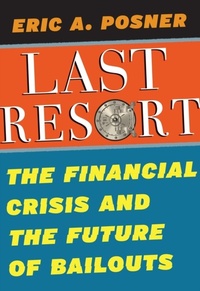
Last Resort
The Financial Crisis and the Future of Bailouts
1st Edition
Published on 22. December 2022
272 pages
978-0-226-42023-3 (ISBN)
Description

The bailouts during the recent financial crisis enraged the public. They felt unfair-and counterproductive: people who take risks must be allowed to fail. If we reward firms that make irresponsible investments, costing taxpayers billions of dollars, aren't we encouraging them to continue to act irresponsibly, setting the stage for future crises? And beyond the ethics of it was the question of whether the government even had the authority to bail out failing firms like Bear Stearns and AIG.
The answer, according to Eric A. Posner, is no. The federal government freely and frequently violated the law with the bailouts-but it did so in the public interest. An understandable lack of sympathy toward Wall Street has obscured the fact that bailouts have happened throughout economic history and are unavoidable in any modern, market-based economy. And they're actually good. Contrary to popular belief, the financial system cannot operate properly unless the government stands ready to bail out banks and other firms. During the recent crisis, Posner agues, the law didn't give federal agencies sufficient power to rescue the financial system. The legal constraints were damaging, but harm was limited because the agencies-with a few exceptions-violated or improvised elaborate evasions of the law. Yet the agencies also abused their power. If illegal actions were what it took to advance the public interest, Posner argues, we ought to change the law, but we need to do so in a way that also prevents agencies from misusing their authority. In the aftermath of the crisis, confusion about what agencies did do, should have done, and were allowed to do, has prevented a clear and realistic assessment and may hamper our response to future crises.
Taking up the common objections raised by both right and left, Posner argues that future bailouts will occur. Acknowledging that inevitability, we can and must look ahead and carefully assess our policy options before we need them.
The answer, according to Eric A. Posner, is no. The federal government freely and frequently violated the law with the bailouts-but it did so in the public interest. An understandable lack of sympathy toward Wall Street has obscured the fact that bailouts have happened throughout economic history and are unavoidable in any modern, market-based economy. And they're actually good. Contrary to popular belief, the financial system cannot operate properly unless the government stands ready to bail out banks and other firms. During the recent crisis, Posner agues, the law didn't give federal agencies sufficient power to rescue the financial system. The legal constraints were damaging, but harm was limited because the agencies-with a few exceptions-violated or improvised elaborate evasions of the law. Yet the agencies also abused their power. If illegal actions were what it took to advance the public interest, Posner argues, we ought to change the law, but we need to do so in a way that also prevents agencies from misusing their authority. In the aftermath of the crisis, confusion about what agencies did do, should have done, and were allowed to do, has prevented a clear and realistic assessment and may hamper our response to future crises.
Taking up the common objections raised by both right and left, Posner argues that future bailouts will occur. Acknowledging that inevitability, we can and must look ahead and carefully assess our policy options before we need them.
All prices
More details
Other editions
Additional editions
Book
03/2018
University of Chicago Press
€29.71
Shipment within 10-20 days
Person
Eric A. Posner is the Kirkland and Ellis Professor of Law at the University of Chicago Law School. He is the author or coauthor of several books, including
Law and Happiness and
The Perils of Global Legalism.
Content
- Intro
- Contents
- Introduction
- One. The Transformation of the Financial System
- Two. Crisis
- Three. The Lawfulness of the Rescue
- Four. The Trial of AIG
- Five. Fannie and Freddie
- Six. The Bankruptcies of General Motors and Chrysler
- Seven. Takings and Government Action in Emergencies
- Eight. Politics and Reform
- Acknowledgments
- Notes
- References
- Index
