

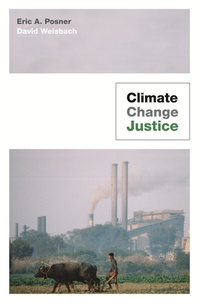
Climate Change Justice
1st Edition
Published on 22. February 2010
232 pages
978-1-4008-3440-2 (ISBN)
Description

A provocative contribution to the climate justice debate
Climate change and justice are so closely associated that many people take it for granted that a global climate treaty should-indeed, must-directly address both issues together. But, in fact, this would be a serious mistake, one that, by dooming effective international limits on greenhouse gases, would actually make the world's poor and developing nations far worse off. This is the provocative and original argument of Climate Change Justice. Eric Posner and David Weisbach strongly favor both a climate change agreement and efforts to improve economic justice. But they make a powerful case that the best-and possibly only-way to get an effective climate treaty is to exclude measures designed to redistribute wealth or address historical wrongs against underdeveloped countries.
In clear language, Climate Change Justice proposes four basic principles for designing the only kind of climate treaty that will work-a forward-looking agreement that requires every country to make greenhouse-gas reductions but still makes every country better off in its own view. This kind of treaty has the best chance of actually controlling climate change and improving the welfare of people around the world.
Climate change and justice are so closely associated that many people take it for granted that a global climate treaty should-indeed, must-directly address both issues together. But, in fact, this would be a serious mistake, one that, by dooming effective international limits on greenhouse gases, would actually make the world's poor and developing nations far worse off. This is the provocative and original argument of Climate Change Justice. Eric Posner and David Weisbach strongly favor both a climate change agreement and efforts to improve economic justice. But they make a powerful case that the best-and possibly only-way to get an effective climate treaty is to exclude measures designed to redistribute wealth or address historical wrongs against underdeveloped countries.
In clear language, Climate Change Justice proposes four basic principles for designing the only kind of climate treaty that will work-a forward-looking agreement that requires every country to make greenhouse-gas reductions but still makes every country better off in its own view. This kind of treaty has the best chance of actually controlling climate change and improving the welfare of people around the world.
All prices
More details
Edition
Course Book
Language
English
Place of publication
Princeton, NJ
United States
Publishing group
De Gruyter
Target group
Professional and scholarly
Edition type
Digital original
Product notice
Reflowable
Illustrations
8 line illus. 11 tables.
File size
3,54 MB
ISBN-13
978-1-4008-3440-2 (9781400834402)
Schweitzer Classification
Other editions
Additional editions
Eric A. Posner | David Weisbach
Climate Change Justice
Book
06/2015
Princeton University Press
€24.50
Shipment within 10-20 days
Eric A. Posner | David Weisbach
Climate Change Justice
Book
03/2010
1st Edition
Princeton University Press
€27.24
Shipment within 10-20 days
Persons
Eric A. Posner and David Weisbach teach at the University of Chicago Law School.
Content
Acknowledgments vii
Introduction 1
Chapter 1: Ethically Relevant Facts and Predictions 10
Chapter 2: Policy Instruments 41
Chapter 3: Symbols, Not Substance 59
Chapter 4: Climate Change and Distributive Justice: Climate Change Blinders 73
Chapter 5: Punishing the Wrongdoers: A Climate Guilt Clause? 99
Chapter 6: Equality and the Case against Per Capita Permits 119
Chapter 7: Future Generations: The Debate over Discounting 144
Chapter 8: Global Welfare, Global Justice, and Climate Change 169
A Recapitulation 189
Afterword: The Copenhagen Accord 193
Notes 199
Index 219
Introduction 1
Chapter 1: Ethically Relevant Facts and Predictions 10
Chapter 2: Policy Instruments 41
Chapter 3: Symbols, Not Substance 59
Chapter 4: Climate Change and Distributive Justice: Climate Change Blinders 73
Chapter 5: Punishing the Wrongdoers: A Climate Guilt Clause? 99
Chapter 6: Equality and the Case against Per Capita Permits 119
Chapter 7: Future Generations: The Debate over Discounting 144
Chapter 8: Global Welfare, Global Justice, and Climate Change 169
A Recapitulation 189
Afterword: The Copenhagen Accord 193
Notes 199
Index 219

