

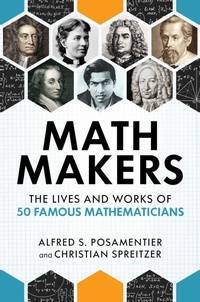
Math Makers
The Lives and Works of 50 Famous Mathematicians
Published on 1. February 2020
440 pages
978-1-63388-521-9 (ISBN)
Description

An entertaining history of mathematics as chronicled through fifty short biographies. Mathematics today is the fruit of centuries of brilliant insights by men and women whose personalities and life experiences were often as extraordinary as their mathematical achievements. This entertaining history of mathematics chronicles those achievements through fifty short biographies that bring these great thinkers to life while making their contributions understandable to readers with little math background. Among the fascinating characters profiled are Isaac Newton (1642-1727), the founder of classical physics and infinitesimal calculus-he frequently quarreled with fellow scientists and was obsessed by alchemy and arcane Bible interpretation; Sophie Germain (1776 - 1831), who studied secretly at the Ecole Polytechnique in Paris, using the name of a previously enrolled male student-she is remembered for her work on Fermat's Last Theorem and on elasticity theory; Emmy Noether (1882 - 1935), whom Albert Einstein described as the most important woman in the history of mathematics-she made important contributions to abstract algebra and in physics she clarified the connection between conservation laws and symmetry; and Srinivasa Ramanujan (1887-1920), who came from humble origins in India and had almost no formal training, yet made substantial contributions to mathematical analysis, number theory, infinite series, and continued fractions. The unusual behavior and life circumstances of these and many other intriguing personalities make for fascinating reading and a highly enjoyable introduction to mathematics.
Reviews / Votes
""A fascinating tour of the history of mathematics, provided by snapshots of the lives of ingenious mathematicians who guided humanity on a vast intellectual journey. From Thales to Brahmagupta, Ramanujan, Mandelbrot, and Mirzakhani, we stand in awe of their perseverance and brilliance." -Clifford A. Pickover, author of The Math Book and Archimedes to Hawking "Math Makers fills a gap that has been left in the literature since the publication of E. T. Bell's classic, Men of Mathematics, over eighty years ago. In addition to profiling the ancients and well-known founders of the field, Posamentier and Spreitzer also include more-contemporary mathematicians, six of whom are women. The authors not only provide enough personal details in each case to pique the reader's interest and remind us that mathematics is a human endeavor but also cleverly introduce an illustrative, serious sample of mathematics. A book that is both informative and entertaining-fun to dip into and handy as a reference." -Colin Pask, Professor Emeritus of mathematics, University of New South Wales, and author of Magnificent Principia "Readers will be captivated by the fifty mathematical figures profiled in Math Makers-especially by the six women discussed. In past centuries, women struggled to obtain permission to study math, but then delivered outstanding contributions to the field. Through these biographies, Alfred S. Posamentier and Christian Spreitzer present complex mathematical accomplishments, revealing the rich world of mathematics." -Gerhard Ackermann, PhD, professor and former president, Beuth University of Applied Sciences, Berlin "Most of us take mathematics for granted. We learn trigonometry and algebra in school, but our everyday use of mathematics permits us to ignore how it originated and by whom it was developed. Through fifty biographies, this book gives us a greater perspective on where our formulas come from, and it reveals the convoluted ways they were derived. Occasionally, theories and formulas are discovered by rare insight and brilliance, but most of the time they are built on prior work in the field. In Math Makers, we learn about those mathematicians whose efforts and achievements have allowed us to advance." -Ira Esformes, MD, former chief of Orthopedics and former chairman of the Department of Surgery at Hackensack University Medical Center, Pascack Valley Hospital "Posamentier and Spreitzer have thrown a party to which they have invited us-the readers-and fifty of the most intriguing and talented men and women in the history of mathematics. The authors introduce us to each guest, telling us who they are and what they have accomplished. Like at any good soiree, we have a grand time, we cherish every moment spent with these fascinating individuals, and we look forward to seeing these old and new friends again." -David S. Richeson, professor of mathematics at Dickinson College and author of Tales of Impossibility "Math Makers dispels the stereotypical image of mathematicians as introverted 'geeks.' These sketches of some of the greatest intellects of all time help to both humanize them as individuals and place their accomplishments into a historical perspective. In addition to providing fascinating details about these experts, the authors explain their subjects' contributions to the discipline in a manner clearly understandable to readers with limited mathematical background. This book will appeal to those who enjoy historical biographies as well as to those intrigued by the field of mathematics." -Stephen J. Margulis, MD, FACPMore details
Language
English
Place of publication
New York
United States
File size
26,12 MB
ISBN-13
978-1-63388-521-9 (9781633885219)
Copyright in bibliographic data and cover images is held by Nielsen Book Services Limited or by the publishers or by their respective licensors: all rights reserved.
Schweitzer Classification
Other editions
Additional editions
Alfred S. Posamentier | Christian Spreitzer
Math Makers
The Lives and Works of 50 Famous Mathematicians
Book
04/2020
Prometheus Books
€26.50
Shipment within 3-4 weeks
Persons
Alfred S. Posamentier has published over sixty books in the area of mathematics and mathematics education, including most recently The Mathematics of Everyday Life (with Christian Spreitzer). Currently, he is Distinguished Lecturer at New York City College of Technology of the City University of New York. After having been on the faculty of the City College of the City University of New York for forty years, where he was professor of mathematics education and dean of the School of Education, he subsequently held the same positions at Mercy College, New York, for five years. He then served as executive director for internationalization and sponsored programs at Long Island University, New York.
Christian Spreitzer is a coauthor of The Mathematics of Everyday Life and The Joy of Mathematics. He is professor of mathematics education at the University College of Teacher Education in Lower Austria and a lecturer at the University of Vienna. He was educated as a mathematician and physicist and received his master's and doctorate degree from the University of Vienna. He has published research articles in peer-reviewed journals on mathematics as well as mathematics education.
Christian Spreitzer is a coauthor of The Mathematics of Everyday Life and The Joy of Mathematics. He is professor of mathematics education at the University College of Teacher Education in Lower Austria and a lecturer at the University of Vienna. He was educated as a mathematician and physicist and received his master's and doctorate degree from the University of Vienna. He has published research articles in peer-reviewed journals on mathematics as well as mathematics education.
Content
- MATH MAKERS
- Dedication
- Contents
- Introduction
- Chapter 1. Thales of Miletus: Greek (ca. 624-546 BCE)
- Chapter 2. Pythagoras: Greek (575-500 BCE)
- Chapter 3. Eudoxus of Cnidus : Greek (390-337 BCE)
- Chapter 4. Euclid: Greek (ca. 300 BCE)
- Chapter 5. Archimedes: Greek (ca. 287-ca. 212 BCE)
- Chapter 6. Eratosthenes: Greek (276-194 BCE)
- Chapter 7. Claudius Ptolemy: Greco-Roman (100-170)
- Chapter 8. Diophantus of Alexandria: Hellenistic Greek (ca. 201-285)
- Chapter 9. Brahmagupta: Indian (598-668)
- Chapter 10. Leonardo Pisano Bigollo, "Fibonacci": Italian (1170-1250)
- Chapter 11. Gerolamo Cardano: Italian (1501-1576)
- Chapter 12. John Napier: Scottish (1550-1617)
- Chapter 13. Johannes Kepler: German (1571-1630)
- Chapter 14. René Descartes: French (1596-1650)
- Chapter 15. Pierre de Fermat: French (1607-1665)
- Chapter 16. Blaise Pascal: French (1623-1662)
- Chapter 17. Isaac Newton: English (1642-1727)
- Chapter 18. Gottfried Wilhelm (von) Leibniz: German (1646-1716)
- Chapter 19. Giovanni Ceva: Italian (1647-1734)
- Chapter 20. Robert Simson: Scottish (1687-1768)
- Chapter 21. Christian Goldbach: German (1690-1764)
- Chapter 22. The Bernoullis: Swiss (1700-1782)
- Chapter 23. Leonhard Euler: Swiss (1707-1783)
- Chapter 24. Maria Gaetana Agnesi: Italian (1718-1799)
- Chapter 25. Pierre Simon Laplace: French (1749-1827)
- Chapter 26. Lorenzo Mascheroni: Italian (1750-1800)
- Chapter 27. Joseph-Louis Lagrange: French/Italian (1736-1813)
- Chapter 28. Sophie Germain: French (1776-1831)
- Chapter 29. Carl Friedrich Gauss: German (1777-1855)
- Chapter 30. Charles Babbage: English (1791-1871)
- Chapter 31. Niels Henrik Abel: Norwegian (1802-1829)
- Chapter 32. Évariste Galois: French (1811-1832)
- Chapter 33. James Joseph Sylvester: English (1814-1897)
- Chapter 34. Ada Lovelace: English (1815-1852)
- Chapter 35. George Boole: English (1815-1864)
- Chapter 36. Bernhard Riemann: German (1826-1866)
- Chapter 37. Georg Cantor: German (1845-1918)
- Chapter 38. Sofia Kovalevskaya: Russian (1850-1891)
- Chapter 39. Giuseppe Peano: Italian (1858-1932)
- Chapter 40. David Hilbert: German (1862-1943)
- Chapter 41. G. H. Hardy: English (1877-1947)
- Chapter 42. Emmy Noether: German (1882-1935)
- Chapter 43. Srinivasa Ramanujan: Indian (1887-1920)
- Chapter 44. John von Neumann: Hungarian-American (1903-1957)
- Chapter 45. Kurt Gödel: Austrian-American (1906-1978)
- Chapter 46. Alan Turing: English (1912-1954)
- Chapter 47. Paul Erdos: Hungarian (1913-1996)
- Chapter 48. Herbert A. Hauptman: American (1917-2011)
- Chapter 49. Benoit Mandelbrot: Polish-American (1924-2010)
- Chapter 50. Maryam Mirzakhani: Iranian (1977-2017)
- Epilogue
- Appendix: Hilbert's Axioms
- Notes
- References
