

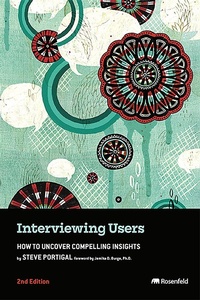
Interviewing Users
Description

Interviewing is easy, right? Anyone can do it... but few do it well enough to unlock the benefits and insights that interviewing users and customers can yield.
In this new and updated edition of the acclaimed classic Interviewing Users, Steve Portigal quickly and effectively dispels the myth that interviewing is trivial. He shows how research studies and logistics can be used to determine concrete goals for a business and takes the reader on a detailed journey into the specifics of interviewing techniques, best practices, fieldwork, documentation, and how to make sense of uncovered data. Then Steve takes the process even further―showing the methods and details behind asking questions―from the words themselves to the interviewer's actions and how they influence an interview. There is even a chapter on making sure that information gleaned from the research study is used by the business in such a way to make it impactful and worthwhile. Oh, and for good measure he throws in information about Research Operations.
But, hey, that's just the nuts and bolts of the book. The truly fun part is Steve's voice and how he portrays this information through amusing anecdotes about his career, fascinating examples from other practitioners, and tips and tricks that only the most experienced UX researchers, like Steve, could come up with. As a nod to the pandemic, he offers ideas for the best way to interview someone remotely, and he also discusses personal bias―how to identify and deal with it so that it doesn't affect interviews.
Everyone will get something from this book. But beyond the requisite information, it's simply a good read. And if you want another good read with stories galore, pick up Steve's other book Doorbells, Danger, and Dead Batteries.
"Quite simply the best book on when, why, and how you should conduct user interview studies." ?Elizabeth F. Churchill, PhD, Senior Director, Google
Who Should Read This Book?- Anyone and everyone who is interested in finding out what makes their business tick, i.e., who their users are.
- Anyone and everyone who wants to learn how to interview and listen to people.
- Anyone and everyone, including CEOs, user researchers, designers, engineers, marketers, product managers, strategists, interviewers, and you.
- User research is key for companies to include in their design and development process.
- The best way to do user research is through interviewing users and determining their needs.
- Interviewing can identify what could be designed or what is actually a problem.
- Teams who meet their users face-to-face will build better products.
- Field research takes a lot of preparation to be successful―and a solid plan in advance.
- There are critical techniques and frameworks for mapping human behavior.
- A good interviewer always puts their participants at ease.
- If you ask the right questions, you'll get the right answers.
- A smart interviewer checks their worldview at the door.
- To establish a rapport with your interviewee, listen and don't be judgmental.
- Research data is a combination of analysis and synthesis.
- The importance of research analysis must be continually highlighted and emphasized to the powers that be.
More details
Person
Steve is the author of two books: this one (first edition), and Doorbells, Danger, and Dead Batteries: User Research War Stories. He's also the host of the Dollars to Donuts podcast, where he interviews people who lead user research in their organizations. Steve is an in-demand presenter who gives talks and leads workshops at corporate events and conferences around the world.
Content
- Intro
- Title Page
- Copyright
- Dedication
- How to Use This Book
- Frequently Asked Questions
- Contents
- Foreword
- Introduction
- Chapter 1: Interviewing Addresses a Business Need
- Learning About Users to Inform Decisions
- A High-Level Research Plan
- To Interview Well, One Must Study
- The Impact of Interviewing
- The Last Word
- Chapter 2: Research Logistics
- Finding Participants
- Scheduling Interviews
- Incentives
- The Interview Guide
- The Last Word
- Chapter 3: Contextual Methods-More Than Just Asking Questions
- Prework
- Showing and Telling
- Bring the Tools
- Observation and Shadowing
- Even More Methods
- The Last Word
- Chapter 4: The Successful Fieldwork Experience
- Effective Team Participation
- Preparing Your Colleagues for Fieldwork
- Planning for Remote Research
- Anticipating the Key Stages of the Interview
- The Last Word
- Chapter 5: Best Practices for Interviewing
- Check Your Worldview at the Door
- Embrace How Other People See the World
- Build Rapport
- Listen
- Optimizing for Remote
- The Last Word
- Chapter 6: The Intricacies of Asking Questions
- There's Power in Your Silence
- The Backchannel Trap
- How You Ask
- When You Ask
- A Palette of Question Types
- Managing the Ebb and Flow of the Interview
- Embracing Your Participant's Worldview
- The Last Word
- Chapter 7: Better Interviews
- Troubleshooting Common Interview Problems
- Interview Variations and Special Cases
- Improving as an Interviewer
- The Last Word
- Chapter 8: Documenting the Interview
- Taking Notes
- Audio Recording the Interview
- Video Recording the Interview
- Photographing the Interview
- Sketching the Interview
- Debriefing After the Interview
- The Last Word
- Chapter 9: Making Sense of Your Data
- Analysis and Synthesis
- Write a Topline Report
- Analysis: Tagging Your Data
- Synthesis: Collaboration and Clustering
- Delivering Research Results
- Brainstorming and Taking Action
- The Last Word
- Chapter 10: Making an Impact with Your Research
- Planning and Tracking Research
- Delivery for Impact
- Driving Interest and Engagement
- Each Organization Has Its Own Challenges
- The Last Word
- Index
- Acknowledgments
- About the Author
- Back Cover
