

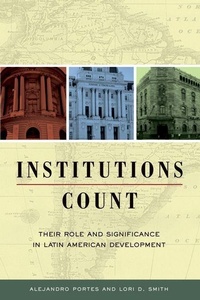
Institutions Count
Their Role and Significance in Latin American Development
1st Edition
Published on 12. September 2012
220 pages
978-0-520-95406-9 (ISBN)
Description

What leads to national progress? The growing consensus in the social sciences is that neither capital flows, nor the savings rate, nor diffuse values are the key, but that it lies in the quality of a nation's institutions. This book is the first comparative study of how real institutions affect national development. It seeks to examine and deepen this insight through a systematic study of institutions in five Latin American countries and how they differ within and across nations. Postal systems, stock exchanges, public health services and others were included in the sample, all studied with the same methodology. The country chapters present detailed results of this empirical exercise for each individual country. The introductory chapters present the theoretical framework and research methodology for the full study. The summary results of this ambitious study presented in the concluding chapter draw comparisons across countries and discuss what these results mean for national development in Latin America.
More details
Other editions
Additional editions
Alejandro Portes | Lori D. Smith
Institutions Count
Their Role and Significance in Latin American Development
Book
09/2012
1st Edition
University of California Press
€31.00
Shipment within 10-20 days

Alejandro Portes | Lori D. Smith
Institutions Count
Their Role and Significance in Latin American Development
Book
09/2012
1st Edition
University of California Press
€60.70
Article exhausted; check different version
Content
List of Illustrations
Preface
Acknowledgments
1. Institutions and Development: A Conceptual Reanalysis
Alejandro Portes
2. The Comparative Study of Institutions: The "Institutional Turn" in Development Studies: A Review
Alejandro Portes and Lori D. Smith
3. Institutional Change and Development in Argentina
Alejandro Grimson, Ana Castellani, and Alexander Roig
4. Institutional Change and Development in Chilean Market Society
Guillermo Wormald and Daniel Brieba
5. The Colombian Paradox: A Thick Institutional Analysis
César Rodríguez-Garavito
6. Development Opportunities: Politics, the State, and Institutions in the Dominican Republic in the Twenty-First Century
Wilfredo Lozano
7. The Uneven and Paradoxical Development of Mexico's Institutions
José Luis Velasco
8. Conclusion: The Comparative Analysis of the Role of Institutions in National Development
Alejandro Portes and Lori D. Smith
Appendix: Investigators
Contributors
Index
Preface
Acknowledgments
1. Institutions and Development: A Conceptual Reanalysis
Alejandro Portes
2. The Comparative Study of Institutions: The "Institutional Turn" in Development Studies: A Review
Alejandro Portes and Lori D. Smith
3. Institutional Change and Development in Argentina
Alejandro Grimson, Ana Castellani, and Alexander Roig
4. Institutional Change and Development in Chilean Market Society
Guillermo Wormald and Daniel Brieba
5. The Colombian Paradox: A Thick Institutional Analysis
César Rodríguez-Garavito
6. Development Opportunities: Politics, the State, and Institutions in the Dominican Republic in the Twenty-First Century
Wilfredo Lozano
7. The Uneven and Paradoxical Development of Mexico's Institutions
José Luis Velasco
8. Conclusion: The Comparative Analysis of the Role of Institutions in National Development
Alejandro Portes and Lori D. Smith
Appendix: Investigators
Contributors
Index
