

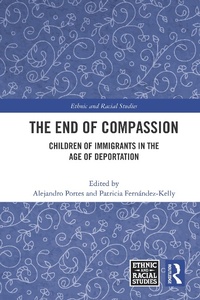
The End of Compassion
Children of Immigrants in the Age of Deportation
1st Edition
Published on 17. December 2020
274 pages
978-1-000-32806-6 (ISBN)
Description

This book brings together the most recent and the most comprehensive collection of articles on a population at risk: the children of immigrants in the United States, especially those children whose parents came to the country without legal authorization.
The end of compassion and the shift to temporary migration to source the labour needs of the American economy have brought in their wake a series of consequences, some of which were predictable and others unexpected. The chapters fully document the nature and implications of the enforcement initiatives implemented by the American government in recent years and their interaction with state policies and local contexts of reception. This collection provides an exhaustive testimony of the severe conditions faced by unauthorized migrant families and their children today and their repercussions in both countries of origin and those where they currently live.
The End of Compassion will be of interest to researchers and academics studying migration in the United States and ethnic and racial studies, and to advanced students of sociology, public policy, law and political science. This book was originally published as a special issue of the journal Ethnic and Racial Studies.
The end of compassion and the shift to temporary migration to source the labour needs of the American economy have brought in their wake a series of consequences, some of which were predictable and others unexpected. The chapters fully document the nature and implications of the enforcement initiatives implemented by the American government in recent years and their interaction with state policies and local contexts of reception. This collection provides an exhaustive testimony of the severe conditions faced by unauthorized migrant families and their children today and their repercussions in both countries of origin and those where they currently live.
The End of Compassion will be of interest to researchers and academics studying migration in the United States and ethnic and racial studies, and to advanced students of sociology, public policy, law and political science. This book was originally published as a special issue of the journal Ethnic and Racial Studies.
More details
Series
Edition
1. Auflage
Language
English
Place of publication
London
United Kingdom
Publishing group
Taylor & Francis Ltd
Target group
College/higher education
ISBN-13
978-1-000-32806-6 (9781000328066)
Copyright in bibliographic data and cover images is held by Nielsen Book Services Limited or by the publishers or by their respective licensors: all rights reserved.
Schweitzer Classification
Other editions
Additional editions
Alejandro Portes | Patricia Fernandez-Kelly
The End of Compassion
Children of Immigrants in the Age of Deportation
Book
09/2023
1st Edition
Routledge
€65.30
Shipment within 15-20 days
Alejandro Portes | Patricia Fernandez-Kelly
The End of Compassion
Children of Immigrants in the Age of Deportation
Book
10/2020
1st Edition
Routledge
€193.50
Shipment within 15-20 days
Persons
Alejandro Portes is Professor of Sociology (Emeritus) at Princeton University, USA, and Professor of Law and Sociology at the University of Miami, USA.
Patricia Fernandez-Kelly is Professor of Sociology and Director of the Centre for Migration and Development, Princeton University, USA.
Patricia Fernandez-Kelly is Professor of Sociology and Director of the Centre for Migration and Development, Princeton University, USA.
Content
Preface
Introduction: Bifurcated immigration and the end of compassion
Alejandro Portes
1. Creating the exclusionist society: from the War on Poverty to the war on immigrants
Douglas S. Massey
2. The students we share: falling through the cracks on both sides of the US-Mexico border
Patricia Gandara
3. DACAmented in the age of deportation: navigating spaces of belonging and vulnerability in social and personal lives
Roberto G. Gonzales, Kristina Brant and Benjamin Roth
4. An imperfect realignment: the movement of children of immigrants and their families from the United States to Mexico
Ruben Hernandez-Leon, Victor Zuniga and Sarah M. Lakhani
5. Hope turned sour: second-generation incorporation and mobility in U.S. new immigrant destinations
Helen B. Marrow
6. Integrating Hispanic immigrant youth: perspectives from white and black Americans in emerging Hispanic communities and schools
Krista M. Perreira, Stephanie Potochnick and M. Priscilla Brietzke
7. The value of reproduction: multiple livelihoods, cultural labor, and immigrants in Iowa and North Carolina
David Griffith
8. Infrastructures of repression and resistance: how Tennesseans respond to the immigration enforcement regime
Meghan Conley and Jon Shefner
9. The integration paradox: contrasting patterns in adaptation among immigrant children in Central New Jersey
Patricia Fernandez-Kelly
10. Coming of age before the great expulsion: the story of the CILS-San Diego sample 25 years later
Cynthia Feliciano and Ruben G. Rumbaut
11. The changing U.S. Latinx immigrant population: demographic trends with implications for employment, schooling, and population Integration
Richard Duran
12. The model minority stereotype and the national identity question: the challenges facing Asian immigrants and their children
Min Zhou and Carl L. Bankston III
Introduction: Bifurcated immigration and the end of compassion
Alejandro Portes
1. Creating the exclusionist society: from the War on Poverty to the war on immigrants
Douglas S. Massey
2. The students we share: falling through the cracks on both sides of the US-Mexico border
Patricia Gandara
3. DACAmented in the age of deportation: navigating spaces of belonging and vulnerability in social and personal lives
Roberto G. Gonzales, Kristina Brant and Benjamin Roth
4. An imperfect realignment: the movement of children of immigrants and their families from the United States to Mexico
Ruben Hernandez-Leon, Victor Zuniga and Sarah M. Lakhani
5. Hope turned sour: second-generation incorporation and mobility in U.S. new immigrant destinations
Helen B. Marrow
6. Integrating Hispanic immigrant youth: perspectives from white and black Americans in emerging Hispanic communities and schools
Krista M. Perreira, Stephanie Potochnick and M. Priscilla Brietzke
7. The value of reproduction: multiple livelihoods, cultural labor, and immigrants in Iowa and North Carolina
David Griffith
8. Infrastructures of repression and resistance: how Tennesseans respond to the immigration enforcement regime
Meghan Conley and Jon Shefner
9. The integration paradox: contrasting patterns in adaptation among immigrant children in Central New Jersey
Patricia Fernandez-Kelly
10. Coming of age before the great expulsion: the story of the CILS-San Diego sample 25 years later
Cynthia Feliciano and Ruben G. Rumbaut
11. The changing U.S. Latinx immigrant population: demographic trends with implications for employment, schooling, and population Integration
Richard Duran
12. The model minority stereotype and the national identity question: the challenges facing Asian immigrants and their children
Min Zhou and Carl L. Bankston III
