

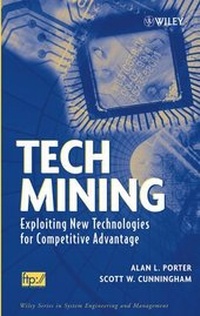
Tech Mining
Description

Reviews / Votes
"...useful to a variety of institutions, programs, and people."(E-STREAMS, August 2005) "Two data mining practitioners explain how to use the availablesoftware tools...to quickly access the technologicalinformation needed to gain competitive advantage." (ResearchTechnology Management, May-June 2005)More details
Other editions
Additional editions
Persons
Content
Preface.
Acknowledgments.
Acronyms & Shorthands-Glossary.
PART I. UNDERSTAND TECH MINING.
Chapter 1. Technological Innovation and the Need for Tech Mining.
1.1 Why Innovation is Significant.
1.2 Innovation Processes.
1.3 Innovation Institutions and Their Interests.
1.4 Innovators and Their Interests.
1.5 Technological Innovation in an Information Age.
1.6 Information About Emerging Technologies.
Chapter 1 Take-Home Messages.
Chapter Resources.
Chapter 2. How Tech Mining Works.
2.1 What is Tech Mining?
2.2 Why Do Tech Mining?
2.3 What Is Tech Mining's Ancestry?
2.4 How to Conduct the Tech Mining Process?
2.5 Who Does Tech Mining?
2.6 Where Is Tech Mining Most Needed?
Chapter 2 Take-Home Messages.
Chapter Resources.
Chapter 3. What Tech Mining Can Do for You.
3.1 Tech Mining Basics.
3.2 Tech Mining Analyses.
3.3 Putting Tech Mining Information to Good Use.
3.4 Managing and Measuring Tech Mining.
Chapter 3 Take-Home Messages.
Chapter 4. Example Results: Fuel Cells Tech Mining.
4.1 Overview of Fuel Cells.
4.2 Tech Mining Analyses.
4.3 Tech Mining Results.
4.4 Tech Mining Information Processes.
4.5 Tech Mining Information Products.
Chapter 4 Take-Home Messages.
Chapter Resources.
Chapter 5. What to Watch For in Tech Mining.
5.1 Better Basics.
5.2 Research Profiling and Other Perspectives on the Data.
5.3 More Informative Products.
5.4 Knowledge Discovery.
5.5 Knowledge Management.
5.6 New Tech Mining Markets.
5.7 Dangers.
Chapter 5 Take-Home Messages.
Chapter Resources.
PART II. DOING TECH MINING.
Chapter 6. Finding the Right Sources.
6.1 R&D Activity.
6.2 R&D Output Databases.
6.3 Determining the Best Sources.
6.4 Arranging Access to Databases.
Chapter 6 Take-Home Messages.
Chapter Resources.
Chapter 7. Forming the Right Query.
7.1 An Iterative Process.
7.2 Queries Based on Substantive Terms.
7.3 Nominal Queries.
7.4 Tactics and Strategies for Query Design.
7.5 Changing the Query.
Chapter 7 Take-Home Messages.
Chapter 8. Getting the Data.
8.1 Accessing Databases.
8.2 Search and Retrieval from a Database.
8.3 What to Do, and Not to Do.
Chapter 8 Take-Home Messages.
Chapter 9. Basic Analyses.
9.1 In the Beginning.
9.2 What You Can Do with the Data.
9.3 Relations Among Documents and Terms Occurring in Their Information Fields.
9.4 Relationships.
9.5 Helpful Basic Analyses.
Chapter 9 Take-Home Messages.
Chapter 10. Advanced Analyses.
10.1 Why Perform Advanced Analyses?
10.2 Data Representation.
10.3 Analytical Families.
Chapter 10 Take-Home Messages.
Chapter Resources.
Chapter 11. Trend Analyses.
11.1 Perspective.
11.2 An Example Time Series Description and Forecast.
11.3 Multiple Forecasts.
11.4 Research Fronts.
11.5 Novelty.
Chapter 11 Take-Home Messages.
Chapter Resources.
Chapter 12. Patent Analyses.
12.1 Why patent Analyses?
12.2 Getting Started.
12.3 The 'What' and 'Why' of patent Analysis.
12.4 Tech Mining Patent Analysis Case Illustration: Fuel Cells.
12.5 Patent Citation Analysis.
12.6 For Whom?
12.7 TRIZ.
12.8 Reflections.
Chapter 12 Take-Home Messages.
Chapter Resources.
Chapter 13. Generating and Presenting Innovation Indicators.
13.1 Expert Opinion in Tech Mining.
13.2 Innovation Indicators.
13.3 Information Representation and Packaging.
13.4 Examples of Putting Tech Mining Information Representation to Use.
13.5 Summing Up.
Chapter Resources.
Chapter 14. Managing the Tech Mining Process.
14.1 Tough Challenges.
14.2 Tech Mining Communities.
14.3 Process Management.
14.4 Enhancing the Prospects of Tech Mining Utilization.
14.5 Institutionalizing the Tech Mining Function.
14.6 The Learning Curve.
Chapter 14 Take-Home Messages.
Chapter 15. Measuring Tech Mining Results.
15.1 Why Measure?
15.2 What to Measure.
15.3 How to Measure.
15.4 Enabling Measurement.
15.5 Effective Measurement.
15.6 Using Measurements to Bolster Tech Mining.
Chapter 15 Take-Home Messages.
Chapter Resources.
Chapter 16. Examples Process: Tech Mining on Fuel Cells.
16.1 Introduction.
16.2 First Step: Issue Identification.
16.3 Second Step: Selection of Information Sources.
16.4 Third Step: Search Refinement and Data Retrieval.
16.5 Fourth Step: Data Cleaning.
16.6 Fifth Step: Basic Analyses.
16.7 Sixth Step: Advanced Analyses.
16.8 Seventh Step: Representation.
16.9 Eight Step: Interpretation.
16.10 Ninth Step: Utilization.
16.11 What Can We Learn.
Chapter 6 Take-Home Messages.
Chapter Resources.
Appendix A: Selected Publication and patent Databases.
Appendix B: Text Mining Software.
Appendix C: What You Can Do Without Tech Mining Software.
Appendix D: Statistics and Distributions for Analyzing Text Entities.
References.
Index.
