

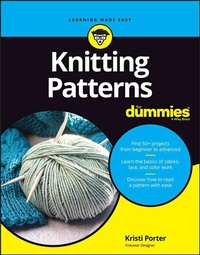
Knitting Patterns For Dummies
Description

Knitting is fun, functional, and stress-relieving--get started today with Knitting Patterns For Dummies! Written for all skill levels and perfect for beginners, it includes patterns for socks, scarves, sweaters, and beyond. Add to your knitting repertoire and experiment with different textures, fun colors, and pattern shapes. You'll love the full-color project photos in the color insert and helpful, easy-to-understand instructions for every single project. Even if you've never followed a written pattern before, you can knit cool stuff with the practical, modern patterns inside. This friendly guide will help you pick the right needles and yarn, step you through reading and knitting the patterns, and then finishing off your masterpieces.
* Select the supplies that are right for your projects
* Learn how to read a knitting pattern
* Practice working common stitches and creating different textures
* Make gifts for friends, clothing for yourself, and cold weather wear
Need more practice? Want fun new ideas? Just getting started? All knitters welcome!
More details
Other editions
Additional editions
Person
Content
Part 1: The Nuts and Bolts (or Sticks and String) of Knitting 7
Chapter 1: The Right Stuff: Knitting Supplies 9
Chapter 2: Gauge Your Success 21
Chapter 3: Do You Measure Up? Size Matters 31
Chapter 4: Break the Code: Reading Patterns 39
Part 2: A Primer on Stitches and Color 49
Chapter 5: The Simplest Stitches 51
Chapter 6: Stitches that Look Tricky but Aren't 59
Chapter 7: Colorful Stitches 79
Part 3: Patterns with Rectangles and Related Shapes 99
Chapter 8: Rectangles to Wear 101
Chapter 9: Rectangles for the Home 123
Chapter 10: Almost Rectangles 139
Part 4: Patterns with Circles, Triangles, and More 167
Chapter 11: Knitting in Circles 169
Chapter 12: Shaping Triangles 189
Chapter 13: Putting Together Rectangles and Triangles 209
Chapter 14: Knitting Beyond Geometry Class 239
Part 5: The Part of Tens 265
Chapter 15: Ten Things You Can Knit with that Aren't Yarn or Needles 267
Chapter 16: Almost Ten Things You Can Do with Your Swatches 271
Chapter 17: Ten Ways to MacGyver Your Knitting 275
Chapter 18: Ten Smart Ways to Care for Your Knits 279
Appendix 285
Index 301
Introduction
I have great enthusiasm for knitting and for sharing the craft with others. Because you've picked up this book, you clearly share at least some of my enthusiasm. It's hard to put a finger on what it is about knitting that pulls people in. Maybe it's the simple, repetitive motions and the feel and look of the fibers and fabrics that we create; or maybe it's the chance to share in a long tradition that cuts across boundaries of age and background. It's also pretty cool to be able to point to a garment and say "I made that beautiful, warm thing with some string and a couple of sticks!" Whatever it is that attracts you, knitting is something that you can return to your whole life, making all kinds of projects - and friends - along the way.
I love teaching people how to knit. And, even more, I love teaching them to knit the things that they want to knit. Putting this book together challenged me to come up with straightforward patterns with broad appeal and lots of room for improvisation. I charged myself with two goals: to make designs that would flatter lots of different people and to think carefully about keeping the shapes simple, relying on basic shapes like rectangles, cylinders, and triangles to create patterns that are knittable and easy to understand.
I hope that you take the patterns in this book and make them your own. Even if you're new to knitting, you can still make design decisions, whether it's the color combination you choose or the yarn and stitch pattern you decide to knit. I firmly believe that all knitters can be their own designers. So, I try to provide opportunities for you to master not only knitting skills but also skills that you need to understand why things are the way they are in a pattern - and how to change them if you want to.
Whether you're a brand new knitter, a seasoned stitcher, or someone returning to the needles after a long absence, this book gives you lots of great patterns to choose from and plenty of help along the way. Knitting Patterns For Dummies is filled with classic knits that won't go out of style - and they're all presented in an easy-to-follow format.
About This Book
Knitting Patterns For Dummies is chock-full of knitting patterns. In fact, the book contains nearly 40 basic designs. And with the variations offered at the end of many of the patterns, you have lots of projects to choose from! You'll find that the patterns are flexible, which means that you can knit from the same pattern more than once using different yarns or details. So, each time you knit from the pattern you can come up with something new and fresh.
The offerings in this book have a broad range of appeal. You can find things for adults, babies and kids, and things for your home - there's something for everyone. But more important, perhaps, is the fact that this book has something for every body. While many knitting patterns top out at rather diminutive sizes, Knitting Patterns For Dummies offers size-inclusive patterns through 3X.
You may have noticed that this is a big book - a big book with lots of writing. Because of all this writing, it may not be as pretty as some of the other knitting books on the shelf. But Knitting Patterns For Dummies has room for lots of patterns, with plenty of space left over for me to explain everything I think you need to know to work your way through them.
For instance, Part 2 offers a mini stitch dictionary with practice opportunities for trying different stitches, which is helpful to consult if you want to substitute a different stitch pattern, figure out how to work successfully with more than one color, or turn your first cable. In addition, if you come across a technique that's unusual or a skill that you may not have picked up yet, you can find it right there in the pattern in the "New skill" section. You won't have to run to your reference shelf, consult other sources, or wait until Friday morning for knitting class. I explain things like picking up and knitting right where you need them (with accompanying diagrams even!). Hopefully, you'll feel like you have an expert knitter right there with you.
Don't worry - you don't have to read more than 300 pages to get started on knitting the great projects in this book! If you're familiar with knitting basics, you can dive right in and start knitting. Look through the table of contents or browse through the photographs in the color insert to decide what you want to make. Pick and choose the information you need at any time.
Conventions Used in This Book
I include a few standard conventions to help you navigate this book:
- Italics point out defined terms and emphasize certain words.
- Boldface text indicates the key words in bulleted and numbered lists.
Monofonthighlights web addresses.
Each pattern in this book begins with a photograph of the finished project. And if you have to use any techniques that may be new to you, they're explained in the "New skill" section of the pattern. I also give you the materials and vital statistics needed for the project right up front; look there to find information regarding the size of the finished project, the materials you need to complete it, the gauge you need to knit at, and any diagrams that may help you complete the project. After the directions for the basic pattern, you'll often find one or more variations. These variations provide instructions and inspiration for altering the pattern, which allows you to knit the same pattern in lots of different ways. I suggest that you read the variations before you start the pattern to see if you want to knit one of the variations instead. In some cases, the supplies you need are different from those listed in the basic pattern.
Like most books of knitting patterns, this book uses conventional pattern formatting and some standard knitting abbreviations. You can familiarize yourself with the abbreviations and find out how to read patterns in Chapter 4.
Foolish Assumptions
This book isn't a "learn to knit" book, though I do think it's a "learn to knit better" book. I assume that you're either a beginning knitter who's looking for an easy introduction to patterns or an experienced knitter who wants some new patterns to try and to experiment with. If you've never knit a single stitch, you may want to flip through Knitting For Dummies by Pam Allen (Wiley), take a lesson, or have a friend guide you through the steps of casting on, knitting, purling, and binding off. Once you have the hang of the absolute basics, you'll be ready to jump into the patterns presented in this book.
And despite the title of the book, I'm assuming that you're no dummy and that you're absolutely capable of doing what you set your mind to. I have little tolerance for those people who claim they can't do basic math or can't follow a set of instructions. The directions in this book are broken down step by step and are written without unnecessary jargon or knitterese. Over half the projects are suitable first projects and all of them are within the grasp of the adventurous novice. Sure, you'll sometimes run into frustration along the way, but I firmly believe that doing something a little bit challenging is good for you. Challenges are good for your brain and good for your self-esteem. In fact, science has shown that having the right amount of challenge is what makes a hobby engaging. So go ahead and be ambitious.
How This Book Is Organized
The first two parts of this book contain information that you may want to know before you start knitting, particularly if you're a new knitter. The bulk of the book, Parts 3 and 4, are the pattern chapters. The patterns in these parts are organized by their basic geometry, starting with the rectangle and moving up in complexity to fully shaped sweaters for the whole family. Similarly, each chapter is organized by level of difficulty, so choose patterns at the beginning of a chapter if you're looking for a simpler project and choose ones at the end of a chapter if you want a more ambitious project.
Part 1: The Nuts and Bolts (or Sticks and String) of Knitting
Part 1 is packed with useful information. Chapter 1, for instance, introduces you to the basic tools of the trade: yarn, needles, and the other gadgets that you want to have at hand. Chapter 2 gives you the lowdown on gauge. Understanding what gauge is and how to knit at the gauge specified in a pattern is vital to knitting pieces that fit well and turn out right. If you're a new knitter, or if the garments you knit never seem to fit right, read Chapter 2 and take it to heart! If you take the opportunity to practice gauge and get it right, you'll be richly rewarded. Chapter 3 deals with taking body measurements and knowing what size garments to knit. Because you can't try your sweater on before you knit it, it's imperative to know what size is right for you. Finally, in Chapter 4, I give you guidance on reading knitting patterns. Knitting can seem like a foreign language at times, but after you master the lingo, you'll be ready to read.
Part 2: A Primer on Stitches and Color
Part 2 provides...
