

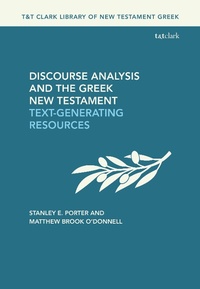
Discourse Analysis and the Greek New Testament
Text-Generating Resources
1st Edition
Published on 28. December 2023
320 pages
978-0-567-70986-8 (ISBN)
Description

This volume examines and outlines a Systemic Functional Linguistic (SFL) model of discourse analysis and its relationship to New Testament Greek. The book reflects upon how SFL has grown as a field since it was first introduced to New Testament Greek studies by Stanley E. Porter in the 1980s.
Porter and Matthew Brook O'Donnell first introduce basic concepts regarding discourse analysis and the major approaches towards it within New Testament studies. They then provide a detailed exploration of discourse analysis in terms of the textual metafunction, beginning with an introduction to the architecture of language within SFL, before exploring several individual elements within it. By focusing upon these individual components - in particular, theme and information structure, markedness and prominence, and coherence and cohesive harmony - Porter and O'Donnell introduce and exemplify the major resources of the textual metafunction.
Porter and Matthew Brook O'Donnell first introduce basic concepts regarding discourse analysis and the major approaches towards it within New Testament studies. They then provide a detailed exploration of discourse analysis in terms of the textual metafunction, beginning with an introduction to the architecture of language within SFL, before exploring several individual elements within it. By focusing upon these individual components - in particular, theme and information structure, markedness and prominence, and coherence and cohesive harmony - Porter and O'Donnell introduce and exemplify the major resources of the textual metafunction.
More details
Series
Edition
1. Auflage
Language
English
Place of publication
London
United Kingdom
Publishing group
Bloomsbury Publishing PLC
Target group
Professional and scholarly
ISBN-13
978-0-567-70986-8 (9780567709868)
Copyright in bibliographic data and cover images is held by Nielsen Book Services Limited or by the publishers or by their respective licensors: all rights reserved.
Schweitzer Classification
Other editions
Additional editions
Stanley E. Porter | Matthew Brook O'Donnell
Discourse Analysis and the Greek New Testament
Text-Generating Resources
Book
06/2025
T.& T.Clark Ltd
€53.40
Shipment within 3-4 weeks
Persons
Stanley E. Porter is President, Dean and Professor of New Testament, McMaster Divinity College, Canada. His latest book is Linguistic Descriptions of the Greek New Testament: New Studies in Systemic Functional Linguistics (2023).
Matthew Brook O'Donnell is Research Associate in the Communication Neuroscience Lab, Annenberg School for Communication, University of Pennsylvania, USA. He is author of Corpus Linguistics and the Greek of the New Testament (2005).
Matthew Brook O'Donnell is Research Associate in the Communication Neuroscience Lab, Annenberg School for Communication, University of Pennsylvania, USA. He is author of Corpus Linguistics and the Greek of the New Testament (2005).
Content
Preface
Abbreviations
Tables, Examples, Figures, and System Networks
Part 1: Discourse Analysis and New Testament Studies
1. Introduction to Discourse Analysis and Its Basic Concepts
2. Discourse Analysis and the Study of the Greek New Testament
Part 2: Toward Systemic Functional Discourse Analysis
3. Context, Co-Text, Register, and Its Metafunctions
4. Information Structure and Thematization
5. Linguistic Highlighting: Prominence, Markedness, and Grounding
6. Cohesion and Coherence
7. Conclusion: Discourse Analysis as a Critical Tool for New Testament Studies
Modern Authors Index
Ancient Sources Index
Abbreviations
Tables, Examples, Figures, and System Networks
Part 1: Discourse Analysis and New Testament Studies
1. Introduction to Discourse Analysis and Its Basic Concepts
2. Discourse Analysis and the Study of the Greek New Testament
Part 2: Toward Systemic Functional Discourse Analysis
3. Context, Co-Text, Register, and Its Metafunctions
4. Information Structure and Thematization
5. Linguistic Highlighting: Prominence, Markedness, and Grounding
6. Cohesion and Coherence
7. Conclusion: Discourse Analysis as a Critical Tool for New Testament Studies
Modern Authors Index
Ancient Sources Index
