

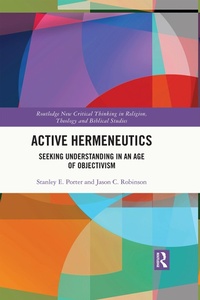
Active Hermeneutics
Seeking Understanding in an Age of Objectivism
1st Edition
Published on 30. December 2020
198 pages
978-0-429-67295-8 (ISBN)
Description

Hermeneutics, as a discipline of the humanities, is often assumed to be in thrall to the same subjectivity of every interpretive method, in direct contrast to the objectivity prized by the natural sciences. This book argues that there is a false dichotomy here, and that ancient and modern ideas of knowledge can be utilized to create a new active form of hermeneutics. One capable of creating a standard by which to judge better and worse models of understanding.
This book explores decisive aspects over which the future of hermeneutics-a future inexplicably tied to a history of hermeneutics-will continue to struggle, namely the limits and possibilities of situated human understanding. This book is located in the middle of a number of major, converging discussions within contemporary intellectual discourse. Drawing upon a wide range of ancient and modern hermeneutical thought, including Aristotle, Bernstein, Heidegger, Kant, and Gadamer, the result is a hermeneutical approach that pushes beyond the traditional limits of human understanding.
This is a bold attempt to move hermeneutics into a new phase. As such, it will be of significant interest to scholars and academics working in General Hermeneutics, Theology, and the Philosophy of Religion.
This book explores decisive aspects over which the future of hermeneutics-a future inexplicably tied to a history of hermeneutics-will continue to struggle, namely the limits and possibilities of situated human understanding. This book is located in the middle of a number of major, converging discussions within contemporary intellectual discourse. Drawing upon a wide range of ancient and modern hermeneutical thought, including Aristotle, Bernstein, Heidegger, Kant, and Gadamer, the result is a hermeneutical approach that pushes beyond the traditional limits of human understanding.
This is a bold attempt to move hermeneutics into a new phase. As such, it will be of significant interest to scholars and academics working in General Hermeneutics, Theology, and the Philosophy of Religion.
More details
Series
Edition
1. Auflage
Language
English
Place of publication
London
United Kingdom
Publishing group
Taylor & Francis Ltd
Target group
College/higher education
ISBN-13
978-0-429-67295-8 (9780429672958)
Copyright in bibliographic data and cover images is held by Nielsen Book Services Limited or by the publishers or by their respective licensors: all rights reserved.
Schweitzer Classification
Other editions
Additional editions
Stanley E. Porter | Jason C. Robinson
Active Hermeneutics
Seeking Understanding in an Age of Objectivism
Book
08/2022
1st Edition
Routledge
€67.00
Shipment within 15-20 days
Stanley E. Porter | Jason C. Robinson
Active Hermeneutics
Seeking Understanding in an Age of Objectivism
Book
12/2020
1st Edition
Routledge
€206.10
Shipment within 15-20 days
Persons
Stanley E. Porter is President, Dean, and Professor of New Testament at McMaster Divinity College, Canada. His many other books include Idioms of the Greek New Testament, Verbal Aspect in the Greek of the New Testament, and, as co-author, Hermeneutics: An Introduction to Interpretive Theory.
Jason C. Robinson is a faculty member at York University and Wilfrid Laurier University, Canada. He has written in many areas including philosophy of education, philosophy of science, ethics, theology, and hermeneutics, including co-authoring Hermeneutics: An Introduction to Interpretive Theory.
Jason C. Robinson is a faculty member at York University and Wilfrid Laurier University, Canada. He has written in many areas including philosophy of education, philosophy of science, ethics, theology, and hermeneutics, including co-authoring Hermeneutics: An Introduction to Interpretive Theory.
Content
Introduction to Another Volume on Hermeneutics and Why This One is Different
1 Objectivity and the Legacy of Epistemic-Foundationalism
2 Ancient Wisdom and the Self-Understanding of Philosophical Hermeneutics
3 The Active Hermeneutical Horizon
4 Transcendence and the Kenotic Person
Conclusion
1 Objectivity and the Legacy of Epistemic-Foundationalism
2 Ancient Wisdom and the Self-Understanding of Philosophical Hermeneutics
3 The Active Hermeneutical Horizon
4 Transcendence and the Kenotic Person
Conclusion
